






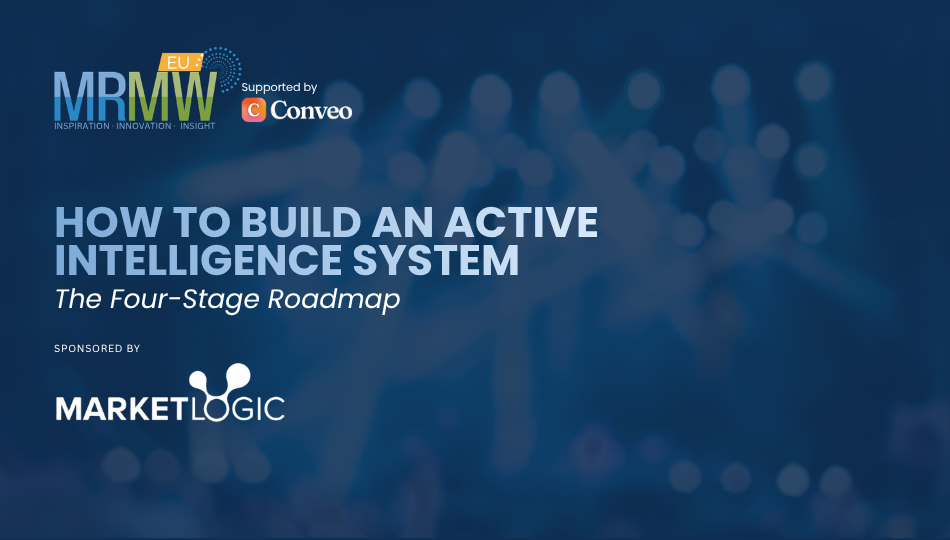
Building an active intelligence system is a four-stage progression: Unify (create a single, AI accessible knowledge base), Democratize (let any team self-serve answers), Synthesize (connect knowledge across the organisation) and Automate (integrate intelligence into decision workflows). Each stage delivers value independently, and the order matters — advanced automation fails without a solid data foundation. The shift from reactive to active intelligence is not a single transformation project. It is a staged progression, and the stages build on each other in a specific order. Organizations that try to skip to advanced automation before the foundation is solid rarely get the results they are looking for. The reason is usually not that the technology is not ready, but that the intelligence infrastructure it runs on is not.
The shift from reactive to active intelligence is not a single transformation project. It is a staged progression, and the stages build on each other in a specific order. Organizations that try to skip to advanced automation before the foundation is solid rarely get the results they are looking for. The reason is usually not that the technology is not ready, but that the intelligence infrastructure it runs on is not.
Why staging matters
Active intelligence systems derive their value from the quality and completeness of the knowledge base they operate on. An agentic AI that monitors fragmented, low-quality, or poorly indexed data will surface fragmented, low-quality insights. The stages exist to build the foundation before the sophisticated capabilities are layered on top of it.
Each stage also delivers measurable value independently. Organizations do not need to commit to a full multi-year transformation to see return. Stage one delivers results in weeks.
Stage 1 — Unify: creating the single source of truth
The first stage is connecting. Most enterprise organizations have intelligence distributed across dozens of systems: internal research repositories, syndicated data subscriptions, agency portals, CRM platforms, social listening tools, and individual inboxes. None of these talk to each other.
Stage one creates a unified, AI-accessible knowledge base from these disparate sources. The immediate value: research duplication drops because teams can discover what already exists before commissioning something new. Time-to-insight falls because finding relevant knowledge no longer requires manual search across multiple systems. This stage typically delivers measurable value within weeks of deployment.
Stage 2 — Democratize: expanding who can access intelligence
Stage one makes intelligence findable. Stage two makes it accessible to the full range of people who need it, not just the insights function. A brand manager can ask a natural-language question and receive an answer grounded in the organization’s own research, without raising a request to the insights team.
This does two things. It expands the number of decisions made with evidence rather than instinct. And it frees insights professionals from handling routine information retrieval, redirecting their time to the work that genuinely requires human expertise.
Stage 3 — Synthesize: connecting knowledge across the organization
The value of synthesis is in the connections it surfaces: an insight from a consumer usage study in one market that is directly relevant to a concept being developed in another; a competitive signal detected in one category that has implications for brand positioning in an adjacent one. These connections exist in the data. They are rarely found by human analysts because finding them requires simultaneously processing more information than any team has bandwidth for. Agentic AI can do this continuously.
Stage 4 — Automate: integrating intelligence into decision workflows
At this stage, AI agents monitor defined signals and trigger alerts when thresholds are crossed. A product team’s development workflow receives an automatically generated brief when consumer signals in a target segment shift meaningfully. The intelligence no longer waits to be found. It arrives at the moment it is needed, in the context of the decision it should inform.
Customers progress swiftly and begin releasing value within weeks and receive full payback on their investment within 6 months, according to Forrester’s Total Economic Impact study for Market Logic Software.
Two factors most commonly determine how quickly an organization progresses. The first is data quality and governance: organizations with clean, well-structured research repositories move faster than those with fragmented, inconsistently tagged data. Investing in data hygiene at stage one is not optional. It is what enables everything that follows.
The second is organizational buy-in. Active intelligence delivers the most value when insights leaders, IT, and business functions are aligned on the goal and have clear ownership of each stage. Organizations that treat deployment as a technology project rather than a cross-functional transformation consistently move slower and capture less value.
From Trusted Retail Intelligence to Human–AI Collaboration at MRMW Europe 2026
Building an active intelligence system raises questions that go beyond technology: how to make AI-generated answers trustworthy, and how insights teams, AI agents and agencies should work together. Market Logic will bring both questions to the stage at MRMW Europe 2026.
Join Olaf Lenzmann, Chief Innovation & Product Officer at Market Logic, alongside Dr. Katia Passari, Head of Business Insights – Retail Intelligence, and Marc Röhder, Project Lead, Business Insights – Retail Intelligence, at REWE Group, for “Ahead of the Wave: How REWE Group Builds Trusted Retail Intelligence at Scale”. The session will explore how REWE Group designed quality-assured processes to support trustworthy AI-generated answers, human oversight and rigorous testing, and how safeguards help users assess the strength—and limits—of the available evidence.
Olaf will also join the panel “Building Sustainable Organizational Structure in the Human–AI Ecosystem”, moderated by Natasa Jovanovic, Senior Insights & Strategy Consultant at Scandinavian Tobacco Group, with Laura Christina Höing (AXA) and Viktor Talan (Mastercard). The discussion will look at how a researcher-agent-agency collaboration model can amplify, rather than replace, human expertise.
📅 MRMW Europe 2026 | October 21–22 | Berlin, Germany
Explore the MRMW Europe 2026 agenda →
Discover more sessions at MRMW Europe 2026:
- From insight to impact: how eBay makes insight matter — Tanya Ozuns & Emilia Torres, eBay
- Globally wired, locally tuned: rewiring agile insights — Stefania Accardo, De’Longhi Group
- Bringing Analytics and Insights Together to Drive Business Growth — Ammar Basit, Haleon
- Content discovery research: why the single-touchpoint model no longer works — Iva Kralj-Taylor, Warner Bros. Discovery