






Qualitative research leadership in times of economic uncertainty demands more than resilience — it demands a fundamentally different operating model. When a research team faces pressure to cover complex, multi-scenario workflows across a global user base, the default answer is a long fieldwork cycle. Microsoft Commerce’s research team found a different answer — not by cutting corners, but by inverting the usual logic. Rigorous preparation went into designing the research window before it opened, so that when execution began, everything could move without friction. What looked like speed from the outside was structure on the inside.
That case sits at the center of a broader question that qual research leaders are navigating right now. As budgets contract and headcounts shrink, the instinct is to treat reduced resources as a resourcing problem — the same work, fewer people, more pressure. The more productive reframe is to treat it as a design problem: not how do we do more with less, but how do we redesign the way we work so that less is enough.
The article is based on a session by Prachi Sakhardande, Principal Design Research and Studio Head, Microsoft Commerce, presented at QUAL360 APAC 2025.
1. Choosing what not to do
The hardest discipline for a research team under pressure is not execution — it is prioritization. Most teams protect everything, deliver less of it, and lose credibility in the process. The more productive response is to make explicit decisions about where research investment is justified and where it is not, based on two variables: how well-defined the problem is, and how high the cost of being wrong.
High-risk, low-clarity problems justify deep exploratory and evaluative work, planned well ahead of execution. Low-risk, well-defined problems call for lighter methods — design, ship, measure — with minimal lead time. The discipline is not in having a framework but in applying it honestly, which means accepting that some work will not get done. A research team that tries to cover everything under pressure ends up doing nothing particularly well. One that chooses deliberately can protect the bandwidth that makes rigorous work possible at all.
2. What AI can and cannot take off the plate
The Microsoft Commerce team drew a practical line through the research workflow: AI handles the operational load — secondary research, transcript cleaning, summary tables, citation foraging, scaffolding for reports — while human researchers own domain immersion, post-interview synthesis, and the construction of arguments that connect findings to decisions. That division is about where AI generates genuine time savings versus where it produces output that still requires the same amount of human judgment to evaluate as the original work would have.
The most useful application has been agents grounded in the team’s own research data rather than general knowledge — retrieving specific evidence, identifying themes, and creating summaries at a speed that changes what is achievable within a sprint cycle. What they cannot do is what a senior researcher does in the final stages of a project: select the evidence that matters, frame it for a specific audience, and make the case that moves a decision. Protecting time for that work is exactly what the rest of the operating model is designed to enable.
3. Scrappy is a method, not a compromise
The crowdsourcing study was not an improvisation. The 3-day execution window was the result of a month of preparation: scenario mapping, facilitator briefing, shared note repositories, and structured follow-up protocols. Speed was the output of preparation, not a trade against rigor. That distinction matters because scrappy, at its best, describes a deliberate reduction of everything that does not add to the quality of the finding — not a lowering of the standard itself.
When the squad runs research independently, guardrails stay in place: a researcher moderates, leading questions are actively managed, and the term “research” is used carefully to avoid the drift toward assumption confirmation that tends to follow when non-researchers lead studies without support. Democratization without rigor is not an efficiency gain. It is a credibility risk.
4. Making the value visible
A research report published and filed is not research that has driven a decision. Closing the gap between insight and product impact requires active effort — tracking findings against product changes, maintaining a continuous improvement dashboard, and incorporating a what’s next into leadership share-outs rather than ending at the finding. The language research uses matters as much as the tracking: platform scalability, deal velocity, and reduced operational costs tend to resonate more directly with budget holders than satisfaction scores. Key insights do not stay relevant by being shared once — they stay relevant by appearing in multiple formats and forums until they are absorbed into how the organization thinks.
The operating model Prachi Sakhardande described at QUAL360 APAC 2025 is not primarily about efficiency. It is about a research team deciding, deliberately, what kind of function it wants to be inside a large organization under pressure — one that protects its bandwidth to do fewer things better, uses AI where it genuinely helps, and measures its impact in the language the business already speaks. The teams most likely to lose ground in a constrained environment are not the ones with the smallest headcounts. They are the ones who have not yet made these choices explicitly.
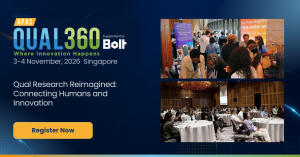
Continue the conversation at QUAL360 APAC 2026
QUAL360 is the only dedicated qualitative research conference in Asia, with 17 years of experience bringing together the region’s senior insights and research community.
The 2026 edition in Singapore brings together leaders from Pandora, Symrise, Google, and more for two days of case studies, peer exchange, and practical discussion on the evolving role of qual research in organizations.
📅 QUAL360 APAC 2026 | November 3–4 | Singapore. Explore the event.