







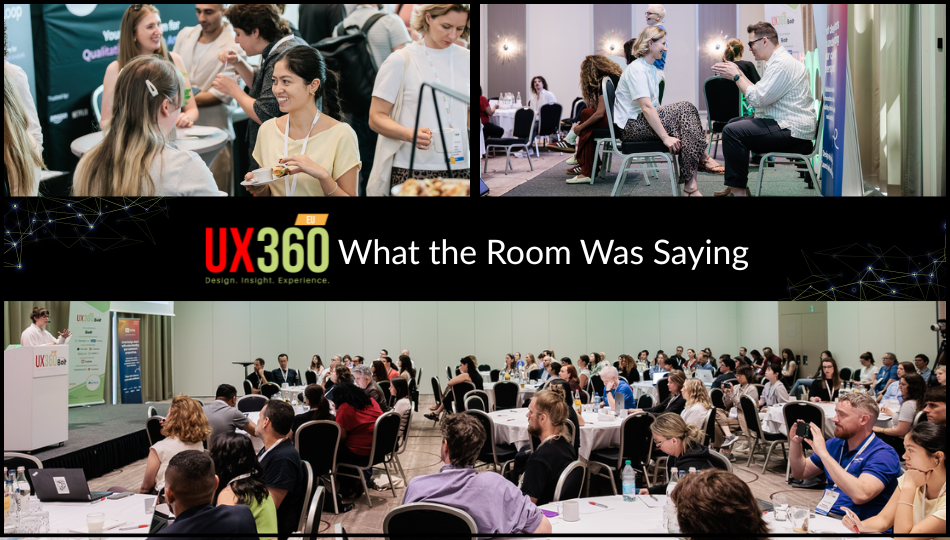
UX360 Europe 2026 has wrapped in Berlin — two days that gave the UX research leadership community plenty to think about.
“AI is no longer the story. It is becoming part of the toolkit — an enabler, a multiplier, a way to move faster. But no longer the elephant in the room.” That is how Dave Lieber summed up these two days — and honestly, it captures the mood better than anything else could.
If last year’s conversations were cautious — one eye on AI, one eye on the exit — UX360 Europe 2026 felt different. Calmer, more grounded, and more interesting. The anxiety had settled into something more productive: a community that has accepted the shift and is now working out what to do with it.
That shift in mood was already visible before the main program even opened. A pre-conference evening at CUPRA City Garage in partnership with Service Design Drinks Berlin kicked things off with a panel on the changing economy and changing design roles. By Tuesday morning, the room had already found its rhythm, set up perfectly for the conversation that followed.

So if not AI anxiety, what were people actually talking about?
The most consistent theme across the two days was not whether to use AI but how to use it without losing what makes research valuable in the first place. Kristina Mann from Deutsche Telekom framed it directly in her session: “The companies that invest equally in AI excellence and human connection will be the ones that shape the future.” The consensus in the room was that AI accelerates synthesis, ideation, and analysis at scale, but that the judgment layer remains human.
What surfaced in the recaps and reactions shared in the days after was a more specific concern. As the team at CoLoop noted, most researchers are already using AI, but predominantly general-purpose tools like Claude and ChatGPT rather than research-specific solutions. The trade-off that comes with that — speed versus the depth of human involvement — is something the community has not fully resolved.
The question is no longer adoption. It is governance.
“The companies that invest equally in AI excellence and human connection will be the ones that shape the future.”
That governance question led straight into a bigger one: if AI can simulate a user, do we still need the real thing?
Real users — still irreplaceable, still the point
Several speakers pushed back on the synthetic user trend with some force. Gabrielė Kraus summarized what many in the room were thinking: “Real users cannot be replaced by synthetic users. In the end, only real user experiences are what we can truly rely on and design for.” Asma Karoobi from Mastercard made a similar argument from a brand perspective — that organizations risk losing market relevance when they move away from genuine user-centricity toward faster, more automated proxies for understanding.

In the same spirit, Michael de Jong from Lely presented field research conducted in barns and working farms, with farmers as users. Lindsay Hendriks captured why it resonated: “It was a great reminder that our users exist in the real world. The goal isn’t just to create products that are easy to use, but to understand the broader context in which people work, make decisions, earn a living, and solve problems every day.” Sometimes, the most effective argument for real research is simply showing what it looks like when it is done properly.
“It was a great reminder that our users exist in the real world. The goal isn’t just to create products that are easy to use, but to understand the broader context…”
The word “democratization” got a challenge
Francesco Sardu from Nestlé used his roundtable to push back on a term the industry has been using comfortably for years. His point was simple and a little uncomfortable: asking questions is not the same as conducting research. If everyone can do research, who is accountable when it goes wrong? His preferred framing — research literacy over democratization — landed with the room. Make research accessible and transparent, yes. But keep the standard.

Paweł Lewicki, attending as an anthropologist, added a different angle: the richest conversations at the conference were the ones that connected UX to trust, care, and human relationships in ways that go beyond typical design frameworks. The disciplinary walls, he suggested, are becoming less useful than they once were.
The value of being in the room
That human connection Kristina Mann mentioned showed up in the hallways, too. Emmanuelle Savarit, author of the book “The UX Research Powerhouse”, ” attended her third UX360 Europe, leaving with new energy and new connections. Kelly Frontani from Schneider Electric reflected on how different an in-person exchange feels compared to another video call. Marc Garcia i Fortuny left with a pointed question about whether design has stopped embracing complexity — the kind of thing that only comes up when the right people are in the same room at the right time. What stood out across these exchanges was less about any single insight and more about a shared feeling: attendees kept describing UX360 not just as a conference, but as a community that is actively taking shape — one they keep choosing to come back to.

The industry spent two years asking whether AI would change UX research. It has. Berlin made clear that the conversation has moved on — to where humans stay irreplaceable, how teams govern the tools they use, and what it actually means to build something people want to use. Harder questions. Better ones.
Missed it? Watch the highlights
Catch the best moments from UX360 Europe 2026 in Berlin — two days of conversations on AI, real users, and the future of UX research, compressed into one watch.
The good news?
You do not have to wait long for the next one. UX360 Virtual is back on February 3–4, 2027 — bringing the global UX research conversation online, from the comfort of your home or office. Speakers and agenda coming soon.
Join the UX360 community on Slack
The conversation does not stop when the conference ends. Join the UX360 Slack community to stay connected with the researchers, designers, and insights leaders you met in Berlin — and keep the discussion going year-round.