






 by
by 
Content discovery research has exposed a gap that most measurement frameworks have not yet closed. Warner Bros. Discovery’s latest research, based on a 10,000-respondent study, found that viewers now encounter six to seven distinct touchpoints on the way to choosing what to watch, with 75% of those discovery paths entirely unique. The single-touchpoint journey, the assumption that one channel drives one decision, is a myth.
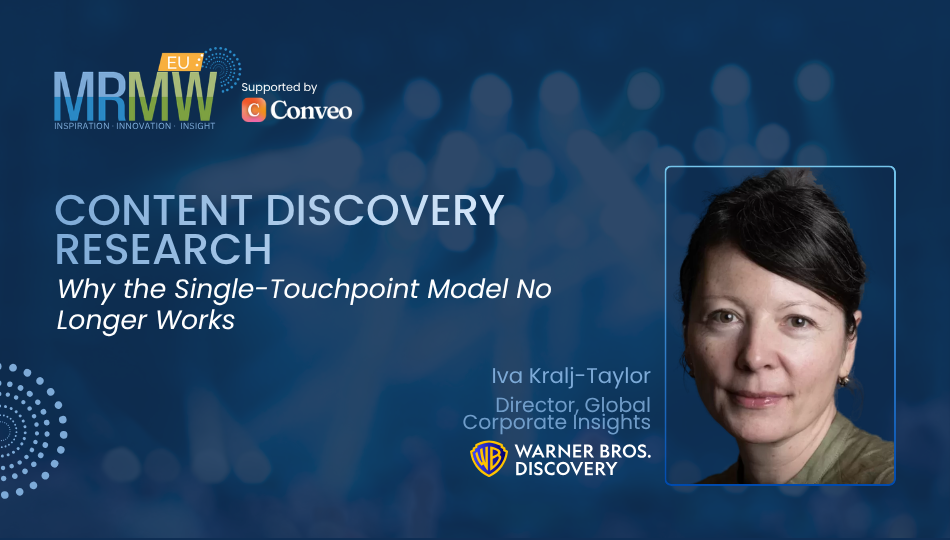
Iva Kralj-Taylor, Director of Global Corporate Insights at Warner Bros. Discovery, has spent over two decades at the intersection of audience behavior and strategic decision-making — across BBC iPlayer, Disney+, and HBO Max. Ahead of MRMW Europe 2026, she shares what the research actually reveals, why short-form video has become an always-on layer in the content discovery journey, and what it means for how insights teams measure effectiveness going forward.
MRMW: What motivates you to join MRMW EU 2026, and what is the core message of your talk?
Iva: MRMW is one of the few gatherings where I get to spend two days with colleagues I genuinely respect from across Europe and across the research industry — not just media. That mix is what makes it valuable: it’s a chance to hear about new studies and methodologies used, to test my own thinking against solving different problems, and to come away with fresh tools and approaches I can bring back to my team at Warner Bros. Discovery.
The core message of my talk is about the short-form Content Discovery Journey — and, more broadly, the difficulty of measuring the effectiveness of any single marketing touchpoint in isolation. Our latest 10,000-responder study shows viewers now encounter 6–7 distinct touchpoints on the way to choosing what to watch, and 75% of those discovery paths are unique combinations. In other words, the “single touchpoint” journey is a myth: more than 90% of the time we see multiple touchpoints working together, and short-form video is now an always-on layer woven through nearly all of them.
What I want the audience to take away is that measurement frameworks built on isolating one channel at a time no longer reflect how audiences actually behave — and that we need new ways of thinking about attribution, effectiveness, and creative when the journey itself is fragmented and personal.
MRMW: How has this impacted your own work and your organization?
Iva: For our corporate strategy teams, the biggest shift has been a more honest conversation about what we can and can’t influence. Short-form video is, in many ways, a Wild West — fragmented, creator-driven, algorithmically shaped, and largely out of a studio’s direct control. But the most valuable finding for us is this: within that Wild West, the official trailer is still king. Trailers remain the single most impactful format, and their influence is amplified further when encountered on SFV platforms.
That reframes the strategic question entirely. Rather than trying to control the uncontrollable, we can focus WBD’s energy on the one lever we own outright — official content, and especially trailers. Strategically that means treating trailers as a portfolio, not a single asset: creating multiple trailers per title, cut for vertical, and tuned differently for YouTube, TikTok and Reels — rather than one hero asset repurposed.
It means seeding official studio content — trailers, clips, compilations — into the creator ecosystem, so the fragmented long tail of SFV amplifies our voice rather than competing with it. And it means rethinking the shelf-life of trailers: in an always-on discovery layer, a trailer isn’t a launch asset that expires after opening weekend — it’s an evergreen strategic tool that can drive re-encounter and library discovery.
That’s the shift I’ve been pushing internally: yes, we’re operating in a fragmented, unpredictable discovery landscape — but the finding that our own official content still carries the most influence is genuinely empowering. It means we’re not passive in this environment; we still have a very strong hand to play.
MRMW: How has market research and insight as a practice evolved in the last couple of years, and how would you like to see it evolve in the next few?
Iva: The single biggest shift I’ve seen — and one I feel every day in my own role — is agility. In the media industry, with the pace of restructures, leadership changes, and constantly shifting business priorities, our role has increasingly become the agile constant: the team that can pivot with the business but still holds a consistent, long-term view of the audience. That combination — flexibility on the surface, consistency underneath — is what makes insights teams genuinely useful in the evolving media landscape.
Looking ahead, I want us to move from reactive to genuinely anticipatory. I want us to spend less time answering set questions and more time shaping the questions the business should be asking. That means investing in foresight, think pieces, and being there before the brief — not after it.
I’d also like us to be braver about discomfort. An insight only changes strategy when it’s allowed to be uncomfortable. I’d love to see the profession get more confident about protecting that space — pushing back when findings don’t fit the narrative the business wanted.
MRMW: Given this evolution, what are two expected and two less obvious skills MRers should possess, and why?
Iva: Analytical rigor (expected): It sounds obvious, but in an AI world where anyone can generate a chart in seconds, being the person who understands what the data can and can’t say — the assumptions, the limitations, the confidence intervals — is more valuable, not less. Rigor is the price of entry for having a strong point of view.
Storytelling (expected): A brilliant insight that doesn’t land changes nothing — so the ability to translate complexity into a story a CFO or CMO can feel is now a core skill, not a nice-to-have. Lead with the human moment, anchor with the number. People won’t remember the chart; they’ll remember how they felt. If you can make a stakeholder feel the consumer’s frustration or delight, you’ve done more than any chart ever will.
MRMW: Apart from work, what can delegates at the event talk to you about? Do you have any particular personal interests, hobbies, or extracurricular activities and engagements?
Iva: Two things, and I’d genuinely love to be interrupted about either.
First, I sing in a 600-member choir in London. We just performed in a stunning church, and there’s something about being one voice inside 600 — the harmonies, the sheer feeling of unity — that no other experience quite matches. If anyone in the audience sings, or has ever thought about joining a choir, come and find me. It’s one of the most joyful things I do.
Second, and slightly conveniently for my job: I love film and television. Working in media insights is the perfect excuse to call watching a great show “research” — but honestly, the recommendations I value most are the ones I’d never have picked up myself. Something in a language I don’t speak, a genre I don’t usually watch, a film about a topic I know nothing about. Those are the conversations I’ll happily have all week — so please, come and tell me what I should watch next.
MRMW: Last but not least, we are publishing “reading/listening guides” on our blog. Can you share your favorite recommendations for inspiration, learning, and leadership?
Iva: Podcast: The Town with Matthew Belloni. It’s a brilliantly reported look at the business of Hollywood and the wider media industry — the deals, the power dynamics, the streaming wars, the political and historical context behind decisions that shape what we all end up watching. Matt brings on the show executives, dealmakers, and journalists who genuinely know what they’re talking about. If you work anywhere near this industry, it’s the most useful 30 minutes of your week.
Book/Blog: Crying in H Mart by Michelle Zauner. What I love about it is that my mother, my daughter, and I all read it — and each of us connected with it from a completely different angle. It’s a beautiful, honest story about identity, food, grief, and roots. As a Croatian living in the UK, it resonated with me deeply — that quiet negotiation between where you’re from and where you’ve made your life. If you’ve read it, come find me — I’d love to hear which parts stayed with you.
From choir rehearsals to trailer strategy, Iva’s range reflects the same instinct she brings to research: staying curious about how people actually experience culture. That instinct is exactly what she’ll unpack on stage in Berlin.
Is Your Attribution Model Built for How Audiences Actually Discover Content?
At MRMW Europe 2026, Iva Kralj-Taylor takes the stage in the session “The Content Discovery Revolution: How Short-Form Is Reshaping the Consumer Journey” — a conversation built for insights and research leaders navigating the gap between fragmented consumer behavior and the measurement frameworks still trying to keep up.
Leaders from KraftHeinz, eBay, Warner Bros. Discovery, De’Longhi, and Procter & Gamble will be in the room.
October 21–22, 2026 | Berlin, Germany
Register for MRMW Europe 2026 →