








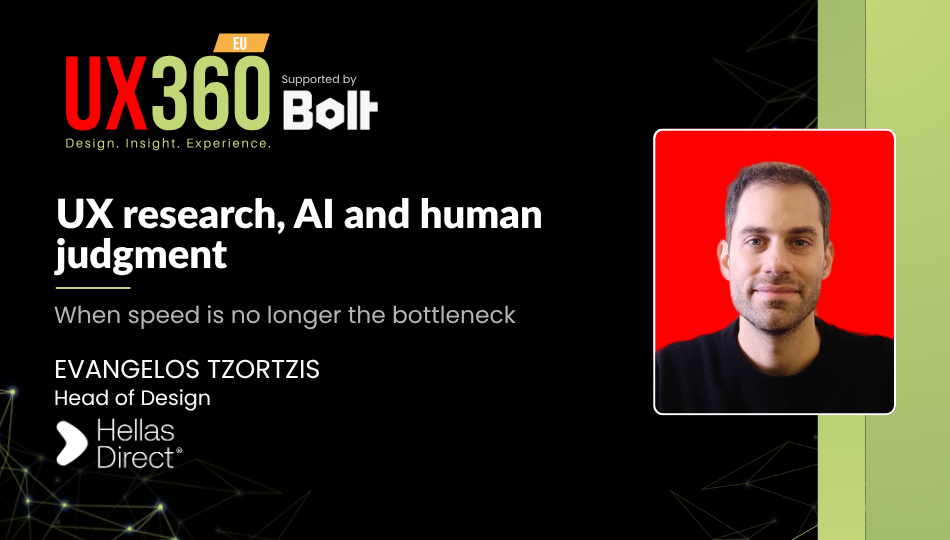
UX Research, AI and Human Judgment — When Speed is No Longer the Bottleneck

For most UX teams, AI arrived as a productivity story. Faster synthesis, quicker prototyping, more ground covered before the end of the day. At Hellas Direct, it landed differently. Speed came — but so did a sharper question that speed alone could not answer: are we building the right thing at all?
Evangelos Tzortzis, Head of Design at Hellas Direct, argues that AI did not bring order to the design process. It accelerated the chaos already inside it. The bottleneck that most teams have not yet confronted is no longer how fast they can produce work — it is whether they have the strategic judgment to decide what work is worth producing. Ahead of UX360 Europe 2026, he makes the case that the most important UX skill right now is knowing when to stop.
UX360: What motivates you to join the UX360 EU 2026, and what is the core message of your talk?
Evangelos: I’m attending because I think we’re all collectively trying to figure out how to navigate a massive shift in our industry. UX360 feels like the perfect place to have real, honest conversations about how messy design actually is right now, especially as we are all trying to adapt to AI. The core message of my talk, “Humans, Chaos, and AI: Charting the Renewed UX Lifecycle,” is a gentle reminder that AI didn’t come to bring order to our workflows; it actually accelerated the chaos. In a nutshell, my talk explores the idea that our value as designers isn’t about engineering a flawless, rigid process. Instead, it’s about learning how to be comfortable operating inside that chaos, using AI for speed, but holding the line as humans to ensure we are actually solving the right problems.
UX360: How has this impacted your own work and your organization?
Evangelos: At Hellas Direct, it transformed our traditional timelines in a good way. Nowadays, we use AI to sift through thousands of user feedback logs, synthesize hundreds of responses, and get early signals all before the sun goes down.
It showed us just how fast we can move. But honestly, it also humbled us. We realized very quickly that while AI can give us a “logical green light” to build a feature, it lacks the human intuition to ask if that feature is actually ethical or wise. It forced our organization to shift its bottleneck: we no longer worry about how fast we can produce the work; we focus almost entirely on the strategic trade-off of what we should build, and when we need to step on the brakes to protect our users.
UX360: How has UX Research and Design as a practice evolved in the last couple of years, and how would you like to see it evolve in the next few?
Evangelos: The last couple of years have felt like a gentle reality check for many of us. We’ve been moving away from long, isolated discovery phases and heavy documentation toward more continuous, evidence-based learning. AI has dramatically accelerated activities such as synthesis, ideation, prototyping, and content generation, allowing teams to explore and validate ideas much faster. When high-fidelity prototypes can be created in hours, a two-week validation cycle can create what I like to call a “Momentum gap.” As a result, UX has evolved to focus on closing that gap, maintaining momentum while ensuring we’re still solving the right problems.
Looking ahead, I’d like to see our community move beyond the initial rush to automate everything. Rather than using AI to replace human insight, we should use it to amplify it. I see designers evolving into strategic facilitators who leverage AI for the heavy lifting, processing information, generating options, and accelerating workflows, while bringing empathy, critical judgment, and systems thinking to help organizations make wiser and more thoughtful product decisions.
UX360: Given this evolution, what are two expected and two less obvious skills UXers should possess, and why?
Evangelos:
User research & empathy (expected): Understanding real user needs remains the core of UX, regardless of technology changes. AI can analyze large amounts of behavioral and qualitative data, but we still need to understand human motivations, emotions, trust, and expectations around AI.
AI-Enhanced design practice (expected): UXers should be proficient in using AI-powered tools for research synthesis, ideation, prototyping, content generation, and evaluation. The value is no longer just creating artifacts but knowing how to effectively collaborate with AI to accelerate and improve the design process.
Systems thinking (less obvious): UXers must understand how users, AI, data, business goals, and technology interact within a larger ecosystem.
AI literacy & critical judgment (less obvious): UXers don’t need to be machine learning engineers, but they need enough AI literacy to understand capabilities, limitations, bias, transparency, and appropriate use cases. Equally important is knowing when not to rely on AI and applying critical judgment to AI-generated insights and design outputs.
UX360: Apart from work, what can delegates at the event talk to you about? Do you have any particular personal interests, hobbies or extracurricular activities and engagements?
Evangelos: Having worked in design teams of very different sizes, from 3 people to 15 and 80+ I’m always happy to chat about how those environments shape UX practice.
I’m also a very hands-on designer and enjoy experimenting with AI and no-code/code tools to bootstrap workflows, optimize processes, and build small side projects that help me test ideas and explore the feasibility of new tools and concepts.
Outside of work, my newest obsession is tennis, and I can happily spend way too much time talking about it.
UX360: Last but not least, we are publishing “reading/listening guides” on our blog. Can you share your favourite recommendations for inspiration, learning, and leadership:
Evangelos:
- Podcast: Lenny’s Podcast. While it is technically a product management podcast, I think it is essential listening for any modern UX professional.
- Book/Blog: Inspired: How to Create Tech Products Customers Love. An old but classic, the ultimate bible for understanding how real, cross-functional product discovery works.
Take this thinking further at UX360 Europe 2026
Evangelos takes these questions into his session “Humans, Chaos, and AI: Charting the Renewed UX Lifecycle” — examining how design teams can embrace uncertainty, maintain momentum through early feedback loops, and make the strategic trade-offs that AI cannot make for them. It is a session built for UX and research leaders who are past the question of whether to adopt AI, and working through what it actually changes about how they lead.
Join senior leaders from DHL, Google, Airbus, Mastercard, Volvo Cars, and more for two days of senior UX conversation in Berlin.
📅 UX360 Europe 2026 | June 23–24 | Berlin, Germany
🎟️ Less than two weeks away.
Register now!