






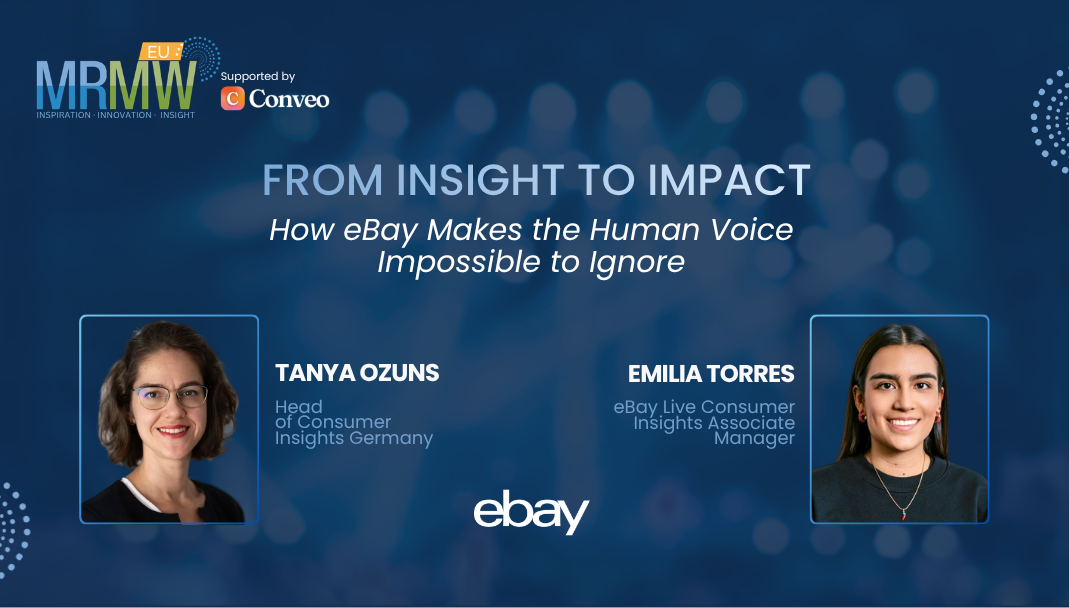
Emilia Torres, eBay Live Consumer Insights Associate Manager, and Tanya Ozuns, Head of Consumer Insights Germany at eBay, have spent the past few years testing how to make consumer understanding impossible to ignore inside a large organization. In the conversation below, they discuss why moving from insight to impact demands design rather than distribution, why stakeholder empathy matters as much as consumer empathy, and which skills the profession will lean on as AI takes over more of the generation of insight.

The distance from insight to impact — the work of turning research into decisions people actually make — is where the insights profession now creates or loses its value. In an era when AI can generate findings faster and cheaper than ever, the strongest methodology and the clearest report still create nothing until someone acts on them. What makes insight matter is not the quality of the research alone, but whether it changes what the business decides to do.
MRMW: What motivates you to join MRMW Europe 2026, and what is the core message of your talk?
Emilia & Tanya: We’re excited to join MRMW Europe 2026 because the insights profession is at a fascinating turning point. One thing we’ve realized over the past few years is that having great research isn’t enough. You can have the strongest methodology, the clearest findings, a beautifully written report — and, with AI, all of that faster and cheaper — but if those insights aren’t shared, understood, and acted on, they won’t create value.
Our talk, “Making Insights Matter in the Age of AI: How eBay Is Making the Human Voice Impossible to Ignore,” explores how we’re responding to that challenge at eBay. We’ll share how we’ve been experimenting with practical ways of bringing consumers closer to everyday business decisions. Rather than asking stakeholders to come to us — to our reports, repositories, or research presentations — we’ve been asking how we can meet them where they already are, and make consumer understanding more engaging and part of their day-to-day work.
The aim is for people to leave with practical ideas they can adapt in their own organizations, whether they work client-side or agency-side. The industry spends a lot of time talking about new ways to generate insights; we should spend just as much time talking about how to activate them and make them matter.
MRMW: How has this impacted your own work and your organization?
Emilia & Tanya: This way of thinking has changed how we approach the role of the insights professional. Previously, the focus was more on delivering great research — robust methodology, high data quality, impartial reporting. Today, delivering robust research is still essential, but the work is just as much about everything that happens after the research is complete.
At eBay, we’re encouraged to create impact and to understand our stakeholders with the same curiosity and empathy we apply to consumers. What motivates them? How do they make decisions? Where do they spend their time? How can we make it easier for them to engage with insights, internalize them, and remember them?
Some of the initiatives that have had the most impact haven’t necessarily been the most technically complex. They’ve been the ones that created genuine human connection — like our Consumer Immersion Event, where colleagues could interact directly with consumers and build empathy in a way that no report could achieve. That experience reinforced an important lesson: insight activation requires design, not just distribution. The impact came from intentionally creating the right format, timing, and setting for people to engage with consumers directly. It’s a reminder that sometimes the simplest ideas have the biggest impact, because they’re memorable, emotional, and connected to real business moments.
MRMW: How has market research and insight as a practice evolved in the last couple of years, and how would you like to see it evolve in the next few?
Emilia & Tanya: Over the last few years, market research has become faster, more connected, and more technologically enabled. AI has accelerated synthesis, improved access to existing knowledge, and opened new possibilities. It’s hard to imagine discussing the future of insights without it.
The biggest change hasn’t just been the introduction of AI itself, but the speed at which it has transformed how we work. We can analyze, synthesize, and access information faster than ever before. But this abundance creates a new challenge: as insights become easier to generate, they can also become easier to overlook. Faster doesn’t automatically mean better, and more information doesn’t necessarily lead to better decisions.
Our role is evolving from producing research to becoming consultative partners who help organizations make better decisions. AI can help us generate and scale insights, but it can’t replace the human side of our work: building relationships, understanding business context, earning stakeholders’ trust, and connecting insights to real decisions. It’s also our responsibility to protect nuance, challenge assumptions, and ensure that real people remain visible behind the data.
Looking ahead, we’d love to see our industry spend as much time talking about the activation of insights as the generation of them. We celebrate innovative methodologies and new AI capabilities — rightly so — but an insight only creates value when it changes a decision. That’s where the biggest opportunity for our profession lies.
MRMW: Given this evolution, what are two expected and two less obvious skills market researchers should possess, and why?
Emilia & Tanya: Previously, the focus for insights specialists was primarily on delivering projects and producing findings. Today, we’re increasingly expected to act as strategic partners who help businesses make better decisions.
So the two skills that will always matter are strategic thinking and empathy. Strategic thinking means going beyond reporting what consumers say and helping the business understand what it means for priorities, choices, and action. We need to connect consumer understanding to business priorities — but also understand the people we’re trying to influence. One lesson we’ve learned is that stakeholder empathy is just as important as consumer empathy. If we don’t understand how our stakeholders think, make decisions, and consume information, even the best research can struggle to drive impact.
Two skills that are becoming increasingly valuable but are talked about less are organization and contextual awareness. As AI becomes better at processing information, researchers will need to become better at structuring knowledge so it’s easy to find, reuse, and build upon. This also includes understanding how knowledge moves through an organization: where decisions are really made, which business rituals matter, and when evidence is most likely to influence the conversation.
And while AI can identify patterns, understanding why they matter still requires human judgment, curiosity, and an appreciation of the broader cultural and business context. Great researchers know when to introduce evidence, whom to involve, and how to build ownership without compromising the integrity of the findings. In a world of abundant information, influence will depend not only on finding the truth, but on creating the conditions in which that truth can be heard, understood, and acted upon.
MRMW: Apart from work, what can delegates talk to you about — any particular personal interests, hobbies, or activities?
Emilia: Outside of work, I’m naturally curious about people, which probably explains why I ended up in market research in the first place. I love traveling and discovering new places; it gives me a chance to observe different cultures and ways of thinking. And recently I’ve taken up running.
I’m also interested in psychology and how people make decisions, both individually and collectively. So I really enjoy, for example, watching video interviews where people talk about their personal journeys or careers — in the entertainment industry, sports, or entrepreneurship. I find documentaries about people interesting and inspirational, too, and I’m always open to good recommendations.
Tanya: Outside of work, delegates can always talk to me about travel and good food. I enjoy hearing people’s recommendations for places, neighborhoods, and sites that aren’t necessarily in every guidebook, and I’m very interested in recommendations for the best restaurants wherever I visit.
I’m also a proud mom, so conversations about children’s milestones, family life, and the ever-changing challenge of work-life balance are equally close to my heart. Becoming a parent has given me an even greater appreciation for how differently people manage priorities, time, and expectations, and it’s allowed me to bring a lot of learnings from everyday life into the workspace.
Reading and Listening Recommendations
From Emilia
- Atlas of the Heart and Daring Greatly — Brené Brown
- Life Lessons from a Brain Surgeon — Dr. Rahul Jandial
- Behave — Robert Sapolsky
From Tanya
- Podcasts: The Diary of a CEO, SmartLess
- Storytelling with Data — Cole Nussbaumer Knaflic
- Alice’s Adventures in Wonderland and The Little Prince
Continue the conversation at MRMW Europe 2026
How much of your team’s best research never makes it into a decision?
At MRMW Europe 2026, Emilia and Tanya take the stage with “Making Insights Matter in the Age of AI: How eBay Is Making the Human Voice Impossible to Ignore” — a session for insights and research leaders who want their work to change decisions, not just inform them.
Leaders from Kraft Heinz, Warner Bros. Discovery, De’Longhi, and P&G will be in the room.
MRMW Europe 2026 | October 21–22 | Berlin. Explore the event.