







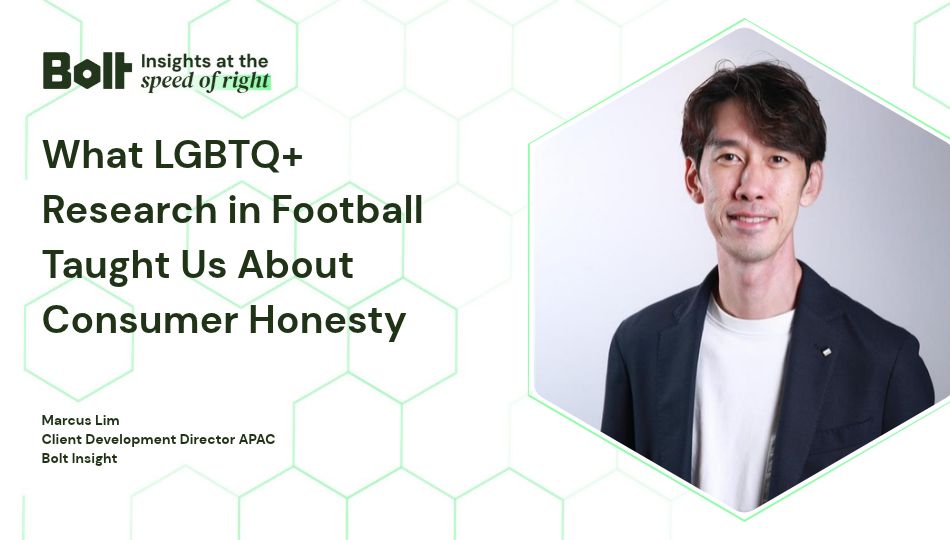
Marcus Lim, Client Development Director APAC, Bolt Insight
Consumer research has never been more sophisticated. The tools, the scale, the speed. And yet the most important question in the industry remains the same one it has always been… Are we measuring what people really think?
It is not a new anxiety. The industry has built entire methodological frameworks around the gap between what consumers say and what they do. Behavioural economics, implicit testing, ethnography, each one another attempt to get closer to the truth by working around what people tell us directly.
But there is a deeper problem that these approaches do not fully address. What if the issue is not that consumers fail to follow through on what they say? What if it is that the version of the consumer we are measuring was never the right one in the first place?
The two versions of every respondent
Every person who sits down to answer a research question brings two versions of themselves to that moment. One is shaped by reflection, social awareness and an understanding of what kind of answer feels appropriate in the context of being researched. This is the version that knows what the right answer is. It has been formed by years of social learning, cultural messaging and the very human instinct to present well.
The other version is the one that makes decisions in real time. In a supermarket aisle, in a stadium, at midnight scrolling through a phone. This version is faster, more emotional and far less concerned with presenting the socially acceptable position.
Most research captures the first version almost exclusively. The conditions of a survey, a focus group or a structured interview signal to respondents that this is a moment for the considered, composed version of their views. The other version, the one that actually drives behavior, rarely makes it into the data.
Why Bolt Insight chose football
When Bolt Insight set out to study this gap, the team wanted a context where the two versions of a person would be as far apart as possible. Where stated belief and real-world reality would be in direct and undeniable contradiction.
Professional football delivered exactly that.
At the 2026 FIFA World Cup, 48 nations competed and 1,248 players took to the pitch. Not one of them was openly LGBTQ+. And yet survey after survey shows overwhelming fan support for inclusion. 92% of respondents in Bolt Insight’s study agreed that a professional footballer should feel safe to come out. 89% said they would be personally comfortable if a player at their own club did so.
The data says one thing. A century of behavior says another. That is not a say-do gap. Nobody is failing to follow through on an intention. It is something more structural, and more interesting.
What the research found
Bolt Insight ran a multi-methodology study across the UK, US and Brazil, combining 3,000 quantitative survey respondents, 89,500 social media mentions tracked across the FIFA World Cup period and 150 AI-moderated qualitative interviews with fans, professional footballers and LGBTQ+ individuals.
The AI-moderated interviews were the decisive element. With no human moderator in the conversation, respondents had no social performance to maintain. The result was data that looked nothing like the survey responses.
Five distinct paradoxes emerged. 89% of fans are personally comfortable with a gay player at their club. Only 28% think other fans feel the same way. The majority is tolerant. Nobody says so out loud. The silence creates a misread that sustains itself without anyone actively choosing it.
66% of people who said they would publicly support a gay player privately advised against him coming out, driven not by hostility but by genuine concern for his mental health and career. Protective caution, expressed at scale, produces the same outcome as indifference.
And at the root of all five paradoxes sits the masculine code. 77% of fans expect male footballers to be tough, emotionally controlled and physically dominant. When the same scenario was presented with a female player, the advice changed completely. The unwritten rules of the men’s game are doing structural work that nobody voted for.
Why this matters beyond football
The football finding is not really about football. It is a demonstration of a mechanism that shows up across almost every category of sensitive consumer research.
Sustainability data overstates willingness to pay. Brand purpose scores outrun actual brand loyalty when a brand is tested on a genuinely difficult question. DEI research reflects the culture organisations aspire to rather than the one that exists. In each case, the stated view is real. It is an accurate reflection of what the reflective self believes. It just does not predict what the other self will do.
The Honesty Gap is not a measurement error. It is a structural feature of research conditions that were designed to produce the reflective self answer. Changing those conditions, by removing the human relationship from the interview, by creating genuine privacy, by asking the question differently, changes what comes back.
For brands operating across APAC markets, where the interplay between individual belief and collective social norms is particularly complex, this matters enormously. The gap between what consumers say in a research context and what they actually do is often wider in high-context cultures precisely because the social performance instinct is stronger.
Standard research methods widen that gap further. Research designed to close it produces something different.
The question that actually matters
The say-do gap asks why consumers do not follow through. It treats the stated position as real and the behavior as the anomaly to be explained.
The Honesty Gap inverts that. It asks whether we were measuring the right thing in the first place. Whether the version of the consumer who answers our surveys is the version we actually need to understand in order to make good decisions.
That is the question the insights industry has been circling for years without quite landing on. And it is the one that matters most.
I will be digging into this further at Qual360 APAC alongside Vijay Raj, former Head of CMI at Unilever, where we will be exploring what the Honesty Gap means in practice and what research teams can do about it.
Consumer Honesty and the Honesty Gap at QUAL360 APAC 2026
Consumer honesty is not always easy to measure, particularly when social expectations influence what people feel comfortable sharing. At QUAL360 APAC 2026, Bolt Insight will explore the Honesty Gap and what researchers can learn from the difference between stated attitudes and underlying beliefs.
Join Marcus Lim, Client Development Director APAC at Bolt Insight, alongside Vijay Raj, former Head of CMI at Unilever, for “The Honesty Gap: Explaining a 100-Year Silence”.
The session will examine the disconnect between stated support and the social pressures that shape what people feel able to say or do — and what that means for the way research is designed and interpreted.
📅 QUAL360 APAC 2026 | 3–4 November | Aloft Singapore Novena, Singapore
Explore the QUAL360 APAC 2026 agenda →
Discover more insights ahead of QUAL360 APAC 2026:
- Go Broader, Not Just Deeper: AI in Qualitative Research — Yashan Cama, Google
- AI Agents, Human Judgment: Rethinking Research at Cathay Pacific — Ernest Hui & Kenneth Law, Cathay Pacific
- What B2B Customers Can’t Tell You: How Passive Data Is Rewriting Qualitative Research — Simon Poon, Ksher Global