







 by
by AI agents in research are making work faster, but at Cathay Pacific speed is no longer the most interesting question. The harder challenge is deciding what researchers should do with that speed — and which parts of the research process should remain deliberately human.
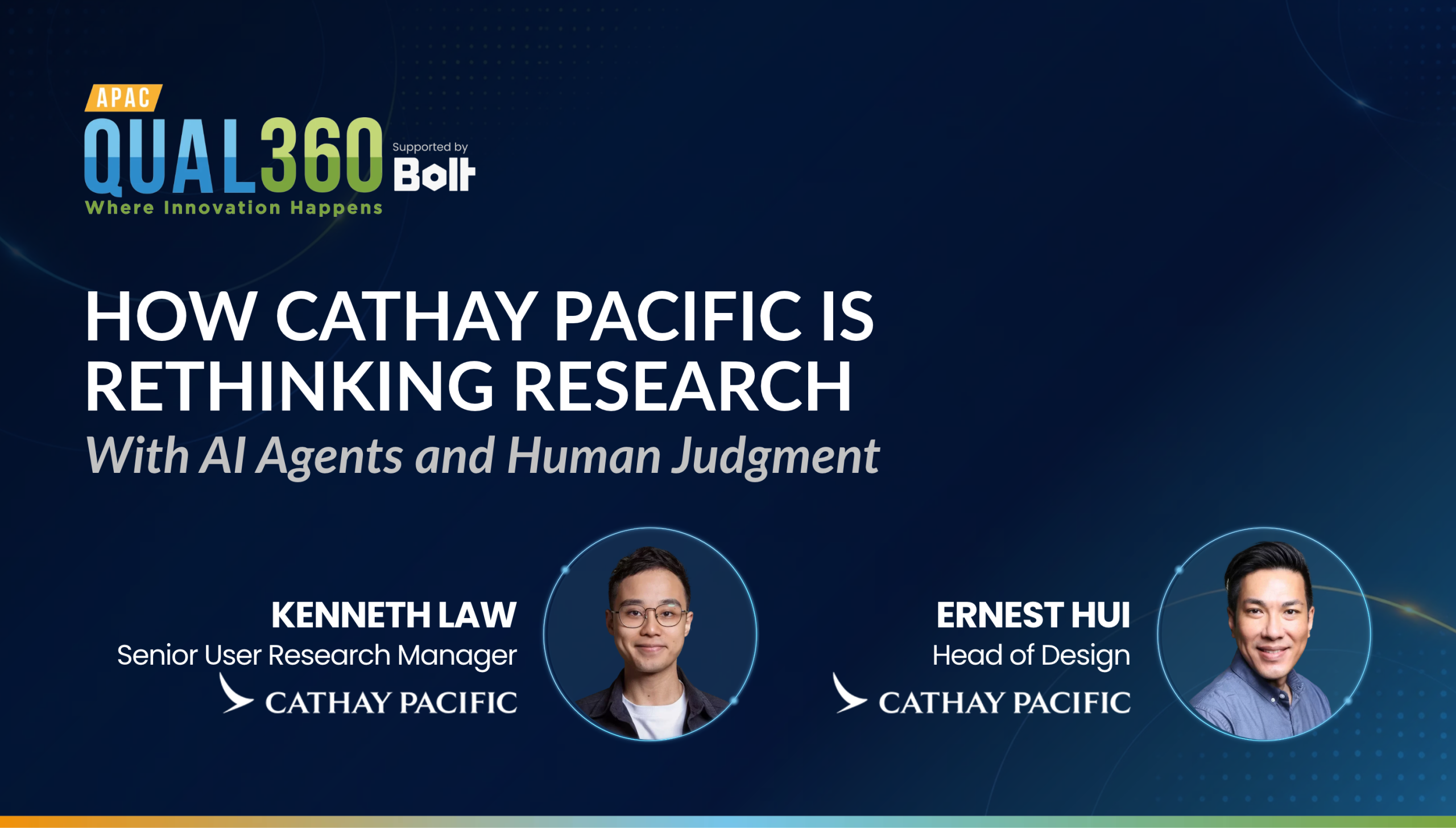
Ernest Hui, Head of Design, and Kenneth Law, Senior User Research Manager at Cathay Pacific, are experimenting with AI agents across research workflows, from retrieving existing knowledge and analysing insights to supporting research preparation. But their approach is not automation for automation’s sake. It is about giving AI clearly defined jobs while allowing researchers to spend more time on interpretation, stakeholder conversations and turning evidence into action.

Senior User Research Manager
Cathay Pacific

Head of Design
Cathay Pacific
For Cathay Pacific, the opportunity is not simply to complete the same research tasks faster. It is to rethink where researchers create the most value. AI can take on repeatable work with defined inputs and reliable sources; human researchers can move further into interpretation, communication and the decisions that follow the research.
That distinction runs throughout Ernest and Kenneth’s conversation — from how research earns influence inside the business to why some interactions with customers should not be automated at all.
AI agents in research: when speed stops being the bottleneck
Kenneth sees one of the biggest shifts in research as a change in the constraint itself. As AI accelerates tasks that once consumed significant researcher time, speed is becoming less of the problem. The harder questions are credibility, meaning and how AI-generated information fits into a repeatable research process.
At Cathay Pacific, that means applying AI where the workflow can be clearly defined and grounded in reliable sources. The team has experimented with agents supporting areas including research repositories, insight analysis, research preparation and discussion guides.
The goal is not simply to produce more. By moving repeatable work into better-defined workflows, researchers can spend more time communicating with stakeholders, resurfacing relevant evidence and making sure insights actually reach the decisions they were intended to inform.
Useful research is not enough
Ernest frames the challenge more sharply. Few people inside an organisation would argue that research is not useful. The more demanding test is whether it has become vital.
His question is simple: “If research disappeared tomorrow, which decisions would stall?”
If the answer is none, research may still be producing valuable work — but it has not yet become indispensable to the decisions the organisation makes.
That changes the researcher’s job. Instead of beginning only with the research request, Ernest argues for treating the business itself as a customer: understanding its pain points, identifying the decisions it needs to make and using research to help solve those problems. The value of research then becomes visible not only in the quality of the work, but in what the organisation can do because that work exists.
Where Cathay Pacific is choosing not to automate
That same logic also creates boundaries.
AI moderation is an obvious example of a capability research teams can now explore. But Cathay Pacific has deliberately kept direct member conversations human for now.
Kenneth describes those interactions as more than another way to collect information. For a premium brand, speaking directly with members is also part of the relationship: an opportunity to hear how people actually feel, while demonstrating that the organisation is genuinely listening.
The relevant question, therefore, is not simply whether AI can perform a research task, but whether automating it strengthens the relationships, evidence and decisions that the research is intended to support.
The 50-slide research report has a distribution problem
Kenneth is also reconsidering one of the most familiar outputs in research: the polished, comprehensive report.
A strong 50-slide deck can demonstrate that the work has been done rigorously. The problem is that stakeholders may never have the time to read it.
That shifts part of the researcher’s responsibility from producing insight to designing how insight reaches people. Sometimes the useful output may be shorter. Sometimes it may be video. Sometimes the most effective intervention is simply resurfacing an existing insight at the moment a relevant decision is being discussed.
For research teams, that means relevance and timing become part of research quality. The work is not finished when an insight has been documented; it is finished when the right people can use it. It is a challenge also explored by eBay’s insights team in From Insight to Impact: How eBay Makes the Human Voice Impossible to Ignore.
Why APAC cannot be treated as one research market
The AI conversation is only one part of the challenge. Ernest also points to something research teams working across Asia Pacific cannot afford to ignore: methodology does not travel unchanged between cultures.
Many established research frameworks were developed in Western contexts. Applying them directly across APAC can produce very different behaviours and, potentially, very different interpretations.
Ernest gives the example of think-aloud testing. Participants in more Western-centric contexts may verbalise their thinking readily, while participants in parts of APAC can be more concise or less overt during the same exercise. The methodology therefore needs cultural interpretation rather than simple replication.
The same applies to samples. APAC contains multiple distinct cultures even within relatively small geographic areas, which makes it risky to assume that participants from another region can act as a proxy for the people a team actually needs to understand. It is another reason why qualitative research across APAC needs to adapt to cultural context rather than applying one methodology unchanged across markets.
From AI agents to research impact at QUAL360 APAC
The question is no longer whether AI will become part of research workflows, but how the researcher’s role should evolve as more tasks are automated—while keeping research connected to customers, business problems and decision-making.
At QUAL360 APAC 2026, Ernest Hui and Kenneth Law will bring this work into both the pre-conference UX Sprint and the main conference. On November 2, they will present “Building a Research Operating System with Bespoke Agents to Drive Business Impact”, sharing how Cathay Pacific is using agents to surface existing evidence, reframe ambiguous stakeholder requests and strengthen research workflows. The conversation continues on November 3, when they will lead Roundtable 5 on the same challenge, giving participants the opportunity to explore how bespoke agents can support research operations while keeping human judgment and research quality at the centre.
They will be joined across the wider programme by research and insights leaders from organisations including Google, Meta, Pandora, Haleon, Bayer, Grab, DBS, 3M and IFF, bringing perspectives across qualitative research, consumer insights, UX research, research operations and AI-enabled workflows.
Explore QUAL360 APAC 2026 | November 3–4 | Aloft Singapore Novena, Singapore.