







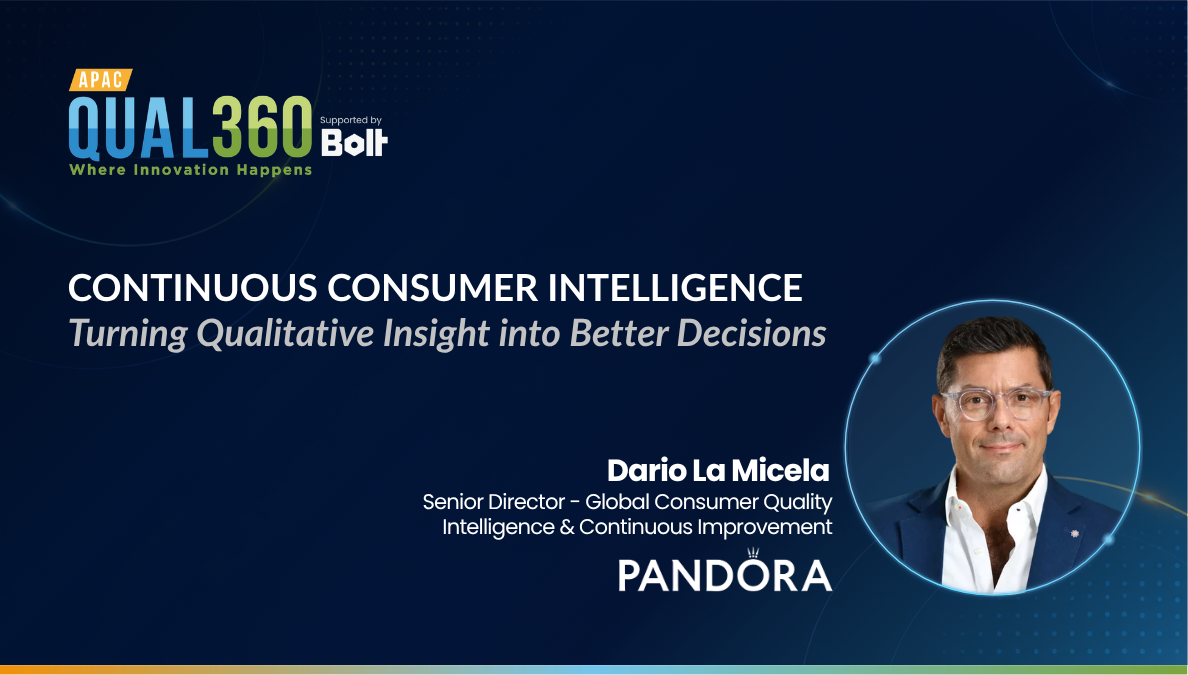

Ahead of QUAL360 APAC 2026, Pandora’s Dario La Micela challenges a familiar assumption in qualitative research: that more research automatically leads to better decisions. More interviews, data, and checkpoints may create a sense of certainty without producing sharper insight. The real advantage, he argues, comes from delivering the right signal at the right decision point—and enabling the teams closest to the consumer to act on it.
Dario is Senior Director of Global Consumer Quality Intelligence and Continuous Improvement at Pandora, with more than 20 years across automotive, eyewear, jewelry, and consumer goods. Ahead of QUAL360 APAC 2026, he explains why the best quality is the right quality rather than the highest, how continuous intelligence has replaced episodic research as the backbone of his work, and where AI accelerates judgment without replacing accountability.
QUAL360: Without giving too much away — what is the core message of your session, and what would you like delegates to take away from it?
Dario: The best quality is not the highest quality; it is the right quality: the level that earns consumer trust, delivers the brand promise, and sustains business performance. Quality only creates value when it operates as one continuous system, from raw materials to the moment a product reaches the consumer’s hands. We are building a closed-loop, consumer-centric intelligence system that connects innovation, manufacturing, quality, and post-sales, so what customers tell us after purchase shapes what we build next. Quality stops being the function that says no, and becomes the function that helps the business make sharper trade-offs between speed, cost, and trust. My takeaway for peers: stop chasing maximum specification, and build the right quality around what consumers actually value.
QUAL360: What is one way your team’s qualitative practice has changed in the last few years — and what would you tell a peer weighing the same shift?
Dario: Continuous consumer intelligence has replaced episodic research as the backbone of how we work. Signals used to reach us after the fact, through complaints, returns, or ad hoc benchmarking. Today they flow through one connected workflow linking innovation, manufacturing, and post-sales, with clear ownership at every handoff, so insight reaches decision-makers while the decision is still open, not after it has been made. Returns have fallen by a sustained double-digit margin, while Continuous Improvement keeps compounding value year after year. My advice to peers: don’t wait for perfect information. Act on credible signals early, keep validating them, and let the infrastructure mature around real business decisions.
QUAL360: Where is AI genuinely adding value in your qualitative work today, and where have you chosen to keep it out — and why?
Dario: AI adds the most value where the challenge is scale and complexity: reading consumer feedback faster, detecting patterns earlier, and improving the consistency of inspection as volumes grow. Today it increasingly supports first-pass analysis and pattern detection; the next step is augmentation — using it to surface insights humans alone might miss, not simply to process faster. What remains firmly human is defining what “right quality” means, interpreting sentiment where culture and context matter, and making the final trade-offs. My principle is simple: AI should accelerate judgment, not replace accountability. It can move the signal faster, but people still decide what matters and what the organization optimizes for.
QUAL360: What is one thing qualitative research could do differently — a habit or assumption that persists because it is familiar rather than because it still works best?
Dario: More research does not automatically mean better decisions. More interviews, more data, and more checkpoints can create a sense of safety without creating more insight — and the same is true in Quality, where more controls do not automatically mean better outcomes. What matters is getting the right information to the right decision point, at the right time, and trusting the teams closest to the consumer to act on it. The habit I would challenge most is treating rigor as volume rather than relevance. The better approach is to manage quality deliberately by product, consumer expectation, and price point, while embedding Continuous Improvement into the culture, not confining it to the factory floor.
QUAL360: You work across APAC markets. What does the rest of the industry consistently misunderstand about running qualitative research in the region — culturally, methodologically, or in how insights get used?
Dario: The biggest misunderstanding about APAC is assuming a centrally designed research or quality model transfers unchanged across the region. Consumer contexts vary enormously, including how directly people express dissatisfaction — run the same process everywhere and you can end up with comparable-looking data but very different signal quality underneath. My principle: standardize the framework, localize the listening and interpretation. Doing this well is as much organizational as methodological, building a connected network across markets, manufacturing, and laboratories so local insight strengthens a shared global standard. Our regional capability building, including advanced laboratory competence in Asia, reinforced that lesson: strong insight comes not only from better questions, but from stronger systems, context, and execution.
QUAL360: What motivates you to join QUAL360 APAC this year, and where are you most looking to learn from peers at this event?
Dario: What draws me to QUAL360 is the chance to have my own thinking challenged, not just to make the case for Quality’s seat at the table. I have built the argument that Quality earns strategic relevance through measurable business value: fewer returns, lower cost, faster innovation, stronger trust. But I want to hear where that logic breaks down in other industries, and where peers are solving the same problem differently. What energizes me most is translating operational learning into system design: building operating models that keep improving long after the energy of launching them has faded. I am especially interested in how others connect insight, technology, and organizational change in practice.
QUAL360: We publish reading and listening guides on our blog — what would you recommend to peers for inspiration, learning, or leadership?
Dario: Three books have shaped how I think about leadership and transformation.
Team Topologies by Matthew Skelton and Manuel Pais sharpened my thinking on ownership, interfaces, and how teams function as a system.
Thinking, Fast and Slow by Daniel Kahneman is a reminder that even the best-designed systems ultimately depend on human judgment and our ability to recognize bias.
The 7 Habits of Highly Effective People by Stephen Covey remains relevant because transformation starts with leadership: begin with the end in mind, seek first to understand, and build trust before expecting change.
For listening, I deliberately look beyond Quality — operations, technology, and supply-chain leaders often offer the most transferable ideas.
How Do You Build a Closed-Loop Consumer Intelligence System?
At QUAL360 APAC 2026, Dario La Micela will take this argument from principle to practice in Designing a Closed-Loop Customer Intelligence Research Operating System (Innovation-to-Post-Sales). The session will explore how qualitative research leaders can move beyond episodic studies, connect consumer signals across functions, and turn insight into continuous organizational learning.
Leaders from Pandora, Symrise, Google, and more will be in the room.
📅 November 3–4, 2026 | Singapore
Explore the event →