







 by
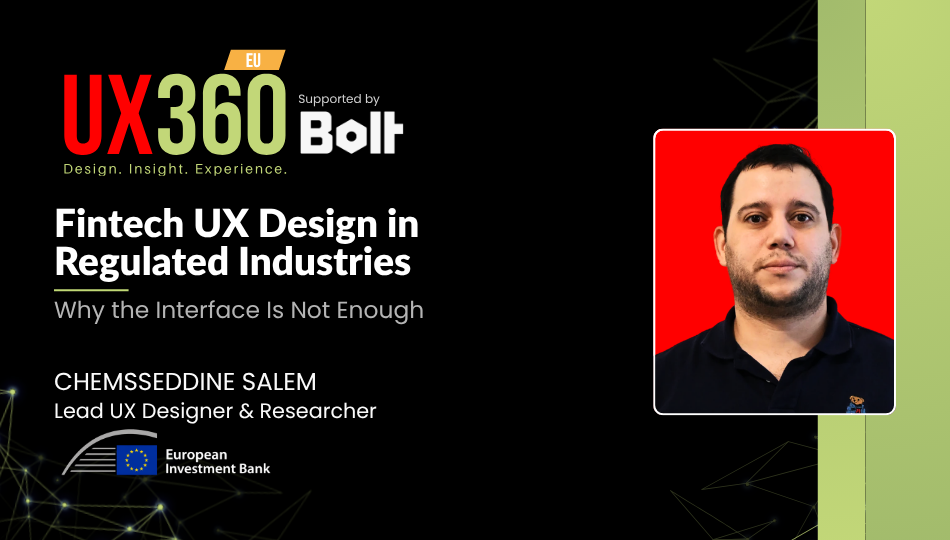
by Fintech UX Design in Regulated Industries: Why the Interface Is Not Enough

Most UX frameworks were built for consumer products. Chemsseddine Salem has spent his career in places where those frameworks break down — financial institutions, energy regulators, public sector systems where compliance is not a footnote but the foundation.
As Lead UX Designer at the European Investment Bank, and through his research initiative Chemss Labs, he has developed a practice rooted in governance, risk, and accountability. Ahead of UX360 Europe 2026, we spoke with him about what regulated environments demand from UX — and why AI makes that conversation more urgent than ever.
UX360: What motivates you to join the UX360 EU 2026 and what is the core message of your talk?
Chemsseddine: What draws me to UX360 EU 2026 is the format itself. Being part of the panel and leading a round table means the conversation goes both ways. You are not just presenting a position, you are in the room with practitioners who are living the same challenges, and that is where the most useful thinking happens.
The thread I want to run through both the panel and the round table is something I keep encountering in my work. UX as a discipline was largely shaped by consumer products. The methods, the frameworks, the way we talk about success. Most of it was built in that context. When you take that into finance, energy, government, into environments with real compliance structures, real accountability, real consequences, some of it holds up and some of it simply does not. With AI now being pushed into all of these sectors, that tension is becoming harder to ignore. That is the conversation I want to open up.
UX360: How has this impacted your own work and your organization?
Chemsseddine: It changed how I walk into conversations. I stopped framing things around user experience and started framing them around risk. That shift alone changed who listens and how quickly things move.
Simple example. Say a design change improves satisfaction scores, the room is polite, but nothing happens. Say it reduces the chance of a user making an error that creates a compliance issue, and suddenly, you are in the same conversation as everyone else. Same decision, different language.
The other thing it changed is how I think about quality. In these environments, a good piece of work is one that is still standing six months later. That means it was documented properly, the rationale was clear, and it could survive scrutiny from people who were not in the original conversation.
UX360: How has UX Research and Design as a practice evolved in the last couple of years, and how would you like to see it evolve in the next few?
Chemsseddine: The big shift I have seen is that UX is being pulled into governance conversations, it never used to be part of. Regulation is driving this – the EU AI Act, DORA, NIS2. These frameworks are creating accountability structures that UX now sits inside, whether it is ready or not. Honestly, it is not fully ready.
What concerns me most is how the profession is approaching AI. Right now, teams are focused almost entirely on the interface: how it looks, how it feels, how intuitive it is. Very few are asking what the model underneath is actually doing, where the training data came from, and whether it reflects the people using the product. We are putting enormous effort into making LLM-powered products feel trustworthy. Garbage in, garbage out. If the training data is biased, incomplete, or simply not representative of the people using the product, the output carries all of that. A well-designed interface on top of it does not fix the problem. It hides it. People use it confidently, they trust what it tells them, and nobody questions what is underneath. In healthcare, in financial services, and in public sector decisions that affect people’s lives. That is where it becomes a serious issue.
Where I want the profession to go is toward owning more of that responsibility. Not just the screen, but the system behind it.
UX360: Given this evolution, what are two expected and two less obvious skills UXers should possess, and why?
Chemsseddine: The two expected ones. First, being able to think beyond the interface. When you make a design decision, it does not stay on the screen. It moves through legal structures, operational processes, and risk frameworks. I have seen small changes in financial systems create compliance problems nobody anticipated, simply because nobody followed that chain.
Second, being able to communicate with people who are not designers: lawyers, risk officers, compliance teams. You have to be able to walk into their world and speak in a way that makes sense to them. If you cannot do that, the work stops moving.
The two less obvious ones:
AI literacy. Not knowing how to use the tools, but understanding enough about how these models work to ask the right questions before you start designing around their output. What was it trained on, who is represented in that data, what happens when it gets something wrong. These are questions the design team should be asking, and most are not.
The second is structuring your work as a decision rather than a design proposal. That means presenting options, explaining the risk of each, and making a clear recommendation with the reasoning behind it. That format holds up in complex organizations. A design presentation often does not.
UX360: Apart from work, what can delegates at the event talk to you about? Do you have any particular personal interests, hobbies or extracurricular activities and engagements?
Chemsseddine: Martial arts. I started karate when I was six years old. Later, I trained for years in a Chinese-Vietnamese martial art in Belgium. At some point, that was not enough, so I went to China and spent a few months at a Shaolin kung fu school where the day ran from five in the morning to nine at night, six days a week. It is one of the most demanding things I have done. What it gives you is not just physical discipline; it is clarity of mind, structure, and the ability to stay focused under pressure. Those things transfer directly into how I work.
I build things: ship models, aircraft, complex Lego sets. I find it genuinely relaxing. You follow a system, work through complexity piece by piece, and at the end, something exists that did not before.
Travel. When I go somewhere new, I am immediately watching how people move, how cities are organized, how systems are designed around local behavior. Every metro system in the world solves the same problem differently. That is live research. It builds knowledge about how people think and navigate that feeds directly into how I approach international or cross-cultural projects.
Food. Strong opinions, low tolerance for mediocrity. If you know somewhere good near the venue, come and find me.
UX360: Last but not least, we are publishing “reading/listening guides” on our blog, can you share your favorite recommendations for inspiration, learning and leadership:
- Must read – Book/Blog:
The Design of Everyday Things by Don Norman
The foundational text. If you have not read it, read it. If you have, read it again. It hits differently once you have spent time in complex regulated environments.
Thinking in Systems by Donella Meadows
Not a UX book, but essential reading for anyone working in high-stakes environments. It changes how you see the consequences of decisions and why things behave the way they do inside complex organizations.
The Lean Startup by Eric Ries
Not for the startup framing, but for the discipline of testing assumptions before building on them — a principle that transfers directly into how UX should approach AI-powered products right now.
ChemssLabs
A blog and knowledge resource dedicated to UX in complex, regulated, and high-stakes systems. It covers the real-world decisions, frameworks, and thinking that shape experiences beyond interfaces across finance, energy, healthcare, and government — designed for senior practitioners working where design meets governance.
Take this thinking further at UX360 Europe 2026
As UX teams face pressure to prove strategic value inside complex organizations, the conversations that matter most are happening at the senior level.
At UX360 Europe 2026, Chemsseddine joins leaders from YouTube, American Express, Schneider Electric, and Scania on the panel “Developing Strategic Talent Development Plan in Your UX Department” — and leads the roundtable “Leveraging UX to Build Trust in the Age of Fakeness” — two sessions at the intersection of governance, AI transformation, and organizational UX leadership.
If you work in or alongside UX, research, or product teams operating in regulated, complex, or AI-driven environments, this is directly relevant to your role.
 UX360 Europe 2026 | June 23–24 | Berlin, Germany
Register now.