







The Most Important UX Skill in 2026 Goes Beyond AI | Maersk

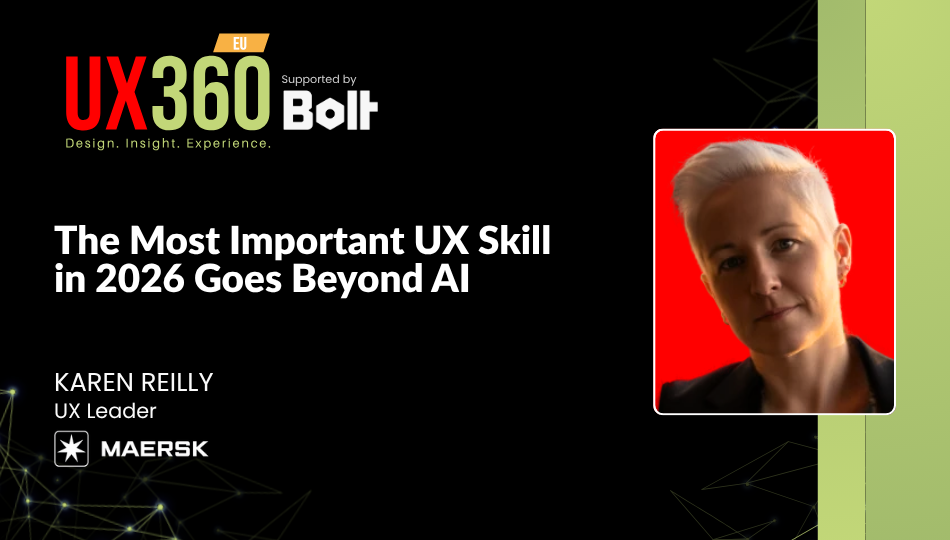
Twenty years into a career built on understanding people, Karen Reilly still believes the most important UX skill in 2026 goes beyond what AI can offer. As a UX leader at Maersk — one of the world’s largest shipping and logistics companies — she has watched teams get pulled deeper into tools, platforms, and automation loops, slowly losing sight of the thing that makes human-centered design irreplaceable: being human.
Ahead of UX360 Europe 2026 in Berlin, Karen sat down to talk about empathy as a competitive advantage, what UX research was always meant to be, and why now — finally — is the moment to reclaim it.
Watch the full conversation:

The Tool Trap: When Productivity Becomes a Distraction
UX teams have more tools than ever before. From AI-powered analysis platforms to increasingly sophisticated design systems, technology is helping researchers and designers work faster, automate repetitive tasks, and scale insights across organizations.
But according to Karen Reilly, there is a risk in becoming too focused on the tools themselves. As workflows become more automated, teams can find themselves spending more time managing platforms than connecting with the people they are designing for, as Karen puts it:
“We get sucked into Figma and all of these things, and we forget that the thing keeping us in this job is our superpower — being human.”
The Competitive Advantage AI Cannot Touch
When AI can handle synthesis, recruitment, and analysis, what is left that only you can do? Karen’s answer is simpler than most teams expect — and more urgent than most organizations realize. Curiosity. Emotional intelligence. The instinct to ask a follow-up question that no prompt would generate.
These are not soft skills to list on a CV. They are the specific human capabilities that no model can replicate, and the ones that will determine which UX functions gain strategic ground over the next three years — and which ones quietly become prompt libraries for product teams.
From Delivery to Strategy: The Shift UX Research Has Been Waiting For
That warning comes with an opening. Because if AI is taking on the operational work, something has to fill the space it leaves behind — and that something is strategy. If empathy, curiosity, and critical thinking are the skills that endure, then the role of UX research must rise to match them.
For years, researchers have spent significant time on operational work — from recruitment and interview scripting to synthesis and reporting. As AI takes on more of those tasks, Karen Reilly sees an opportunity for researchers to focus on the work they have long wanted to do: influencing decisions earlier, understanding business priorities, and helping shape what organizations build next.
In other words, the future of UX research may be less about generating insights and more about ensuring those insights drive strategy.
The capacity for that has always been there. AI is finally clearing the path to it.
Karen walks through exactly how her team at Maersk is making that shift — watch the full conversation now.
Take this thinking further at UX360 Europe 2026
Karen brings this thinking to life at UX360 Europe 2026 — leading the workshop “Improvise to Empathize: Harnessing Your Human Superpowers” and joining Google, thyssenkrupp, and GoodHabitz on the panel “Phoenix Rising: UX Research Reborn as Transformational Power”.
Two sessions at the intersection of human leadership, strategic influence, and the future of UX research. If that is where your practice is heading, this is the room to be in.
Join senior leaders from DHL, Google, Airbus, Mastercard, Volvo Cars, and more — UX360 Europe 2026 | June 23–24 | Berlin