






 by
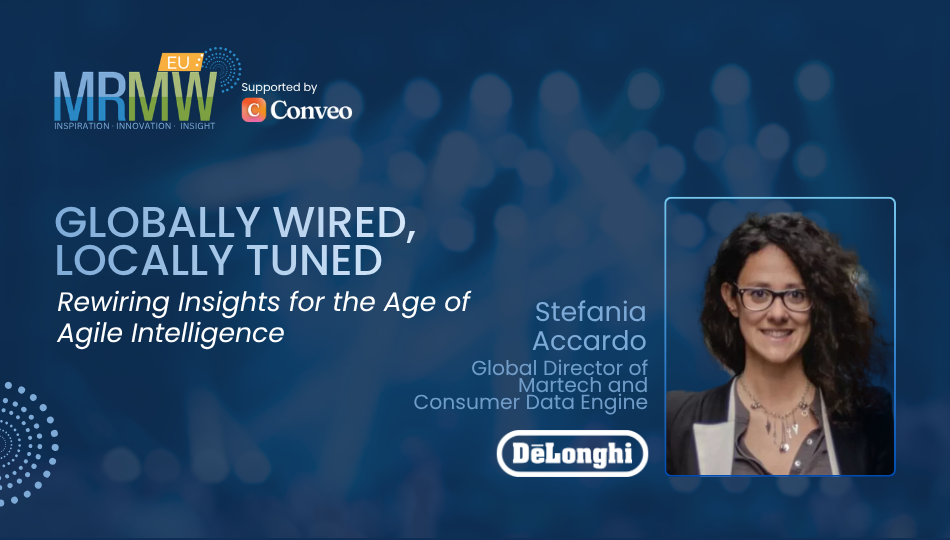
by Rewiring insights for the age of agile intelligence means solving a paradox that most global brands know well: how to stay globally wired and locally tuned at the same time. Stefania Accardo, Global Director of Martech and Consumer Data Engine at De’Longhi Group, has spent 15 years working across international markets — at Colgate-Palmolive, PepsiCo, and now De’Longhi — on exactly this problem: how to turn a signal into a decision, and that decision into action, and — increasingly — how to build the trust needed to make that action stick across markets that no longer behave as separate territories.
Ahead of MRMW Europe 2026, she makes the case that the borders between markets have quietly dissolved — a trend can spark in one location and prove just as fruitful on the other side of the world — and that insights teams need to be rewired to keep up.

The gap between the aspirational and the real consumer

For years, research briefs have chased the aspirational consumer — an idealized version of who a brand wants to reach. The problem, Stefania argues, is that this figure is often very different from the real consumer, and the distance between them is no longer just a research gap. It is an ecosystem gap: the channels and cultural trends that shape how people actually discover and buy have shifted, and insights functions built for a more static world have not kept pace. When a shopper in Australia reads a German product review auto-translated into English, the consumer journey has become genuinely borderless — and understanding it means closing the gap between the consumer a brand imagines and the one who actually exists.
Globally wired, locally tuned
The tension Stefania describes is one every global brand recognizes: how to operate at worldwide scale while staying genuinely relevant locally. She sees it playing out in the consolidation of agencies into global brands, and in retailers like Amazon, Temu, and Alibaba that move fluidly between local and global. The answer, she suggests, is not to choose between the two but to build an ecosystem that serves both — feeding local markets, headquarters, and the data backbone at once. That reframing is what turns an insights team from a producer of studies into the connective tissue of a global business — though, as Stefania explains, that shift asks insights leaders to rethink almost everything about how their teams are structured.
Why trust is the new oil
If data was the new oil of the last decade, Stefania argues that trust is the new oil of this one — directly linked to consumer retention, sales, and innovation. As AI and agile tools reshape how insights teams work, the value does not come from the tools alone but from trust in the people using them. Alongside trust, the harder question, she suggests, is what happens to insights teams that don’t make that shift in time.
Literature and Listening Recommendations
- Philosophy Eats AI — a recent thesis published by MIT. Stefania recommends it to researchers as a reflection on critical thinking and cultural shifts, connecting to the philosophical side of how researchers interrogate their work.
- Mind Masters by Columbia Business School — a YouTube series on the data-driven science of decoding human behavior. A natural fit for researchers who come from a psychology or human behavior background.
How Do You Build Insights That Are Globally Wired and Locally Tuned?
At MRMW Europe 2026, Stefania Accardo takes the stage in the session From Scale to Speed: Rewiring Insights for the Age of Agile Intelligence — a session built for insights leaders working to turn worldwide data into locally actionable intelligence.
She also hosts a roundtable in The Research Hot Seat: Ask Me Anything — How to Build Agile Insights Systems That Balance Global Reach With Local Impact.
October 21–22, 2026 | Berlin, Germany
Register for MRMW Europe 2026 →