







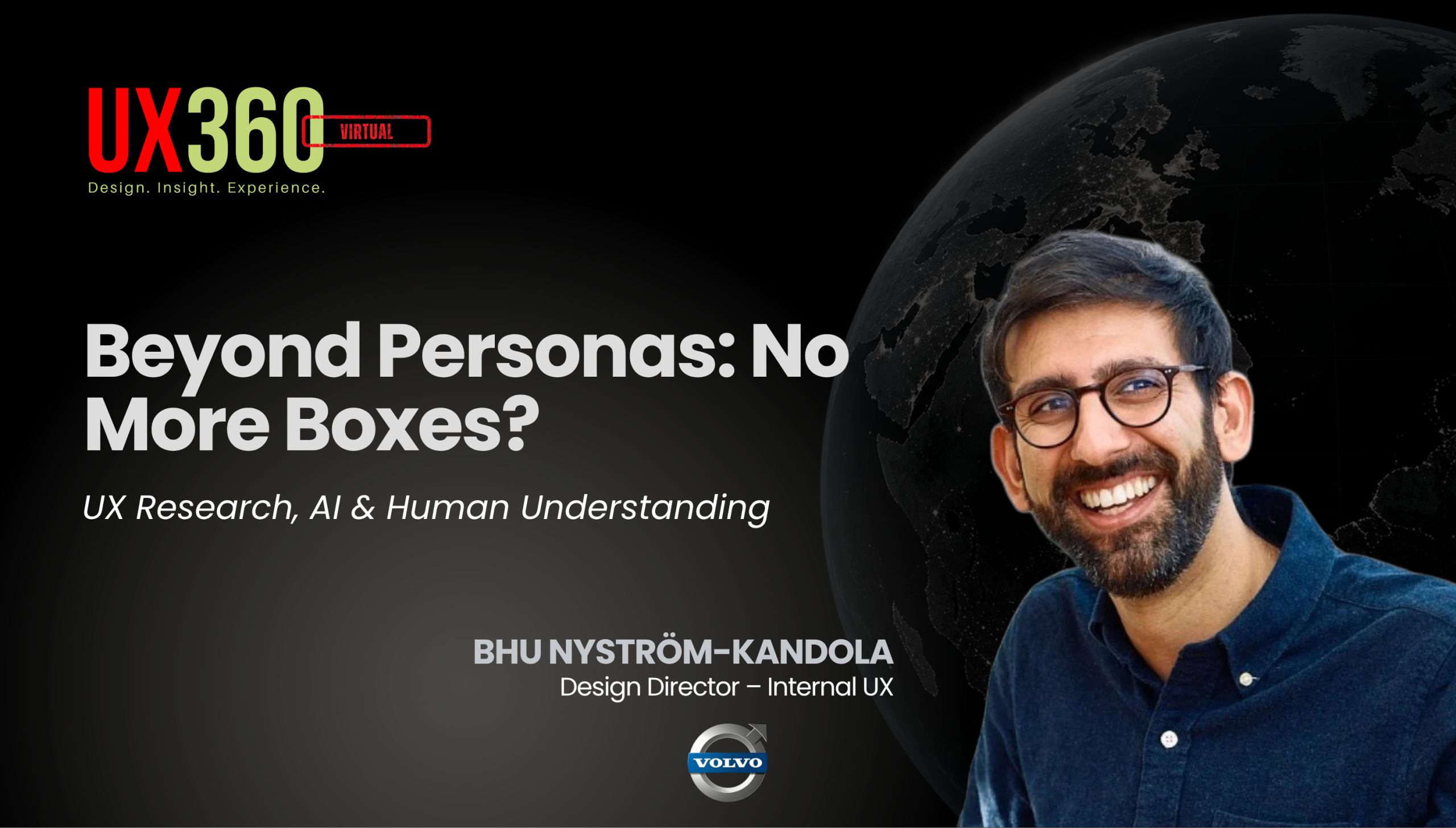
UX research beyond personas raises a familiar but increasingly important question: when do the categories researchers use to understand people begin to limit what they can see?
For Bhu Nyström-Kandola, a design leader at Volvo Cars, the concern is that personas and archetypes can become boxes that define users too narrowly. Rather than treating these groupings as fixed descriptions, he encourages teams to think about experiences that can respond to a wider range of expectations.
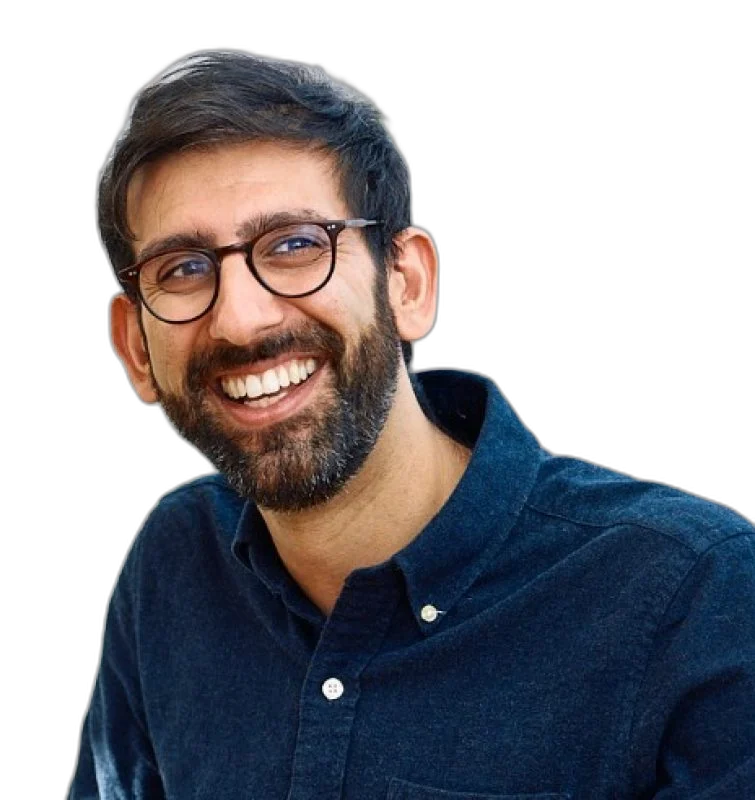
Ahead of UX360 Virtual Summit 2027, Bhu shares his thoughts on moving beyond rigid research categories, using AI to support synthesis, adapting UX operating models and helping design professionals shape their own careers. He will also join a panel on how UX leadership and career development are evolving.
UX research beyond personas: why Bhu questions the boxes
Personas and archetypes can help researchers organise findings and communicate patterns. But they can also encourage teams to think of people as members of a small number of fixed groups, especially when an initial research framework becomes a long-standing design assumption.
Bhu believes this habit deserves more scrutiny. In his interview, he argues that UX research still places too much emphasis on “boxing people into groups to frame experiences.”
His aspiration is to investigate how emerging capabilities, including AI, might help teams consider a broader spectrum of user expectations rather than designing only for a handful of predefined types.
He captures that ambition in two words: “no boxes!”
The implication is not that every difference between users disappears or that research can satisfy every possible need. It is a challenge to treat personas as useful working models, not as the boundaries of what a product experience can become.
AI-assisted synthesis should support human judgement
Asked where AI is genuinely adding value to UX research, Bhu points to synthesis: helping teams process what they have learned and use it to inform the next direction.
He describes AI as “a colleague to support rather than something working on its own.”
This framing matters. Synthesis involves more than producing summaries. Researchers need to understand which signals are significant, how findings relate to the questions being investigated and what they mean for design decisions.
Bhu’s response presents AI as a supporting capability within that process, rather than an autonomous replacement for the people responsible for interpretation. He does not claim that AI can independently establish what all users want.
For a related discussion of the fundamentals that should remain in place as research tools evolve, see our interview with Jen Blatz on UX research rules worth breaking.
Why flexible UX operating models matter
Research and design practices are changing, and Bhu sees adaptability as a central requirement for teams navigating that change.
He describes an ongoing effort to work with greater agility and intelligence, while remaining humble about the limitations of any single approach. His advice to peers is to stay open to different operating models instead of assuming that the current process is the only workable one.
“No way is perfect so agility is the key,” he explains.
For UX leaders, that leaves an important practical question: how can teams adapt their methods and ways of working while retaining the judgement needed to turn research into useful direction?
Bhu does not prescribe one universal process. His emphasis is on remaining receptive to change and avoiding the assumption that familiar structures are necessarily the best ones.
From research signals to informed design decisions
At the centre of Bhu’s perspective is a straightforward belief: research is essential to making better-informed decisions.
The challenge is to identify meaningful signals and translate them into direction. That requires teams to do more than collect observations or repeat established research routines; they must decide what the evidence means for the experience they are creating.
In his role at Volvo Cars, Bhu works on consumer experiences and how customers engage with products. His speaker biography connects that work with the broader aim of developing experiences that support customer relationships and business outcomes.
His comments suggest that research practice, synthesis and design leadership are closely connected: the value comes from what teams learn and what they can responsibly do with that understanding.
Reimagining UX career growth and leadership
Alongside his interview, Bhu will participate in Reimagining UX Career Growth: From Discipline History to Cross-Functional Leadership, a panel at UX360 Virtual 2027.
The discussion will examine how UX roles and expectations have developed, why senior career growth increasingly intersects with strategy and cross-functional leadership, and what capabilities may help emerging practitioners navigate an evolving field.
The published agenda also highlights communication, stakeholder alignment, systems thinking and data and AI fluency as areas for discussion. These are panel themes, rather than a claim that Bhu alone will address every topic.
Bhu’s own message for delegates is encouraging: he wants people to feel confident about the industry and empowered to shape their individual journeys within it.
Learning from other UX leaders
For Bhu, joining UX360 is an opportunity to hear how other researchers and design leaders approach challenges similar to those he encounters.
He is interested in exchanging perspectives, understanding different ways of working and learning from people who face comparable questions about research, decision-making and leadership.
That curiosity is consistent with his advice about agility: when there is no perfect operating model, other practitioners’ experiences can be a useful source of reflection and new ideas.
Reading & listening: Bhu’s recommendations
Rather than recommending a particular UX textbook, Bhu encourages designers and researchers to look beyond their own discipline.
His three recommendations are The Economist, Monocle and Dezeen.
His reasoning is that understanding how the wider world is changing can provide valuable perspective for people working in research, design and leadership. Economic developments, culture, business, design and the built environment all offer ideas that extend beyond established UX conversations.
For Bhu, looking outside the design arena is part of staying curious about the contexts in which people’s expectations are formed.
Explore UX career growth at UX360 Virtual 2027
Bhu Nyström-Kandola will join a cross-industry panel at UX360 Virtual Summit 2027 to explore how UX careers are evolving and how researchers and designers can develop their value as professional boundaries change.
The panel, Reimagining UX Career Growth: From Discipline History to Cross-Functional Leadership, brings together perspectives from Volvo, Schneider Electric, Skyscanner and YouTube, moderated by a representative from Hyatt Hotels Corporation.
Panel: Reimagining UX Career Growth: From Discipline History to Cross-Functional Leadership
Panelist: Bhu Nyström-Kandola, Volvo Cars
Date: Wednesday, 3 February 2027
Time: 16:30–17:15 CET
Format: Online panel discussion
Across 3–4 February 2027, UX360 Virtual will bring together UX research practitioners and leaders to discuss methods, evidence, emerging technologies and the changing role of UX in organisations.