






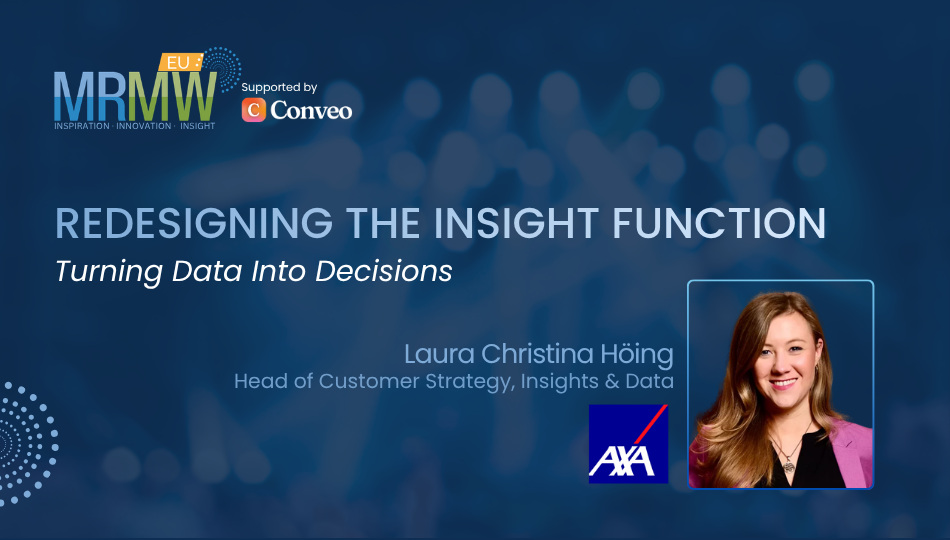
Redesigning the insight function is becoming the defining task for insight leaders: deciding how the team is structured, who holds decision rights, and where AI fits, so that research changes decisions rather than merely informing them. Most organizations still run on reports that change nothing and choices shaped by politics rather than evidence. Laura Höing, Head of Customer Strategy, Insights & Data at AXA Germany, has spent more than 13 years rebuilding that function from the inside, turning a reporting team into what she calls a strategic bridge-builder between data and the decisions it should inform.
In the conversation below, she makes the case that translating knowledge into decisions — not producing more of it — is the differentiator, and lays out what that takes in practice: democratizing access to insights, replacing politics with evidence, using AI to buy back time for the questions that matter, and governing that AI so it sharpens human judgment rather than bypassing it. She previews the honest lessons she’ll share on stage at MRMW Europe 2026, and lays out the skills the next generation of researchers will need.
MRMW: What motivates you to join MRMW Europe 2026, and what is the core message of your talk?
Laura: I have spent the last few years trying to answer one question: how do you build an organization where insights actually shape decisions? MRMW Europe 2026 feels like the right space to explore that together. My core message is simple — the real differentiator is translating knowledge into decisions. But how do we actually get from insights to decisions?
At AXA Germany, we have been transforming my area of responsibility — Customer Strategy, Insights, and Data — from a reporting function into a strategic bridge-builder that connects data, insights, and decision-making across the organization. A core part of that journey is democratizing customer insights: making them easily accessible to everyone in the organization, not only to those who know how to commission a study. We want colleagues to use data, not politics, when making decisions. And we want to measure in order to improve, not just to report numbers upward. AI has been a powerful enabler of this: it delivers efficiency, so we can free up time for the real, impact-driven questions. I look forward to sharing what that journey looks like in practice, including the honest lessons.
MRMW: How has this impacted your own work and your organization?
Laura: Committing to the idea that insights only matter when they change decisions has always guided us organizationally. It has made us brutally honest about relevance and impact: are we actually changing anything, or are we just producing beautiful reports?
The most visible expression of insights shaping decisions has been our repositioning as a bridge-builder. We co-develop strategies with stakeholders across the entire organization, bringing together people and perspectives that would not normally sit in the same room.
Some of our most powerful insight moments still happen in person. In our “Customer Lab,” colleagues without day-to-day customer contact sit face-to-face with real customers, and that direct human experience is often what turns a one-time stakeholder into a genuine, recurring user of insights. AI makes it much easier to scale our work; it frees up time and energy for the questions that truly matter — the ones with direct business impact. We want to spend less time on production and more on what comes after: the activation, interpretation, and strategic use of insights.
When colleagues start coming to you proactively — not because they have to, but because they trust that you will help them make better decisions based on evidence rather than assumption — that is when you know the model is truly working. Increasingly, people across the organization recognize that strategy development becomes significantly stronger when you build it on two solid pillars: market research and customer insights. Start there, and you end up with something that is not just strategically sound but genuinely customer-driven.
MRMW: How has market research and insight as a practice evolved in the last couple of years, and how would you like to see it evolve in the next few?
Laura: The biggest shift is the blurring of boundaries — between research, analytics, and data science, and between insight production and strategic decision-making. AI has compressed timelines from months to days.
Market research and insight teams must redesign their workflows. Most are layering AI onto old processes, and that is where the opportunity is being missed. AXA’s AI strategy is “building business better.” Looking ahead, I want to see insight functions claim their seat at the strategic table as genuine “insight activists,” and get serious about responsible AI governance as a real competitive advantage.
MRMW: Given this evolution, what are two expected and two less obvious skills market researchers should possess, and why?
Laura: AI fluency (expected). Not just prompting, but knowing where AI adds value, where it introduces risk, and how to critically evaluate inputs and outputs. This includes interrogating the underlying data itself. AI can produce confident-sounding outputs at remarkable speed, but if the data it is built on is incomplete, biased, or unrepresentative, the decisions that follow will be too. True AI fluency means asking not just “what does this output tell me?” but “what is this output based on — and who or what might be missing from that picture?” Speed is only an advantage if the foundation is sound.
Commercial storytelling (expected). Translating complex findings into clear business narratives. Insights only have value when they are used.
Bridge-building and orchestration (less obvious). The ability to connect the right people, data, and perspectives at the right moment. Some of our most impactful work at AXA has come from bringing together teams that would not normally collaborate.
Use data, not politics (less obvious). The willingness to say “the data tells a different story than we expected” and stand behind it, even when it is uncomfortable. In a world of confirmation bias and fast-moving AI outputs, the researcher who can challenge assumptions with confidence and thoroughness is more valuable than ever.
MRMW: Apart from work, what can delegates talk to you about — any particular personal interests, hobbies, or activities?
Laura: I am passionate about inclusion. The work we do with AXA EssentiALL — making insurance accessible for underserved communities — connects to something I care about deeply: financial resilience should not be a privilege.
I also love finding ways to be more efficient, whether that is management or any other smart-working tips and tricks. Come find me.
Reading and Listening Recommendations
Podcast
- OMR Education Podcast — hands-on, actionable digital marketing and e-commerce insights (in German)
Book
- Invisible Women: Exposing Data Bias in a World Designed for Men — Caroline Criado Perez
Continue the conversation at MRMW Europe 2026
How much of your team’s work still ends in a report no one acts on?
At MRMW Europe 2026, Laura Höing takes the stage with “From Data to Decisions: Designing the Insight Organization of the Future” — a session for insight leaders rethinking their team’s structure, decision rights, and AI governance for what comes next.
Laura will be joined by insight leaders from Kraft Heinz, eBay, Warner Bros. Discovery, De’Longhi, and P&G — all wrestling with the same question: how to make insight functions decision-makers, not just report-writers.
MRMW Europe 2026 | October 21–22 | Berlin. Explore the event.