






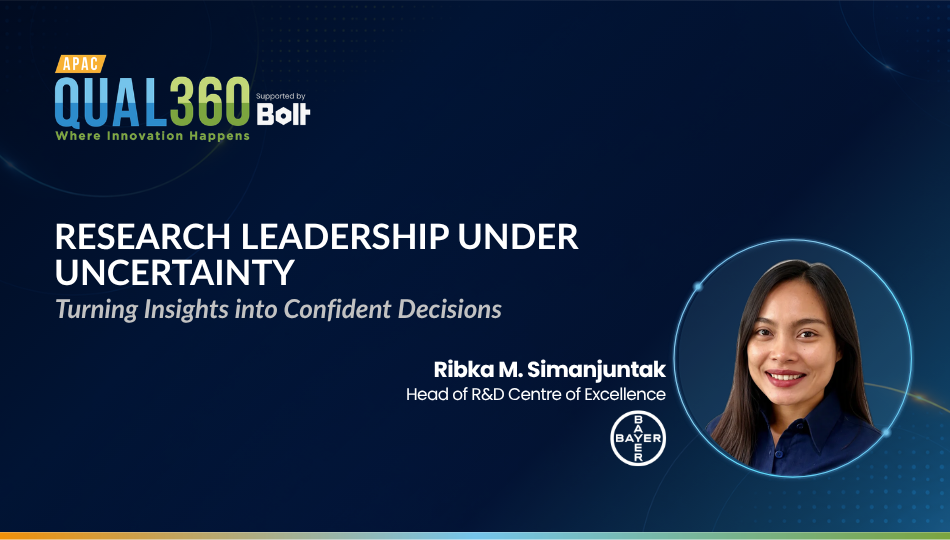

Research leadership under uncertainty is not about eliminating every doubt before acting. It is about creating enough clarity for teams to make responsible decisions while uncertainty remains. Ribka Martina Simanjuntak, Head of R&D Centre of Excellence at Bayer, argues that the value of research extends beyond the quality of the analysis itself: insights create real impact when they help people align around priorities, understand risk, and act with confidence.
Ahead of QUAL360 APAC 2026, Ribka discusses how leaders can balance scientific rigor with decisive action, why research should begin with the decision rather than the methodology, where AI can accelerate qualitative work without replacing human judgment, and why cultural intelligence is essential across APAC. Her message is clear: the strongest research teams turn ambiguity into progress while remaining grounded in empathy, context and genuine consumer needs.
QUAL360: Without giving too much away — what is the core message of your session, and what would you like delegates to take away from it?
Ribka: Throughout my career in R&D, I have learned that the greatest challenges rarely come from a lack of expertise, data, or talent. More often, they come from having to make important decisions when information is incomplete, priorities are competing, and the stakes are high. The core message of my session is that leadership is not about having all the answers. It is about creating clarity when things are uncertain, helping teams focus on what matters most, and giving people the confidence to move forward.
In today’s environment, waiting for perfect certainty is rarely an option. The leaders who create the greatest impact are those who can balance scientific rigor with decisive action while empowering others to do the same. I hope delegates leave with practical ideas for turning ambiguity into progress and uncertainty into meaningful outcomes.
QUAL360: What is one way your team’s qualitative practice has changed in the last few years — and what would you tell a peer weighing the same shift?
Ribka: One of the biggest shifts for my team has been moving from generating insights to becoming stronger partners in decision-making. Earlier in my career, success was often measured by the quality of the analysis itself. Today, I see success differently. The real value of insights comes from their ability to help people make better decisions, align around priorities, and take action with confidence.
This has changed how we work with stakeholders. Rather than starting with methodologies or data collection plans, we begin by understanding the business challenge, the decisions that need to be made, and the outcomes we are trying to achieve. My advice to peers would be simple: focus first on the decision and the impact you want to create. When research becomes a catalyst for action, its value extends far beyond the insight itself.
QUAL360: Where is AI genuinely adding value in your qualitative work today, and where have you chosen to keep it out — and why?
Ribka: AI is already creating tremendous value by helping teams analyze information faster, identify patterns more efficiently, and reduce time spent on repetitive tasks. This allows researchers and leaders to focus more energy on interpretation, collaboration, and strategic thinking. At the same time, I believe the more AI advances, the more important human qualities become. Working across diverse markets has taught me that understanding people requires empathy, judgment, and context.
We need to understand not only what people say, but why they say it and what influences their decisions. AI can help us see patterns, but people are still essential for understanding meaning and making responsible decisions. I see AI as a powerful partner, but not a substitute for human curiosity, compassion, and leadership.
QUAL360: What is one thing qualitative research could do differently — a habit or assumption that persists because it is familiar rather than because it still works best?
Ribka: I believe qualitative research could spend less time trying to eliminate every uncertainty and more time helping organizations create better outcomes for the people they serve. In Consumer Health, our purpose is ultimately much bigger than generating insights. Our goal is to improve people’s wellbeing through products, experiences, and solutions that address real needs. Deep consumer understanding remains essential, but progress often requires making responsible decisions before every question has been answered.
The most valuable research is not the research that provides perfect certainty. It is the research that helps us understand what matters most to consumers, what risks need attention, and where there is enough evidence to move forward confidently. When insights lead to meaningful improvements in people’s lives, their true value is realized.
QUAL360: You work across APAC markets. What does the rest of the industry consistently misunderstand about running qualitative research in the region — culturally, methodologically, or in how insights get used?
Ribka: One of the most common misconceptions is that APAC can be approached as a single region. In reality, it is one of the most diverse regions in the world, with different cultural norms, health beliefs, consumer behaviors, and ways of building trust. The more markets I have worked across, the more I have realized how much there is still to learn. While strong methodologies are important, true understanding requires humility, curiosity, and respect for local realities. Consumers may share similar needs, but the context behind those needs can vary significantly from one market to another.
Some of the most meaningful insights come not from asking better questions, but from listening more carefully and being open to perspectives that challenge our assumptions. In APAC, cultural intelligence is every bit as important as methodological excellence.
QUAL360: What motivates you to join QUAL360 APAC this year, and where are you most looking to learn from peers at this event?
Ribka: What motivates me most is the opportunity to learn from people who are passionate about understanding consumers and creating meaningful impact. While I am honored to contribute as a speaker, I see myself as a learner first. Throughout my career, many of the lessons that shaped me most came from conversations with peers who approached challenges from different perspectives and experiences. I am particularly interested in learning how organizations are using insights, technology, and new ways of working to navigate growing complexity.
Beyond that, I am always inspired by discussions about leadership and talent development, because I believe one of our most important responsibilities as leaders is helping others grow. Events like QUAL360 remind us that learning does not happen in isolation. It happens when people come together, share openly, and challenge one another to think differently.
QUAL360: We publish reading and listening guides on our blog — what would you recommend to peers for inspiration, learning, or leadership?
Ribka: Three books have shaped my leadership journey over the years.
Good to Great by Jim Collins taught me that sustainable success begins with people. Before strategy, technology, or processes, great organizations focus on building strong teams, creating the right culture, and developing leaders who can thrive in complexity.
Grit by Angela Duckworth reinforced the importance of perseverance and purpose. Working in R&D has taught me that innovation rarely follows a straight path. Breakthroughs often come after setbacks, and meaningful progress requires resilience, continuous learning, and the discipline to keep moving forward when the outcome is still uncertain.
Built to Last by Jim Collins inspired me to think beyond short-term achievements and focus on developing organizations, capabilities, and leaders that continue to grow long after any individual leader moves on. It reinforced my belief that our greatest legacy as leaders is not the projects we deliver, but the people and capabilities we leave behind.
Together, these books remind me that sustainable impact comes from investing in people, persevering through uncertainty, and building capabilities that endure. These lessons continue to shape how I lead today.
How Do You Lead a Research Team When Budgets, Timelines, and Stakes Collide?
At QUAL360 APAC 2026, Ribka Martina Simanjuntak takes the stage in the session “From Ambiguity to Action: Leading High-Impact Research Teams When Budgets, Timelines, and Stakes Collide“ — a session built for research leaders who need to translate executive ambiguity into clear decisions and rapid, rigorous qual plans.
Leaders from Pandora, Symrise, Google, and more will be in the room.
November 3–4, 2026 | Singapore
Explore the event →