








Predictive UX research raises a question that becomes more important as artificial intelligence develops: can a model anticipate what real people will do, or does it merely generate answers that sound plausible?
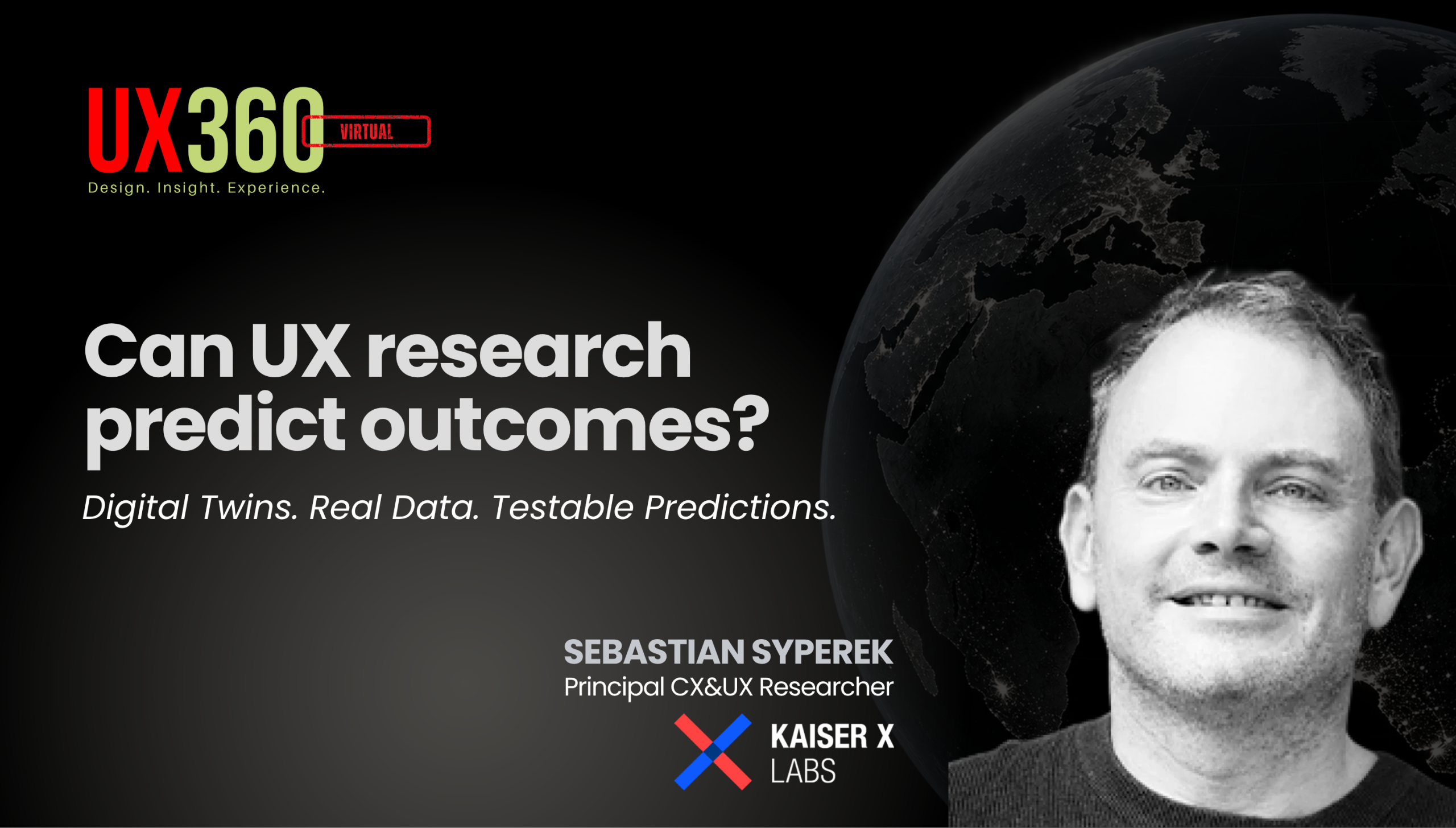
For Sebastian Syperek, Principal CX & UX Researcher at Kaiser X Labs, a company of Allianz, the distinction is fundamental. Drawing on more than 20 years of experience across market research, customer experience and UX research, he argues that AI has considerable potential when it is grounded in empirical evidence, clear hypotheses and careful validation.

Ahead of UX360 Virtual Summit 2027, Sebastian discusses an experiment involving 499 football fans, the possibilities and limitations of digital twins, and why quantitative methods should play a larger role in UX research. His upcoming session asks whether research can become more predictive without mistaking synthetic responses for real human behaviour.
Predictive UX research needs more than convincing AI answers
AI can produce detailed, persuasive predictions. Whether those predictions reflect reality is a separate question.
As Sebastian puts it, “The much more interesting question is whether those answers are actually correct.”
His view is that AI and quantitative research could become a powerful combination, provided that researchers start with real respondent data, formulate clear hypotheses and establish a way to test predictions against observed outcomes.
That emphasis on validation changes the conversation. Instead of judging an AI-generated answer by how reasonable it sounds, researchers can ask whether the underlying model produces predictions that hold up when checked against reality.
From 499 football fans to human-grounded digital twins
Sebastian’s UX360 case study takes this question into an experimental setting: football predictions.
He used quantitative research with 499 real football fans to explore whether their collective judgements could help anticipate future outcomes. According to the session agenda, participants completed a MaxDiff study measuring how they perceived the relative strength of teams. Their individual responses then formed the foundation for a set of digital twins and a crowd-based prediction model.
The important detail is where the model begins. Rather than asking AI to invent what respondents might think, Sebastian’s approach starts with preferences provided by actual people. AI-supported context can then be incorporated into the prediction process.
His presentation will also address how to evaluate those forecasts: recording predictions before outcomes are known and assessing their quality with measures such as Brier Score and Log Loss. The purpose is not to assume that a digital twin is accurate, but to find out whether the approach performs when tested.
The experiment offers a practical way to examine the promise of synthetic approaches while keeping the difference between generated predictions and observed evidence in view.
Why quantitative UX research matters for product decisions
Sebastian believes UX research has an opportunity to become more quantitative and more closely connected to business decisions.
Qualitative interviews and usability testing are valuable for understanding experiences, uncovering friction and explaining why people struggle. But organisations may also need to know how widespread a problem is, how strongly it affects satisfaction and which improvements deserve priority.
He offers a straightforward distinction: discovering ten usability issues is useful; identifying the three that affect the most users and have the greatest impact on satisfaction is a different challenge.
Quantitative UX research can help teams move from identifying problems to making better-informed decisions about what to address first. For Sebastian, the ultimate goal is not simply to deliver findings, but to demonstrate how research influences decisions and, ideally, outcomes.
AI as a research assistant, not a replacement for real respondents
Sebastian already uses AI in his research practice, particularly when handling large volumes of qualitative material. It can support the structuring of open-ended responses, pattern identification and coding. He also experiments with combining survey data and large language models.
But he draws a firm boundary around claims made from synthetic respondents.
“We need to distinguish between generating plausible answers and measuring actual human attitudes or behaviour.”
That does not mean rejecting the technology. It means treating AI as an assistant and an experimental capability rather than assuming its outputs are equivalent to empirical observations. Sebastian would want strong supporting evidence before accepting synthetic responses as substitutes for actual respondent data.
For another perspective on retaining research discipline as AI tools evolve, read our interview with Jen Blatz on UX research fundamentals and AI.
Bringing market research, CX and UX research closer together
With a background spanning market research, customer insights and UX, Sebastian is interested in how the boundaries between these disciplines are becoming less distinct.
He questions the tendency to associate UX research primarily with qualitative methods. Understanding individual experiences is essential, but different business questions call for different types of evidence.
Rather than beginning with a disciplinary label, he encourages researchers to choose the method that best answers the question. Approaches originating in market research, customer experience or UX can be combined when the problem calls for it.
For teams considering a similar shift, the practical implication is clear: method selection should follow the decision the research needs to support.
What Sebastian hopes to learn at UX360
For Sebastian, UX360 Virtual 2027 is an opportunity to compare approaches with researchers working across different disciplines.
He is particularly interested in concrete examples of how AI is being used in research: what works, what does not and how teams can protect methodological quality while experimenting.
Alongside sharing his digital twins experiment, he hopes to exchange ideas with peers who are questioning how research methods can evolve without losing their evidential foundations.
Reading & listening: Sebastian’s recommendations
Book: Quantitative User Experience Research, by Chris Chapman and Kerry Rodden. Sebastian recommends it to UX practitioners looking to understand how quantitative methods can help answer more strategic questions. He particularly values the connection it makes between statistical thinking and practical UX challenges.
Podcast: CXEinfachMachen, Sebastian’s German-language podcast, which covers practical topics across customer experience, UX and research.
He also encourages UX professionals to draw inspiration from behavioural science, traditional market research and customer experience management rather than relying exclusively on UX-specific literature.
Explore predictive UX research at UX360 Virtual 2027
At UX360 Virtual Summit 2027, Sebastian Syperek will explore what happens when quantitative human research and AI-powered prediction models are brought together—and how researchers can test whether those predictions deserve to be trusted.
His session, Can UX Research Become More Predictable? Human-Grounded Digital Twins, Synthetic Respondents, and Quant UX Research, will cover the 499-fan experiment, its digital twins approach and the importance of validating forecasts against real outcomes.
Session: Can UX Research Become More Predictable? Human-Grounded Digital Twins, Synthetic Respondents, and Quant UX Research
Speaker: Sebastian Syperek, Principal CX & UX Researcher, Kaiser X Labs
Date: Thursday, 4 February 2027
Time: 15:30–16:00 CET
Format: Online case study
Across 3–4 February 2027, UX360 Virtual will connect research professionals and leaders around methodologies, evidence, decision-making and the practical role of AI in UX research.