







AI in qualitative research is changing how quickly researchers can gather evidence and how widely they can explore consumer experiences. Yet faster answers are not always better decisions. The deeper challenge is to understand the people and circumstances behind the signals, and to know what that understanding means for the business.
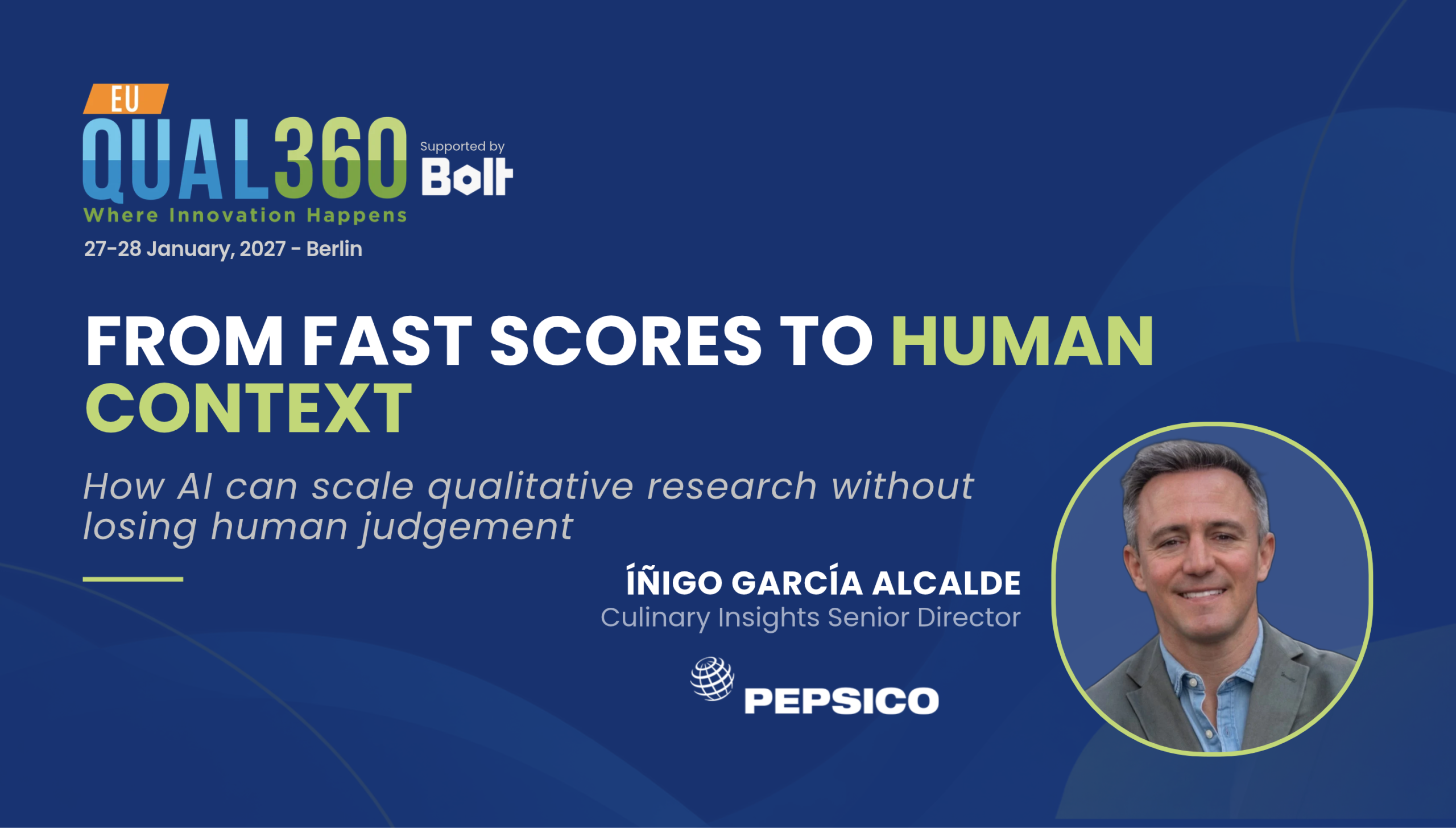
For Íñigo García Alcalde, Culinary Insights Senior Director at PepsiCo, speed, scale and depth do not have to be opposing objectives. Research teams can use new technology to extend qualitative enquiry while preserving the human judgement needed to challenge assumptions and inform innovation.

Culinary Insights Senior Director
PepsiCo
Speaking with Nicole Pierscionek of Merlien Institute ahead of QUAL360 Europe 2027, Íñigo explores living digital twins, AI-moderated interviews, decision-ready qualitative evidence and an innovation example in which a better understanding of customers led to a different commercial conclusion.
Watch the interview: Íñigo García Alcalde on AI and qualitative research
Watch the conversation with Íñigo García Alcalde and Nicole Pierscionek on the Merlien Institute YouTube channel.
Watch the full interview directly on YouTube.
From fast scores to human context in qualitative research
Rapid testing can help a brand identify changing preferences and promising ideas. However, the result of a test does not necessarily explain why an idea appeals to someone, which occasions it serves or how it fits into their existing behaviour.
Íñigo sees potential in combining always-on qualitative research with living digital twins: evolving representations informed by fresh evidence about real consumers, rather than static profiles built from a single research exercise. The aim is to bring richer human context into decisions that often have to be made quickly.
That perspective also underpins his upcoming QUAL360 Europe session. As innovation cycles accelerate, the question is not simply whether companies can collect consumer signals faster, but whether they understand enough about those signals to act on them well.
When human insight changed the business question
One of the interview’s most useful examples comes from an earlier stage of Íñigo’s career in foodservice. His team was assessing a proposed plant-based range, with the initial assumption that it could attract new customers.
Closer attention to customer motivations pointed to a different opportunity. Rather than primarily bringing new people into the business, the range could give existing frequent customers more choice and more reasons to return.
The distinction mattered. Greater visit frequency was not the original goal, so the team decided to deprioritise the concept. The research did not merely indicate whether customers liked the idea; it challenged the commercial premise behind it.
This is where qualitative insight becomes especially valuable: a finding can be useful even when it changes the question or leads a team not to proceed. It helps decision-makers separate an attractive possibility from one that fits the objectives they are actually pursuing.
Start with the decision, not the methodology
When discussing how to judge the strength of qualitative evidence, Íñigo begins with the decision. What must stakeholders decide? What would be the cost of getting it wrong? And what evidence would make them change their minds?
From there, he distinguishes between what the team knows, what it believes and what still needs testing. The point is not to demand perfect evidence for every choice, but to make sure the evidence is appropriate to the uncertainty and consequences involved.
For researchers, this changes the conversation with stakeholders. Rather than arguing for a method in isolation, they can explain how a particular piece of human understanding helps the organisation assess risk and make a more informed choice.
A related QUAL360 speaker interview with BSH on translating qualitative insights into business decisions explores the same challenge of connecting consumer understanding to strategic action.
AI in qualitative research: better questions, not just faster answers
AI is often discussed as a way to produce answers or accelerate the research workflow. Íñigo is equally interested in its capacity to help people ask better questions.
He describes using AI as a thought partner to clarify context, interrogate assumptions and consider a problem from the customer’s perspective. AI-moderated interviews may also make open-ended conversations possible with a wider range of participants than before.
That expansion brings opportunities, but it is not the same as generating better insight automatically. Researchers still need to recognise contradictions, evaluate the quality of the evidence and decide which conclusions the organisation can responsibly draw.
The distinction is important: AI can extend the reach of research; researchers remain accountable for the judgement that turns conversations and observations into meaningful decisions.
Moving beyond the traditional trade-off between depth and scale
Qualitative research has long been described through a series of trade-offs: deep but small, broad but shallow, or rigorous but slow. Íñigo believes that AI-enabled interviewing, continuous research communities and digital ethnography are beginning to challenge these categories.
Instead of relying only on isolated projects, research teams could accumulate evidence across conversations, markets and moments in time. They could revisit assumptions as behaviours change, building a more responsive understanding of customers and emerging needs.
That does not mean greater volume alone produces greater insight. The researcher’s responsibility shifts towards posing sharper questions, spotting inconsistencies and interpreting context, particularly when automated processes make it easier to collect information at scale.
These questions also connect to Merlien’s review of QUAL360 Europe 2026, which explored how the industry is balancing AI, speed and data abundance with human judgement.
What should remain human by 2030?
Looking ahead, Íñigo expects the boundary between qualitative depth and quantitative reach to become less rigid. AI-moderated interviewing could support probing conversations with more participants, while living research platforms could allow evidence to be revisited and developed over time.
Yet he wants one principle to remain constant: research must stay connected to real people, their behaviour and the context in which decisions are made.
Technology can change how widely and quickly researchers engage with people. It cannot, by itself, determine what an insight means for the business or how a choice will affect consumers. The future may involve more automation, but it will also demand more careful interpretation and accountability.
Beyond the session: new research approaches and global perspectives
Outside his presentation, Íñigo is keen to exchange ideas about the rapid changes in qualitative research, including how new providers and emerging technologies are widening access to methods across different markets.
He is interested in learning from the approaches other practitioners are testing as the industry changes. Away from work, he draws energy from sport, particularly running and training along the beach in Barcelona.
Reading & listening: Íñigo’s recommendations
Íñigo also shares a couple of influences that inform how he approaches research, innovation and decision-making:
- AI and strategic thinking: Geoff Woods’ The AI-Driven Leader and the CRIT framework, which encourages users to build better context and have AI ask questions before jumping to an answer.
- Book: The Right It, by Alberto Savoia, on testing whether an idea is worth pursuing before investing in executing it well.
- Personal inspiration: Running and training in Barcelona, rather than a particular song.
From fast scores to human context at QUAL360 Europe 2027
At QUAL360 Europe 2027, Íñigo will continue this discussion with Sidharth Kapil, Strategic Insights Lead, UK Foods at PepsiCo, in their session “Fast Scores Need Human Context: Building Living Digital Twins for Innovation at PepsiCo”.
The presentation is scheduled for Thursday, 28 January 2027, 13:50–14:20 in Berlin. It will examine how ongoing qualitative approaches and fresh human evidence can help innovation teams look beyond rapid scores and make more informed choices.
Explore QUAL360 Europe 2027 and register | 27–28 January 2027 | Berlin, Germany.