







Continuous UX research offers a different way to approach one of the most persistent challenges in product development: how can teams make confident design decisions when evidence is fragmented across individual studies? Rather than treating research as a final checkpoint before launch, a continuous approach allows organisations to build knowledge that becomes more valuable over time.
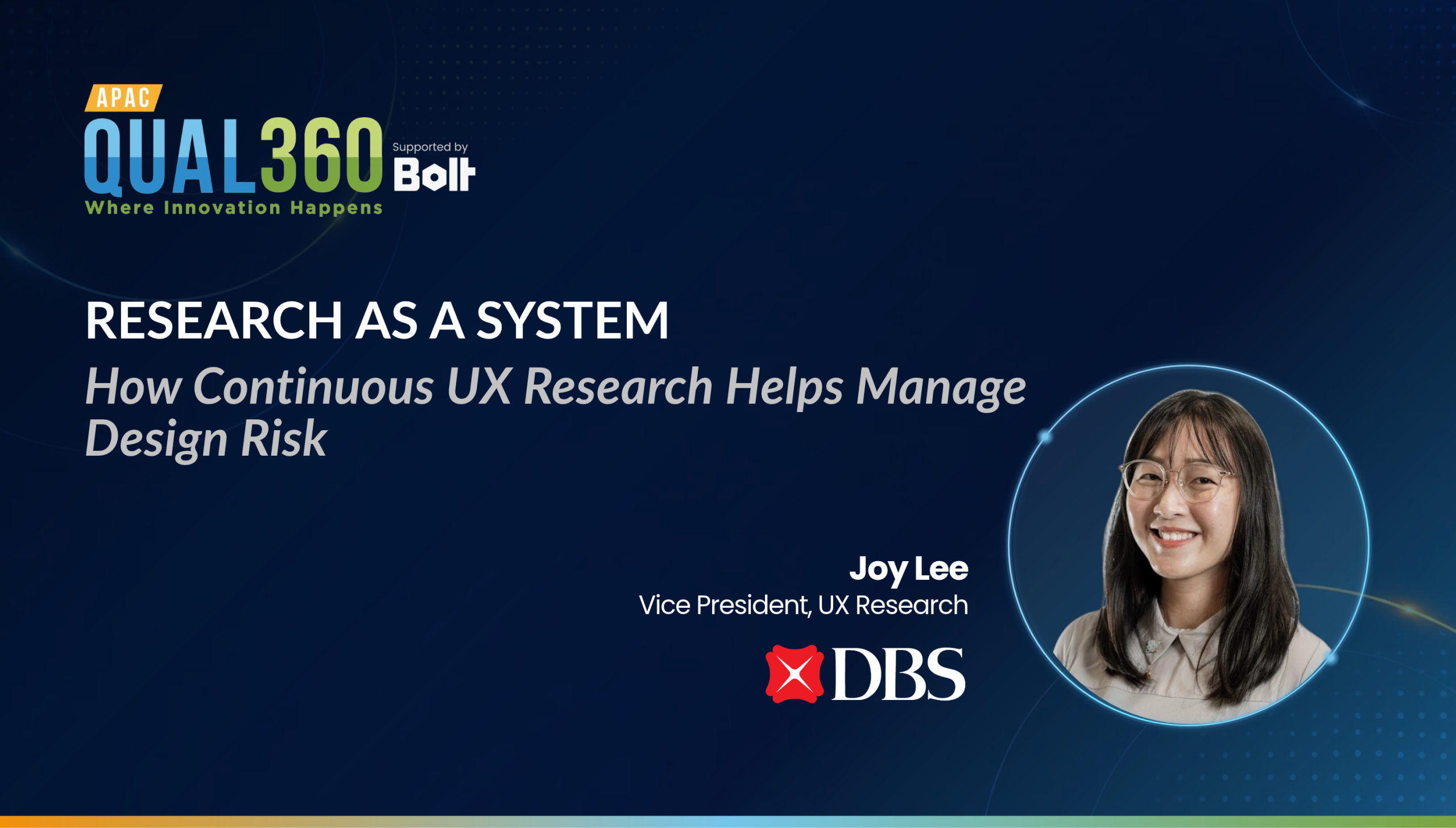
For Joy Lee, Vice President, UX Research at DBS, this means moving beyond isolated research projects towards programmes where findings can be compared, connected and used to understand design risk. The opportunity is not simply to conduct more research, but to make existing evidence more useful for the decisions that follow.

Vice President, UX Research
DBS
Ahead of QUAL360 APAC 2026, Joy shares her perspective on building a research evidence ecosystem, using GenAI without surrendering researcher judgement, combining qualitative and quantitative evidence, and understanding why cultural context matters across Asia-Pacific markets.
Why continuous UX research starts before launch
Research is often commissioned to answer a particular question: is a new feature usable, does a concept resonate with customers, or is a proposed journey ready for launch? These studies can provide valuable answers, but Joy believes organisations risk missing something important when they treat each project as an independent exercise.
“Many organisations still treat research as a checkpoint: an isolated step that validates a design before launch.”
Her approach reframes research as a continuous source of decision support. Instead of waiting until a design is nearly complete to identify potential problems, teams can build an understanding of customer needs and recurring design challenges throughout the development process.
Joy describes the ambition as “building an evidence ecosystem where insights accumulate over time”, allowing researchers to develop a clearer picture of a product’s potential impact on customers before launch.
This distinction matters because managing design risk is not only about identifying problems. It is also about understanding what is already known, where uncertainty remains and which questions require further investigation.
From standalone studies to evidence that accumulates
One of the most significant changes Joy describes in her qualitative research practice is a shift away from treating research as a collection of separate projects.
“Today, we think much more in terms of programmes rather than specific studies.”
In a conventional project-based approach, teams might commission research around an individual feature, customer journey or business question. Once the findings have been delivered, however, their usefulness may remain limited to the original project.
A programme-based approach places greater emphasis on cross-study standards, consistency and tracking. When research is designed with comparability in mind, findings from different studies can contribute to a broader understanding of customer behaviour and product performance.
“We’re less interested in what happened in a single session and more interested in what patterns continue to appear across dozens of studies.”
For UX research teams, this changes how the value of a study is considered. An individual finding may answer an immediate design question, but a recurring pattern across multiple projects can reveal something more persistent about the customer experience.
The underlying challenge is familiar across the insights industry: ensuring that research remains accessible and useful beyond its original purpose. Merlien has explored a related perspective in the four-stage roadmap for building an active intelligence system, which examines how organisations can connect existing knowledge and bring evidence into decision-making workflows.
Building an evidence ecosystem to manage design risk
A continuous research programme becomes particularly valuable when teams need to make decisions under uncertainty. Product launches involve assumptions about customer expectations, behaviours and the effectiveness of proposed solutions. Research can help examine those assumptions, but a single study rarely provides the complete picture.
Joy’s session at QUAL360 APAC will explore how cumulative evidence, benchmarking and continuous learning can support greater confidence in product launch decisions.
The principle is to treat findings as part of an evolving body of knowledge rather than a collection of disconnected reports. Consistent approaches allow researchers to recognise changes, compare results and identify questions that require closer attention.
Equally important is the way evidence is communicated. A research programme can generate valuable insights, but those insights need to be presented in ways that different stakeholders can understand and apply.
For research leaders, this raises a practical question: are findings being delivered as individual outputs, or are they becoming part of a system that helps the organisation make better decisions?
Where GenAI helps — and why researchers must retain judgement
Generative AI is creating opportunities to reduce the operational demands of qualitative research. Joy sees particular value in helping researchers manage larger volumes of material without allowing technology to replace the interpretation and judgement that make research meaningful.
“The most valuable use of GenAI today is not in generating insights. It’s in reducing the labour and logistics burden around research.”
She identifies several useful applications, including transcript handling, first-pass summarisation, identifying recurring themes and navigating existing research. These activities can consume substantial time, particularly when researchers are working across multiple studies.
By reducing some of that workload, GenAI can help researchers manage broader research programmes and work more efficiently with accumulated evidence.
However, Joy draws a clear distinction between supporting the research process and defining how evidence should be interpreted.
“Be wary about letting a GenAI tool do the thinking for you.”
Her concern is not that AI lacks practical value, but that its usefulness depends on the questions, assumptions and direction established by the researcher. A poorly defined frame can lead to wasted effort, even when the technology processes information quickly.
This emphasis on the researcher’s role connects with another QUAL360 APAC speaker interview, Yashan Cama of Google on how AI is expanding the possibilities of qualitative research.
For Joy, the opportunity lies in using technology to scale research activity while preserving the human judgement required to ask the right questions and interpret the findings responsibly.
Why qualitative research needs quantitative evidence
Another assumption Joy challenges is the idea that qualitative or design researchers can work effectively without access to broader organisational data.
Qualitative research is valuable for understanding motivations, perceptions and experiences. But interpreting those findings becomes more useful when researchers can place them alongside other evidence about customers and the business.
Joy points to the importance of “the scaffolding provided by internal data, customer data and other forms of quantitative data.”
That supporting information can help researchers understand the context in which qualitative observations occur. It can also make findings easier to interpret and more actionable for stakeholders who need to decide what happens next.
Her message is that qualitative and quantitative evidence should not be treated as competing approaches. Both can contribute to a clearer understanding of a problem, particularly when teams need to connect customer experiences with wider patterns and organisational priorities.
For research teams, this makes access to relevant data and the ability to triangulate different sources of evidence an important part of the research process.
Across APAC, translation is only the beginning
Working across Asia-Pacific markets introduces another layer of complexity. Organisations may be tempted to think that adapting research to different countries is primarily a matter of translating questions, discussion guides or research materials.
Joy argues that the greater challenge often comes later, when researchers need to understand why a particular experience or concept does not work in a local market.
“In reality, translation is frequently the easy part. The harder challenge is the interpretation of why something doesn’t work.”
A product journey, workflow or design concept may be interpreted differently depending on local experiences and expectations. Without sufficient context, researchers can struggle to understand what has caused a negative reaction or where a design needs to change.
This is why Joy highlights the role of regional fieldwork partners. Their understanding of local markets can support more accurate interpretation and help research teams distinguish between surface-level reactions and deeper contextual issues.
For organisations conducting research across APAC, the implication is that cultural understanding should inform how findings are analysed and applied, not simply how research questions are translated.
Reading & listening: Joy’s recommendation
We also asked Joy to share a source of inspiration for fellow researchers:
- Reading: Articles by Tash Willcocks on Medium. Joy recommends her writing for its perspectives on learning and design, describing her thinking as “really insightful and profound.” For researchers interested in design practice, learning and professional development, it offers another perspective to explore.
Research as a system at QUAL360 APAC 2026
Joy’s perspective points towards a broader role for UX research: not simply validating individual design decisions, but building an evidence base that organisations can return to as products, customer expectations and business priorities evolve.
Continuous UX research requires more than conducting studies regularly. It depends on comparability, access to relevant information, thoughtful interpretation and the ability to connect findings across projects. GenAI may reduce the operational effort involved, but researchers remain responsible for defining the questions and understanding what the evidence means.
On Wednesday, 4 November 2026, 14:45–15:15 (Singapore time), Joy will present “The New Risk Advisor: Qualitative User Research as a Structured System for Managing Design Risk and Uncertainty” at QUAL360 APAC 2026.
Her presentation will explore how research can operate as a continuous decision-support system, how cumulative evidence can contribute to product launch confidence, and how researchers can communicate findings that inform action across functions and stakeholders.
The wider QUAL360 APAC 2026 programme brings together research and insights professionals from organisations including Google, Cathay Pacific, Bayer, L’Oréal, 3M and DBS, with discussions spanning qualitative research, customer understanding, emerging technology and research leadership.
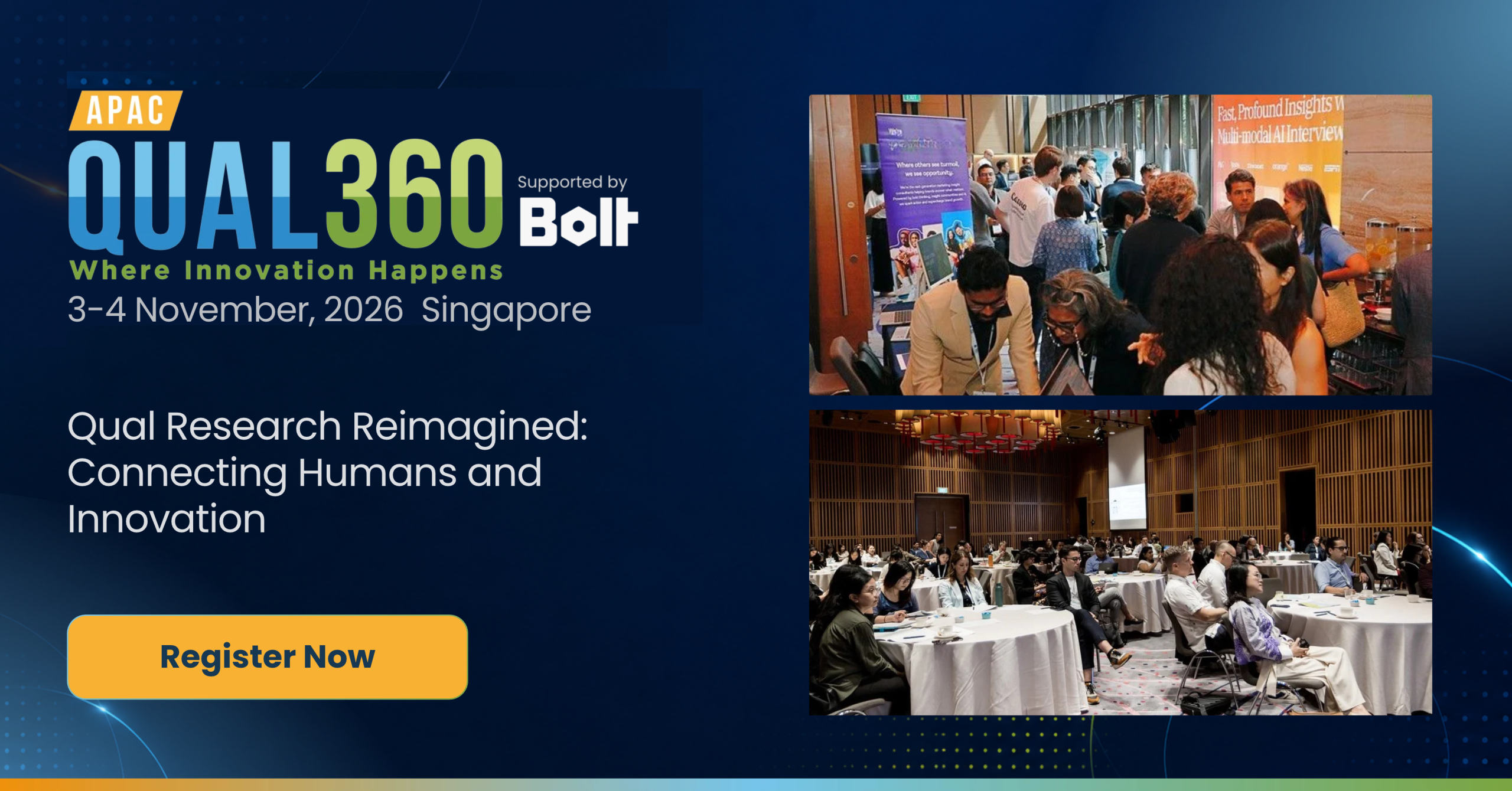
Explore QUAL360 APAC 2026 and register | 3–4 November 2026 | Aloft Singapore Novena, Singapore.