






 by
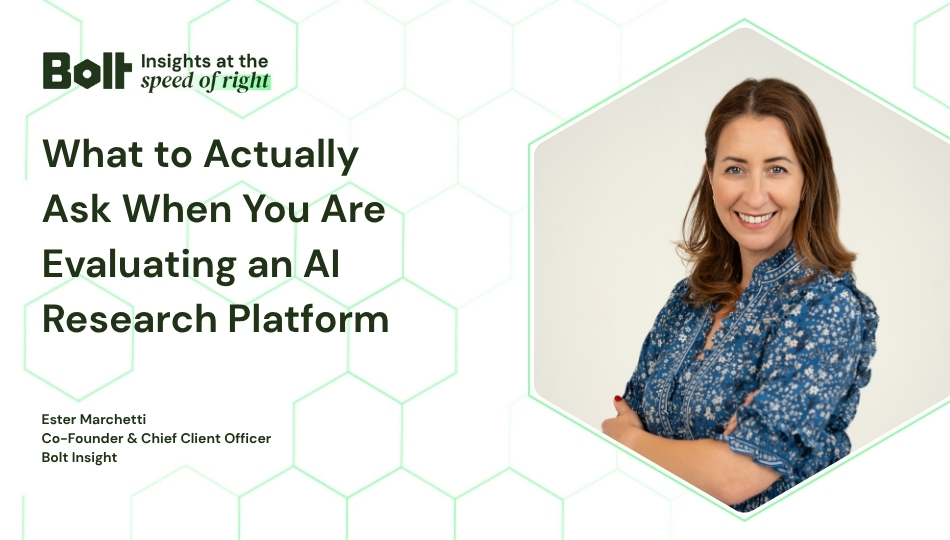
by Ester Marchetti, Co-Founder and Chief Innovation Officer, Bolt Insight
The AI research platform market has got very noisy, very quickly. New entrants arrive every month, each one promising smarter moderation, faster turnaround and insight at a scale that was not possible before.
Most of the conversation focuses on speed and price. Those things matter, but they are not the right starting point. The question that actually matters is whether a platform makes researchers better at their jobs. That is considerably harder to get right than being fast or cheap.
Having built Bolt Intelligence from the ground up, here are the five questions I would put to any platform before trusting it with real research.
Is the AI actually doing research, or just automating it?
This distinction matters more than most platform demos would have you believe. An AI that automates moderation follows a predetermined path. An AI trained to think like a researcher knows when to push, when to hold back and when to follow an unexpected thread rather than the planned one.
The 2026 AI in Consumer Insight report from Asia Research Media found that 95% of industry stakeholders have observed technical errors in AI outputs, with hallucinations the most frequently cited problem. That number reflects what happens when automation is mistaken for intelligence. The platforms contributing to it are the ones where research thinking was not embedded in the AI from the start.
Are you limiting how people respond, or giving them real choice?
Text-only research is a design choice that feels neutral but is not. When you constrain how respondents can answer, you constrain what they feel able to share. Some things are easier to show than describe. Some emotions are harder to fake on video than in a text box.
The platforms worth looking at in 2026 allow respondents to engage via text, audio, video and images. AI probing tools currently sit at 44% adoption but are projected to reach 67% in the near term as the industry recognises that adaptive, multimodal engagement simply produces better data. Giving people genuine choice over how they respond makes research more comfortable and more honest.
Is global research built for the world, or just translated for it?
There is a version of global research that is really just one study with the language swapped out. Cultural context, the social norms, the local reference points, the things that shape what people actually mean when they say something, do not travel with a translation.
The same 2026 Asia Research Media report found that 32% of research stakeholders specifically cite cultural insensitivity as a drawback of AI, pointing to outputs that are linguistically accurate but contextually wrong. If a platform cannot demonstrate genuine cross-cultural depth rather than just multilingual capability, that is worth probing before you commit.
Have they actually solved the speed versus quality trade-off, or just picked a side?
Speed is no longer a differentiator. Every AI research platform is fast. The platforms that matter are the ones that have figured out how to be fast without becoming shallow.
47% of stakeholders expect AI-powered quality control to be the single biggest growth area in AI research applications over the next two years. The most effective implementations catch quality problems during fieldwork rather than after the debrief, monitoring conversations in real time and flagging low-quality responses before they contaminate the analysis layer. That changes what quality assurance actually means in practice.
Does your research build on itself, or does every project start from scratch?
This is the question most research buyers have not thought to ask, and it might be the most important one on the list.
Research that lives in separate decks, commissioned by different teams at different times for different purposes, is working against itself. Every study that does not connect to the ones before it is leaving intelligence on the table. 49% of research professionals cite getting more value from existing research as a top benefit of AI. The platforms that actually deliver on that benefit are the ones where findings from one study feed into the next, where audience understanding deepens over time rather than resetting with every new brief, and where the intelligence a team builds is genuinely cumulative.
Meta-analysis across studies, dynamic audience models that update as understanding grows, and AI that works continuously in the background rather than only when a new project is commissioned… that is what compounding intelligence actually looks like in practice.
The right platform is not the one with the most features. It is the one that makes your research more powerful, your findings more defensible, and your understanding of consumers more connected over time.
Sources
Asia Research Media, AI in Consumer Insight 2026
Beyond the AI Research Platform: Human Context at MRMW Europe 2026
Evaluating an AI research platform is not only about technology—it is also about how that technology supports more thoughtful, human-centred research. See how Bolt Insight brings this perspective to life at MRMW Europe 2026.
Join Gabriela Carazato, General Manager Europe at Bolt Insight, alongside Fernando Cobos, for “The Ripple Effect: GLP-1, Permission, and the Taboos Women Are Rewriting”.
The session will explore how researchers can approach sensitive subjects with greater empathy, create space for honest conversations, and capture women’s experiences across different life stages.
📅 MRMW Europe 2026 | October 21–22 | Berlin, Germany
Explore the MRMW Europe 2026 agenda →
Discover more sessions at MRMW Europe 2026:
- From insight to impact: how eBay makes insight matter — Tanya Ozuns & Emilia Torres, eBay
- Globally wired, locally tuned: rewiring agile insights — Stefania Accardo, De’Longhi Group
- Geopolitical risk in market research — Martina Bozadzhieva, Oxford Economics
- Content discovery research: why the single-touchpoint model no longer works — Iva Kralj-Taylor, Warner Bros. Discovery