






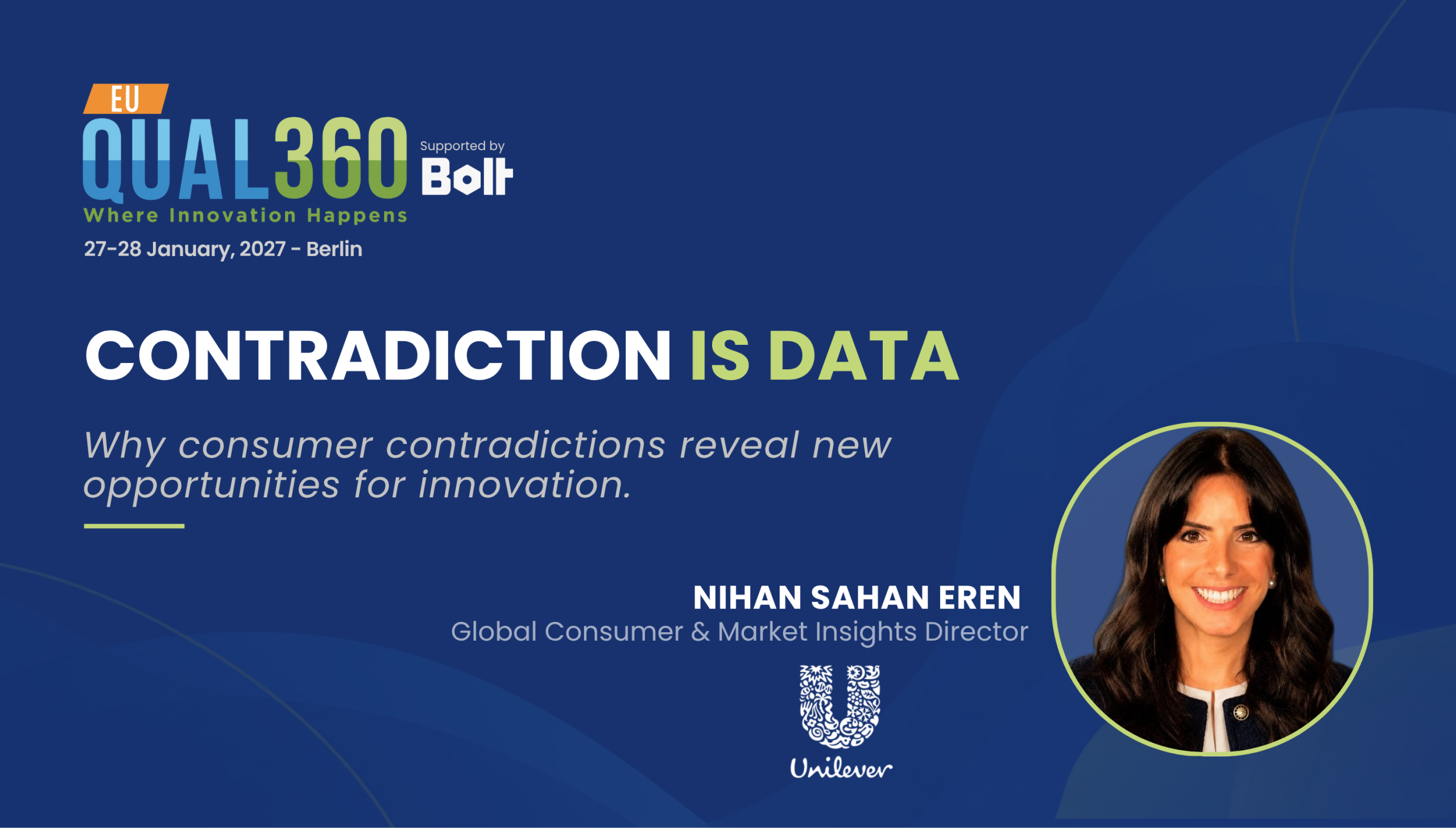
Most research is designed to find consistent answers. Nihan Sahan Eren, Global Consumer and Market Insight Director at Unilever Food Solutions, is more interested in the inconsistencies. Ahead of her QUAL360 Europe 2027 session, The World of AND, she explains why contradictions in qualitative research often point to the opportunities businesses miss, how understanding chefs can change an innovation brief, and why AI makes human judgement more valuable, not less.

Global Consumer and Market Insight Director
Unilever Food Solutions · Unilever
The World of AND: contradictions in qualitative research
For decades, businesses have asked people to choose. Healthy OR tasty. Affordable OR high quality. Human OR machine.
But what if the next era of growth isn’t about offering more choices, but about removing the need to choose?
My session, The World of AND, explores a shift from accepting contradictions as limitations to recognising them as opportunities for innovation.
And I believe qualitative research has a particularly important role to play in this shift. Because the most interesting human truths are rarely found in perfectly consistent answers. They often hide in contradictions.
If delegates remember one thing, I hope it is this: OR helps us understand the choices people make today. AND challenges us to imagine the possibilities they don’t yet have.
And perhaps the future of insight belongs to those who are curious enough to question the compromises everyone else has accepted.
AI makes better questions more valuable
AI is teaching me something fascinating about human intelligence: perhaps our greatest advantage was never our ability to process information, but our ability to give it meaning.
AI can identify patterns, connect seemingly unrelated ideas and generate possibilities at a speed we could never match. But it also exposes a fundamental distinction between recognising a pattern and understanding why that pattern matters.
For researchers, this raises an uncomfortable question: if AI can increasingly do what we have traditionally called analysis, what is the uniquely human value we bring?
I believe the answer lies in curiosity, empathy, cultural intuition and judgement. In recognising when an apparently logical answer misses something profoundly human.
AI is making answers cheaper. That should make better questions more valuable.
The biggest lesson is that we should stop competing with machines on what they do best and start investing in what makes human understanding irreplaceable.
When understanding chefs changes the innovation brief
One example comes from the world of professional kitchens, where we work closely with chefs.
A conventional business question might be: how can we help chefs become more efficient?
But when you understand the reality of a professional kitchen, the question becomes much richer. Chefs are not simply looking for speed. They want efficiency without sacrificing creativity, consistency without losing authenticity, and convenience without compromising their professional pride.
Suddenly, the opportunity is not simply to make cooking faster. It is to give chefs more freedom to create without adding complexity to their kitchens.
That is a very different innovation brief.
For me, this illustrates why qualitative understanding matters. It helps us move beyond the functional problem to the human tension underneath it.
Sometimes the most valuable outcome of research is not a better answer to the business question. It is discovering that the business was asking the wrong question.
When is qualitative evidence strong enough to act on?
I don’t believe the strength of qualitative evidence should be judged by how many people repeat the same thing.
Sometimes the most revealing insight comes from the person who disagrees with everyone else.
For me, strong qualitative evidence has three characteristics: it reveals a meaningful human truth, explains behaviour rather than simply describing opinions, and has the potential to change a decision.
I also look for coherence across different contexts, and whether we have seriously explored alternative explanations.
When the insight is interesting but its relevance, prevalence or commercial implications remain uncertain, that is when I bring in other evidence, behavioural data, quantitative research or experimentation.
And the level of evidence should always reflect the consequences of the decision. A reversible experiment and a major investment do not require the same certainty.
Research should not eliminate uncertainty. It should help businesses make better decisions in the presence of uncertainty.
The Da Vinci mindset: skills beyond the next research tool
I would put intellectual curiosity, critical thinking, cultural intelligence, creativity and courage at the top of the list.
Curiosity to ask questions nobody has thought to ask. Critical thinking to challenge even the most convincing AI-generated conclusions. Cultural intelligence to understand the meaning behind human behaviour. Creativity to connect insights across disciplines. And courage to challenge a business assumption when the evidence tells a different story.
I am particularly interested in what I call the Da Vinci mindset: the ability to bring together disciplines that traditionally operated separately.
The future researcher will need to be an anthropologist AND a strategist, a storyteller AND an evidence challenger, a technology enthusiast AND a guardian of human context.
But perhaps the most underrated capability is the courage to say, “I think we are asking the wrong question.”
In a world where everyone has access to intelligence, the differentiator will be what we dare to do with it.
Why speed must not replace human understanding
I think we are in danger of confusing the speed of producing insights with the depth of understanding people.
There is enormous excitement around faster interviews, automated analysis, synthetic respondents and instant summaries. Much of this is genuinely valuable.
But human beings are not always consistent, rational or even fully aware of why they do what they do.
And sometimes our industry’s obsession with finding clear, consistent answers leads us to tidy away the very contradictions that make people interesting.
Someone can care deeply about sustainability and still prioritise convenience. Want healthier food and refuse to compromise on indulgence. Value authenticity and embrace technology.
These are not necessarily research errors to eliminate. They may be the beginning of a breakthrough.
My provocation is simple: contradiction is not noise. Contradiction is data.
We should use technology to make research faster, certainly. But not at the expense of making human beings seem simpler than they really are.
Outside work: curiosity, culture and conversations
I am endlessly curious about what makes us human, particularly in a world increasingly shaped by artificial intelligence.
Outside my corporate role, I write about trust, leadership, culture and the human side of change. I am also fascinated by how different cultures approach the same fundamental questions about life.
Lately, I have been exploring Eastern philosophy, particularly Taoism, and what it can teach us about navigating uncertainty without constantly trying to control everything.
I love conversations that challenge my worldview, and I genuinely believe we become wiser by learning from lives we haven’t lived ourselves.
So come and talk to me about philosophy, culture, the future of humanity, the books that changed your thinking, or even the contradictions you are still trying to make peace with.
I promise not to turn every conversation into a research interview. Although I cannot guarantee I won’t ask why!
Nihan’s reading and listening recommendations
Books, podcasts and music recommended by Nihan:
In your ears — Podcast
Insights & Innovators — MRII
Insights & Innovators Podcast
A great way to stay connected to the changing world of insights and the people pushing our industry forward.
And a personal favourite: Nasıl Olunur? — Nilay Örnek
A Turkish podcast where journalist Nilay Örnek explores the lives, experiences and journeys of fascinating people from culture, arts and many other fields.
I have a simple belief: life is too short to learn everything through our own mistakes. Learning from other people’s experiences is one of the smartest shortcuts to wisdom.
That’s why I love this series. Every conversation feels like borrowing another person’s lifetime of learning.
On your reading list — Book
Everybody Lies: Big Data, New Data, and What the Internet Can Tell Us About Who We Really Are — Seth Stephens-Davidowitz
A fascinating reminder that what people say, what they believe and what they actually do are not always the same thing.
It challenges our assumptions about truth, social desirability and the limits of traditional questioning. For anyone working in insights, it is an invitation to become more curious about what remains unsaid.
My current philosophical exploration: Tao Te Ching — Lao Tzu
I am increasingly interested in Eastern philosophy, particularly the Taoist concept of Wu Wei often understood as effortless or non-forcing action.
What fascinates me is the idea that strength does not always come from control. Sometimes it comes from flexibility, knowing when to act and when to allow things to unfold.
In a world obsessed with acceleration, optimisation and control, that feels almost revolutionary.
Working / thinking / inspiration track — Song
Training Season — Dua Lipa
I could give you a deeply intellectual answer here, but I am also a proud follower of popular culture!
Training Season is one of my favourite push-harder tracks at the gym. Great energy, great rhythm, and just the right attitude for those moments when you need to push yourself a little further.
Apparently, even my playlist lives in the World of AND: philosophy AND pop music, reflection AND a good workout!
Join Nihan Sahan Eren at QUAL360 Europe 2027
Nihan will present “The World of AND: Why the Future Belongs to Those Who Stop Forcing People to Choose” at QUAL360 Europe 2027 in Berlin. Explore the official QUAL360 Europe programme for details.
Explore QUAL360 Europe 2027 and register | 27–28 January 2027 | Berlin, Germany.
For another QUAL360 Europe speaker perspective, read Íñigo García Alcalde’s interview on AI in qualitative research at PepsiCo.