








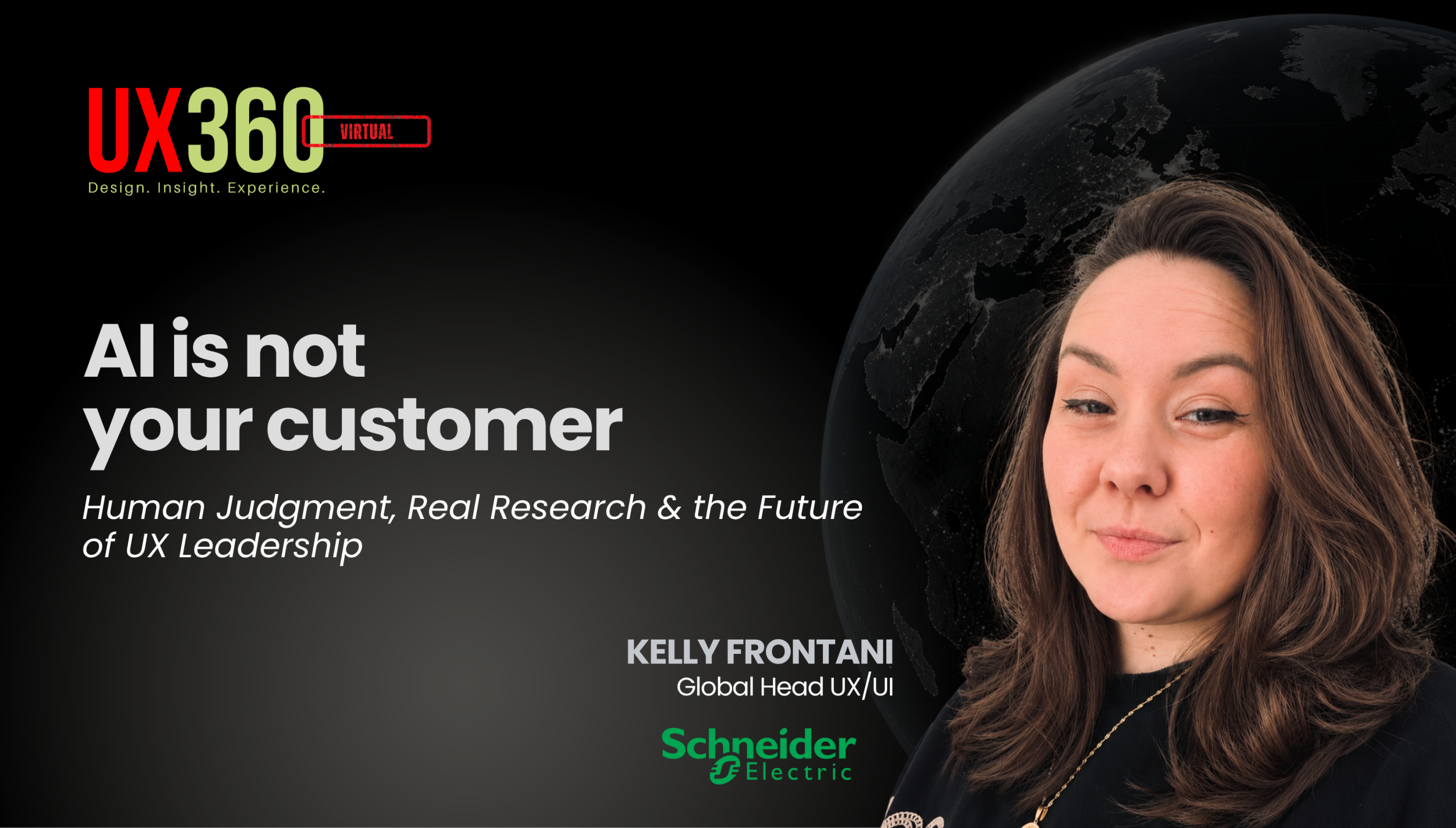
AI in UX research raises a practical question: when technology can analyse information faster, what should still depend on human judgment and conversations with real customers?
For Kelly Frontani, Global Head UX/UI at Schneider Electric, AI can support research and design teams without replacing the people at the centre of their work. In an interview with Merlien Institute ahead of UX360 Virtual Summit 2027, Kelly discusses where AI helps, why UX should influence business roadmaps, and what organisations risk losing when they stop talking to actual customers.
The conversation also looks at leadership, candid exchanges with peers and the lessons Kelly finds beyond professional reading. The excerpts below are drawn from the supplied interview transcript, lightly edited for readability.

Global Head UX/UI
Schneider Electric
Watch the interview: Kelly Frontani on AI and UX research
Watch the full interview directly on YouTube.
People first: making AI useful for the people adopting it
Asked what she hopes delegates will take away from her panel discussion, Kelly begins not with a technology or a feature but with the people expected to use it. For her, successful adoption includes confidence, understanding and room to ask questions.
What we see a lot is that a lot of people are talking about AI, about the technology, about things that are changing. But my view is always people first, right? My first question wouldn’t necessarily be, “How should we use AI?” It would be, “How do we motivate people to use it in the right way? And how do we make them comfortable if they have questions, if they don’t understand it?” So everything, for me, always comes from the people side first.
Why UX needs to help build the business roadmap
The discussion then turns to the position of UX within organisations. Kelly describes a shift away from treating UX and content as separate teams that receive instructions after decisions have already been made. The alternative is to involve UX in deciding which problems and priorities the business should pursue.
What I’ve been trying to change, within Schneider but also, I think, industry-wide, is that we should be more integrated within the business. It’s very cliché to say, “Oh, we need to have a seat at the table,” but it really comes down to this: we should build the roadmap with the business. What should we be working on? Versus, “Oh, they create the roadmap and they just send it over to us, and we just build it.” We need to be a part of that conversation.
For another view on how UX practices and operating models are evolving, read our interview with Bhu Nyström-Kandola on AI, leadership and change.
AI in UX research: benchmarking and the work around the work
Kelly identifies practical ways AI can reduce effort around a project. Instead of handing the core design decisions to a model, she points to activities such as benchmarking, processing performance data and summarising findings for the business.
Where I see AI helping us is with all of the work around the work. AI can help us with benchmarking. It can help us process performance data that we get in raw Excel files or something. We can throw it in there and say, “Okay, what are the highlights? What’s working well? What’s not working well?”
But her distinction between assistance and decision-making is deliberate. She wants outputs checked rather than simply accepted, even when AI seems to offer a plausible direction.
And I’ve purposely chosen to stay away from having AI design for us because I still feel like this is very much a human thing. You should always validate what an AI is telling you, whether it’s benchmarking or design or anything else. In my view, an AI can give you direction, but it cannot make the actual decision for you.
AI is not your customer: the limits of automated UX research
One of the clearest boundaries in the interview concerns customer testing. Kelly warns against treating information produced by AI as equivalent to research with the people who actually buy or use a product. What appears in online information is not necessarily what an organisation’s own customers would say.
I think everybody is really trying and finding their way right now. What should we do with AI? What shouldn’t we do? I think the biggest trap we shouldn’t fall into is thinking that AI can replace our actual customer when we’re testing, right?
Even if we’re benchmarking with AI, it’s telling us what it can find on the web. We’re not actually talking to our customers, and that’s going to be different for every company, for every industry. We still need to talk to the actual customer.
I think this is where I’m being super conscious: “Okay, let’s use it where we should, but let’s not automate everything,” because we shouldn’t lose that connection to our actual buyer.
For a related perspective on which established practices deserve to be challenged, explore our interview with Jen Blatz on UX research rules worth breaking.
Why honest peer conversations matter more than polished slides
Asked what she most looks forward to at UX360 Virtual, Kelly highlights the value of exchanging uncertainties and experiences with other practitioners. Rather than a perfectly rehearsed answer, she is interested in what peers have actually learned while facing similar challenges.
Having those honest conversations with people is what truly makes it valuable for me, because that’s not something you can prep in a nice slide, in a nice deck, you know? So I’m very much looking forward to it.
Leadership lessons beyond work: reading fantasy fiction
Kelly closes on a more personal note. Rather than recommending another UX or leadership podcast, she explains why she has been choosing fiction and finding familiar leadership themes in stories outside her working day.
So I’ve started to read fantasy books. I’m currently reading the Throne of Glass series. But it’s funny because even in those fiction stories, you can still see things coming through: leadership, inspiring people, delegating, all of that.
Join Kelly Frontani at UX360 Virtual 2027
Kelly will participate in the panel Reimagining UX Career Growth: From Discipline History to Cross-Functional Leadership at UX360 Virtual Summit 2027.
The published programme explores how UX roles and skills have evolved, how leadership extends beyond craft and how practitioners can demonstrate their strategic contribution across disciplines. These are programme themes, not additional quotations attributed to Kelly.
The panel also features Bhu Nyström-Kandola (Volvo Cars), Nyssa Packard (Skyscanner) and James Lang (YouTube), with Gavin Johnston (Hyatt Hotels Corporation) as moderator.
Panel: Reimagining UX Career Growth: From Discipline History to Cross-Functional Leadership
Panellist: Kelly Frontani, Schneider Electric
Date: Wednesday, 3 February 2027
Format: Online panel discussion
Taking place online on 3–4 February 2027, UX360 Virtual brings together UX researchers, designers and leaders to discuss research practices, emerging technology and the future of the profession.
Explore UX360 Virtual Summit 2027