







 by
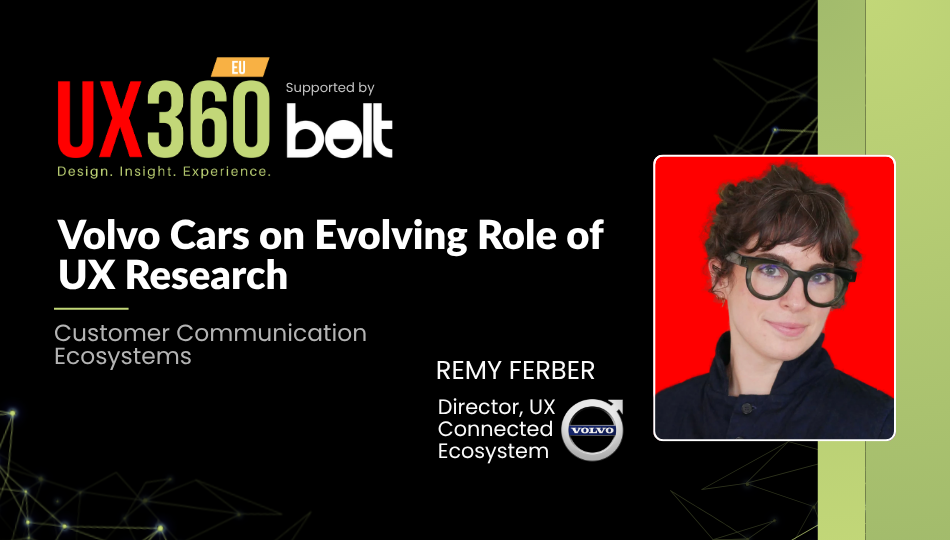
by Volvo Cars on Evolving Role of UX Research in Customer Communication Ecosystems

Customers no longer experience brands through isolated products or channels. They move across apps, devices, notifications, support interactions, marketing communications, and connected services — often within the same journey. As these ecosystems become more complex, the challenge for UX is shifting from designing interfaces to designing continuity.
At Volvo Cars, Remy Ferber, Director, UX Connected Ecosystem, believes customer communication is no longer separate from the product experience. Increasingly, it is the experience. As organisations evolve towards connected ecosystems and direct-to-consumer relationships, UX teams are being pushed into a far more strategic role: orchestrating coherence across fragmented customer journeys.
Watch the full conversation:

Beyond the interface
The traditional boundary between “the product” and “customer communication” is disappearing. Historically, UX teams have traditionally focused on optimising what happens inside interfaces, while communication has lived elsewhere — in marketing systems, lifecycle campaigns, support operations, or CRM workflows. As Remy puts it, customer communication is becoming “an inherent implicit part of the user experience.”
The problem is that most organisations are still structured around ownership rather than continuity. Internally, every touchpoint belongs to a different team. Externally, customers only experience the result – whether the journey feels coherent or fragmented. That gap is increasingly a UX challenge.
From design execution to orchestration
What makes this shift particularly important is that it changes the role of UX itself. UX teams are being pulled into conversations traditionally owned by CX, marketing, product, and commercial functions:
What is the right moment to communicate?
Which channel creates the right value exchange?
How should experiences adapt across devices and contexts?
What does consistency actually mean across a multi-product ecosystem?
“These are the kinds of conversations,” Remy suggests, “where UX can help make sure that what we’re presenting to end users feels like it was thought from the outside in, not the inside out.”
These are no longer simply communication questions. They are orchestration problems.
And unlike traditional UX work, they cannot be solved inside a single interface. They require alignment across systems, teams, and operational silos — positioning UX less as a delivery function and increasingly as a connective layer across the organisation.
A broader mandate for UX
From Remy’s perspective, the evolution of UX is not necessarily about expanding into entirely new disciplines, but about operating more fluidly across them.
As the boundaries between teams become less rigid, UX is increasingly expected to contribute beyond execution alone — framing problems more strategically, bringing a stronger cross-functional perspective, and helping define experience quality across increasingly connected environments. As a result, the strategic value of UX comes less from ownership of interfaces and more from its ability to create alignment across experiences.
Making UX Research Count at the Decision Level
For UX and research leaders, the focus is shifting from delivery to influence—ensuring insights shape decisions, not just inform them.
UX360 Europe 2026 brings together senior leaders working at that level. This is where leading organisations apply research to guide product strategy, examine case studies grounded in execution, and gain frameworks that link UX work directly to measurable business outcomes.
Connect with peers facing similar challenges and learn innovative methods and cutting-edge strategies from DHL, Google, Airbus, Mastercard, Volvo Cars, and more.
If you work in or with UX, research, or product teams, this is directly relevant to your role.
 UX360 Europe 2026 | June 23–24 | Berlin, Germany
 Regular Rate Ends May 23 — register now.