






 by
by MRMW MENA 2025 — A Social Media Review
Where AI, Empathy, and Cultural Intelligence Redefined the Future of Insights
MRMW MENA 2025 in Dubai brought together some of the most influential voices shaping the future of market research, UX, CX, and consumer strategy across the region — and far beyond it. Leaders from global brands like The Estée Lauder, Unilever, Givaudan, Careem (Uber), Standard Chartered Ventures, Mashreq Al-Arabi Bank, and more, joined founders, academics, and innovation leaders to explore one urgent question:
How do we scale insight, speed, and AI—without losing the human core of our work?
Across two packed days, the conversations went far beyond tools and trends. What emerged instead was a more mature, grounded dialogue about responsibility, cultural nuance, empathy, and the real-world complexity of applying AI inside large, messy organizations.
1. AI Is Everywhere — But Empathy Is the Differentiator
AI was impossible to ignore at MRMW MENA, but what stood out was how thoughtfully it was discussed. Rather than treating AI as a silver bullet, speakers emphasized that it must be anchored in human understanding, cultural context, and ethical judgment.
Pedro Aguilar Domínguez from The Estée Lauder Companies shared his perspective on CRM transformation in the Middle East, highlighting the importance of local relevance and genuine consumer connection. His reflections, reinforced a core truth:
Speed is meaningless if insight can’t be acted on. Cultural understanding isn’t a nice-to-have — it’s the foundation of trust.
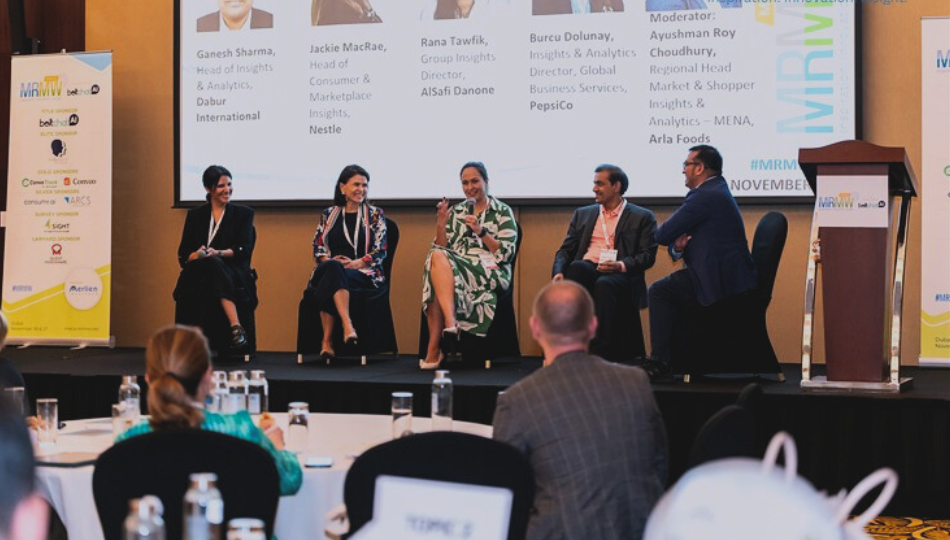
Karishma Makhijaney from Unilever led a panel on operationalizing AI in market research, framing the conversation around three critical pillars — speed, skill, and safeguards — as noted in her social media post.
The broader takeaway was clear:
AI isn’t replacing research teams — it’s raising the bar. Organizations that combine automation with human judgment, storytelling, and ethical discernment are the ones gaining real competitive advantage.
As shared by Dr Asma A. Qureshi, one of the audience reflections came from Parvati Mahadev:
“If humans become redundant, then AI becomes redundant too — because no one will be left to buy the products it powers.”
2. Cultural Intelligence Is Not a Constraint — It’s a Growth Strategy
Across sessions, a recurring theme was the need to avoid “copy-paste” global strategies. Adoption doesn’t scale if culture is ignored.
Rowan Salama, Lead Product Researcher at Careem (Uber), shared her experience scaling research across multiple markets, emphasizing the importance of local nuance and maintaining rigor while democratizing access. This was echoed in her social media reflections.
In the reflection shared by Dr Asma A. Qureshi, Amanda Cano from Mashreq Al-Arabi Bank reinforced the importance of localisation in research — not just to build trust, but to create digital experiences that truly resonate with people.
Together, these insights pointed to a simple truth:
research must meet people where they are — culturally, digitally, and experientially.
3. Leadership, Collaboration & Community Fuel Insights
The conference also demonstrated how human networks, mentorship, and collaboration amplify insight impact.
Rafik Boshra of Givaudan showcased “The Taste of Feelings,” connecting sensory attributes with emotions to drive holistic experiences. Karishma Makhijaney highlighted how panelists and peers catalyzed meaningful discussions on the future of AI-powered research.
The vast majority of the social media posts summingup MRMW MENA underscored a common theme: the people behind the insights are as important as the insights themselves.
4. Human-Centric Metrics & Actionable Insights
Ankesh Agarwal, CCXP, shared how his teams ensure insights lead to action, not just reports, through centralised hubs, bite-sized formats, and real-time distribution. Meanwhile, Richa Gupta reflected on how empathy and human understanding shape better products and stronger teams. These insights collectively pointed to a simple but vital principle:
data is powerful, but only when interpreted, contextualized, and applied by humans.
5. Smart Listening & Cultural Context — The Human Core of Insights
While technology and AI dominated many discussions, several speakers reminded the audience that insight is ultimately human. Empathy, context, and cultural understanding are irreplaceable.
Richa Gupta emphasized that truly understanding people goes beyond segments or personas — every voice, story, and lived experience shapes better decisions and stronger organizations.
Rafik Boshra showcased how sensory research can tap into subconscious emotions, creating experiences that are both emotionally rich and actionable for brands. These presentations highlighted that while AI can accelerate insights, human judgment and contextual interpretation remain the guiding force.
What MRMW MENA Signals for the Region
MRMW MENA 2025 made one thing unmistakably clear: the region is not “catching up” — it is actively shaping the future of insights.
From conversations about AI governance and cultural nuance to debates on empathy, democratization, and decision velocity, this was not a conference about tools. It was a conference about responsibility.
Responsibility to:
• Design for real humans, not abstract users
• Respect cultural context
• Challenge automated outputs
• Translate insight into action
• Preserve meaning in a world of speed
What made this edition truly special wasn’t just the content — it was the community. Market researchers, insight professionals, strategists, product leaders, and CX professionals came together to share success stories, how to deal with uncertainty, lessons, and lived experiences.
And in a world increasingly shaped by automation, that may be the most human — and most strategic — advantage of all.