








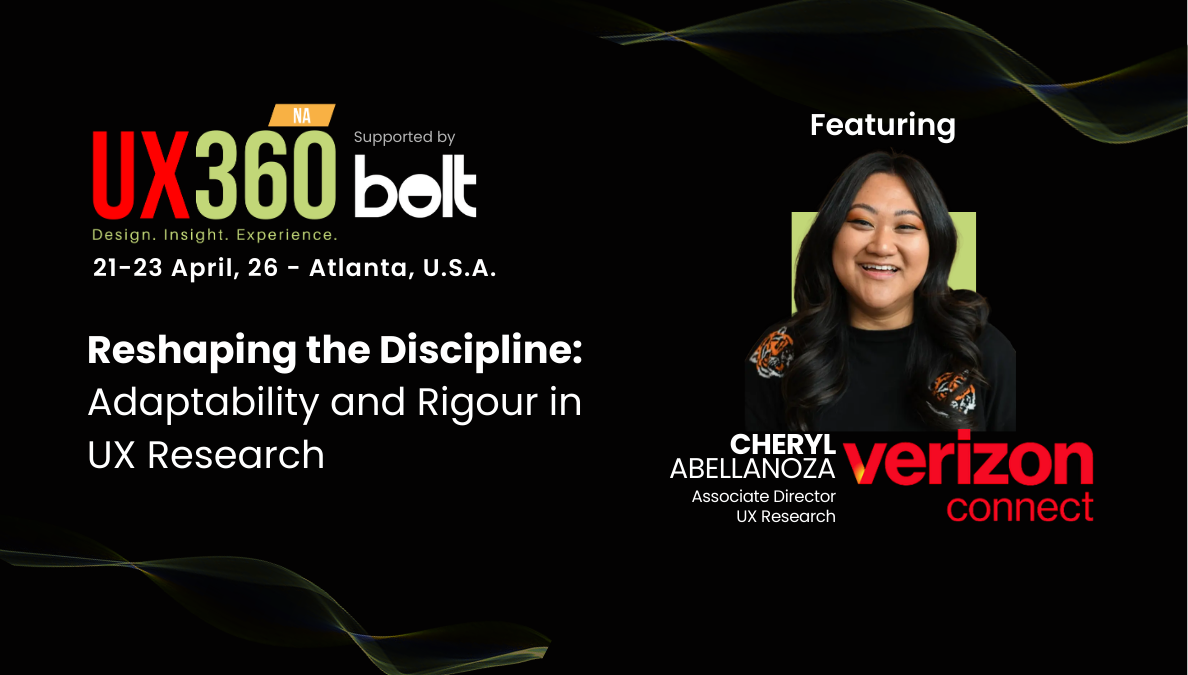
Reshaping the Discipline: Adaptability and Rigour in UX Research
UX as a discipline is evolving — not disappearing, not being replaced, but reshaping itself in response to new tools, new expectations, and new organizational realities. As teams grapple with AI, shifting maturity models, and the growing demand to prove impact, UX researchers are being asked to adapt faster than ever before.
In the lead-up to UX360 North America 2026— the inaugural gathering of UXers in the U.S.A. — we spoke with Cheryl Abellanoza, Associate Director of UX Research at Verizon Connect, to hear how researchers and designers navigate change and lead with impact.
Watch the full conversation to hear Cheryl’s perspective on the current state of UX research, the unseen rigor behind research work, and how UX professionals can speak the language of the business—without losing sight of the people they serve.
Prefer reading? A full written recap and summary are available below.

For quick reference, we’ve included an AI-assisted summary of the main themes discussed.
UX360: To dive right in — without giving too much away — what’s the key focus of your presentation, and what do you want delegates to take away from it?
Cheryl: We’re having really important conversations right now about how UX is evolving, while also recognizing that some elements of UX will always remain foundational pillars of the discipline. I’ll be talking about what I’ve learned around UX research maturity models, and how teams grow and evolve over time.
I’ll also explore how we’re using different kinds of tools — not just within UX, but beyond it — to do different kinds of work. That combination of maturity, tools, and adaptability is really what I’ll be focusing on in Atlanta.
UX360: And AI is obviously part of that broader conversation. How would you describe the current state of UX research, and where do you see it going in the next year or two?
Cheryl: A metaphor that comes to mind is healthcare.
You go to a general doctor first, but when something needs a targeted approach, you’re referred to a specialist. I think UX is collectively having that same conversation right now.
Many teams are being reorganized or given new “north stars” to help organizations implement UX practices at scale. They may call it different things, but at the heart of it, it’s still UX — championing the people we serve.
The names may change, but UX researchers will continue to be specialists providing targeted help. I’ve had great advice from mentors along the way. One colleague, Paul Boshears, once said:
“What you do at work is often not that different from what you do in life.” If you’re a UX researcher at heart, that mindset follows you everywhere.
Another mentor, April Durett, once told me: “Your superpower is adaptability. Use it.” And I think that really captures what we’re facing now.
UX360: You’ve been in the industry for a while and at Verizon Connect for over eight years. How did you originally get into UX, and how has your perspective changed over time?
Cheryl: I often joke with my team that we’re the “island of misfit toys.” None of us came into UX the same way. I came from an academic background — I studied cognitive psychology and neuroscience and thought I’d become a therapist, counselor, or psychometrician.
During grad school, I realized I missed talking to people. I’d spent time doing one-on-one interviews in therapy settings, and then long hours in labs running fMRIs. UX brought those worlds together. When I started, I was combining a lot of eclectic ideas.
After more than eight years in the field, I see that everyone is doing something similar. We all come from different foundational principles that help us make sense of the world, and we bring those perspectives into different roles — UX, product, engineering — all working toward the same goal: creating better experiences for users.
UX360: You’re also a founding instructor at the UXR Institute, which is led by Leo Hoar, PhD, so teaching clearly remains important to you.
Cheryl: Absolutely. I’m a lifelong learner and a lifelong teacher. Our goal is to bridge that information to application: our courses help students, especially research-teams-of-1, learn vital info that they can bring directly to their day-to-day!
UX360: On a more personal note — what’s your biggest UX pet peeve, and how do you deal with it?
Cheryl:
I think the biggest one is the feeling that UX has to fight for a seat at the table.
Many of us have felt left out of conversations at one point or another.
But at the same time, those conversations are often about things UX can make better.
So I’ve reframed it:
instead of being left out, people are often looking to us to be the experts.
My focus now is on learning how to translate our work — how to speak different languages so our insights land with different audiences.
UX360: That ties nicely into a big theme at UX360 — speaking the language of the business. Following on from that, what’s one thing non-researchers should better understand about UX research?
Cheryl:
There’s a lot of unseen labor in research.
Before anyone sees a single insight, there’s participant screening, question design, and rigorous planning.
Writing good research questions is a discipline in itself.
That rigor often gets overlooked, but research teams think through every step of a project and every methodological decision.
If non-researchers want to understand UX research better, I’d say:
Get involved. Sit in. Ask questions.
You’ll quickly see how intentional the process really is.
UX360: Finally, we’ve been compiling a UX reading and podcast list. Are there any resources you’d recommend?
Cheryl:
- Lean Product Playbook by Dan Olsen (this was extremely helpful early in my career to learn JTBD and how to integrate my work into the cross-functional team)
- Transformed by Marty Cagan (about the Product Operating Model, and how UX designers and researchers are vital parts!)
- The Expansion Sale by Erik Peterson and Tim Riesterer (teaches how to leverage your customer experience journey and philosophy in order to fight churn and fuel retention).
Discussions like this are exactly why UX360 North America exists.
As UX continues to evolve — shaped by AI, organizational change, and increasing expectations for impact — the need for thoughtful, experience-driven conversations has never been greater.
UX360 NA 2026 brings together practitioners, leaders, and educators to explore not just what is changing in UX, but how we adapt without losing sight of the people we serve.
By bringing voices like Cheryl Abellanoza’s, UX360 highlights the real UX challenges — from building organizational influence to translating research into business decisions — and provides practical guidance.
📍 Join us at UX360 North America 2026 | Atlanta, Georgia, U.S.A | April 21–23. This is a chance to gain hands-on insights from UX research peers, learn cutting-edge techniques and gather skills that will matter tomorrow.
Register today before conference seats sell out!