






 by
by The Human Spark
Why human understanding becomes the competitive edge in AI-driven marketing
By Tom De Ruyck, Chief Growth Officer at Human8 and Katia Pallini, Marketing Director at Human8
2025 marked a tipping point. It is the year AI stopped being experimental and became operational at scale, amplifying everything from consumer expectations to brand capabilities. Across industries and touchpoints, AI has moved from pilots to practice. TIME even named the ‘architects of AI’ as Persons of the Year 2025, underscoring just how deeply this technology is reshaping our world.
Yet as AI transforms marketing, it also comes with a risk. By leaning on existing data and patterns, AI relies on what’s already exists. The result? A growing sea of content, experiences and ideas that are efficient, but increasingly indistinguishable. With that, brands risk sliding into sameness: a loss of distinction, authenticity and ultimately growth. This is also what we found in our 2026 What Matters study, interviewing 13300 consumers from 16 markets, we found that 54% of people believe that from the clothes we wear to the content we consume, everything is starting to feel the same.
The paradox of our time
The world is accelerating through AI, yet on its own, it leads to convergence, not distinction. This paradox sits at the heart of what we found when analysing over 100 CMO interviews across global brands including L’Oréal, Samsung, Nestlé, Unilever and Mars.
CMOs are clear about the value of AI. As Asmita Dubey, Chief Digital and Marketing Officer at L’Oréal puts it: “Now, our marketing is augmented through generative AI”. AI is enhancing speed, efficiency and capability across the marketing function. But those same leaders are equally clear about its limits. As a Nestlé CMO cautions: “If we don’t have humans driving AI in a very strategic manner, then we’re all going to get the same vanilla results, and that’s not good, because differentiation is key to winning in business.”
Brands that aren’t riding the AI wave are missing the boat, yet those that rely on it too heavily risk losing their way. While it can drive short-term gains in efficiency or individual creativity, yet in the long run it can erode brand distinction.
In other words, AI can amplify what brands do, but humans are still crucial in the mix. The brands that will lead the next era of marketing are those that use AI not to replace human judgment, but to elevate it.
Going beyond the algorithm
To thrive in this AI-powered world, brands need more than technological capability.
As pointed out in a recent article in the Wall Street Journal “The AI slop of it all creates so much distrust, and they see that the brands that are winning right now are the ones that are most authentic, human and relatable.”
Based on the CMO interview analysis and working with brands across the globe, we came to understand that this is composed of four important dimensions: community, culture, closeness and creativity.
- Community: from broadcasting to belonging
For too long brands have focused on ‘marketing to consumers’, yet today we see a shift to ‘belonging to people communities’.
People don’t live as isolated individuals, they define themselves through shared interests, values, passions and conversations and expect brands to meet them there.
CMOs describe evolution as “shifting from broadcasting to belonging, attention to connection… It’s about really mattering to people.” As a result, brands are increasingly moving from one-way messaging to fostering two-way relationships, inviting communities into dialogue and co-creation. As Gina Kiroff, Chief Marketing Officer of Knorr explains: “We are really trying to insert ourselves into culture and be part of the conversation and communities that are already happening.”
AI makes this shift even more urgent. As AI accelerates content creation and automates large parts of marketing, messages risk becoming more generic, interchangeable and disposable. In a world flooded with AI-generated output, belonging becomes the new differentiator. Communities are where meaning, trust and cultural relevance are formed, things AI alone cannot manufacture.
For brands tapping into communities, means connecting with what we can label as ‘interested and interesting’ consumers. Far too often brands focus on the masses, the mainstream consumers. Yet if you truly want to understand what matters to people, you need to engage ‘passionate consumers’, the involved enthusiasts – those that have a genuine interest in the topic, stay informed and love to share and exchange ideas.
This is exactly what we observed in a project with Co-op, the UK retailer, on the online community that we have running with the brand. Our goal was to zoom-in a new trend in the health space ‘health unscripted’. To do this, we engaged with both mainstream and passion consumers, which we identified through 12 markers of health. What we found was striking. Not only was there a significant difference in engagement levels, with passionate consumers using 253 words per activity on average, compared to 59 words among mainstream consumers, but the way they talked about health was fundamentally different. Passionate consumers used far more emotional and expressive language, providing more context and meaning.
This shows that if you want to truly understand a topic, uncover cultural nuance and spot opportunities, there is great value in connecting with passionate consumer communities.
- Culture: from observing to participation
Consumer behaviour doesn’t happen in a vacuum. It’s shaped by the context of people’s lives: the codes they live by, the conversations they engage in and the societal shifts they navigate.
Today, CMOs emphasize that brands must actively participate in culture, rather than merely observe it. As Gaurav Datta, Global Vice President of Personal Care at Unilever notes, “Brands that connect authentically with cultural moments can create stronger emotional ties and drive better commerce and media results.” This belief sits at the heart of our yearly ‘What Matters’ report, where together with our cultural experts at Space Doctors we identify the cultural shifts and emerging themes shaping people and brands.
In an age of algorithmic prediction, cultural understanding becomes a strategic advantage. Because while algorithms excel at pattern recognition, culture lives in nuance, contradiction and lived experience, which requires human interpretation to be truly understood.
Understanding culture can take different forms. At a tactical level, it may involve optimisation through semiotic analysis, decoding meaning in communication, packaging or design. At a strategic level, it can drive profound brand transformation.
An example is the work we have done for Barbie. By identifying the deep and often invisible impact of cultural bias on self-belief affecting girls as young as five, we uncovered a powerful opportunity for Barbie to play a meaningful role in helping girls imagine broader futures and break down perceived barriers. Through rich semiotic and cultural analysis across six markets, combined with expert and influencer interviews, we explored the social and cultural forces holding young girls back from reaching their full potential. This work enabled Barbie to reclaim its status as a positive role model, grounded in cultural relevance rather than nostalgia.
- Consumer closeness
Yet human and cultural insights are not enough. Brands often mistake more data for more understanding.
Today, marketers and employees that are highly data-literate, but emotionally less connected with the customers they serve. The rapid technological and societal change is eroding empathy and human connection in business.
Data influences the mind. Yet empathy moves the heart. And it’s the heart that sparks action, creativity and impactful decision-making. Many marketers and senior leaders never see an actual consumer.
To stay relevant, brands and marketers need to break out of the “executive bubble” and engage in real-world sensing to understand the experiences, emotions and realities of real people. This is what we label as ‘consumer closeness’, and can take many shapes from visiting an actual consumer, to engaging in online connect sessions, to socialization initiatives to make employees truly grasp, understand and feel consumer frictions and insights.
For example, L’Oréal’s BeautyTalks program connects thousands of employees with consumers, healthcare professionals, and hairdressers in 29 countries. Since its launch in 2021, over 3,000 stakeholders across 30 entities have participated, achieving a satisfaction score of 4.6/5 and a recommendation score of 8.7/10. As Sandrine Morel, CMI Director, L’Oréal Global Customer Insights, notes: “BeautyTalks brings us closer to markets and drives consumer centricity across L’Oréal.”
AI can amplify, accelerate, and scale marketing like never before. But on its own, it risks generating efficiency without meaning, volume without distinction. What brands increasingly need is the human spark – deep human understanding through closeness, human and cultural insights.
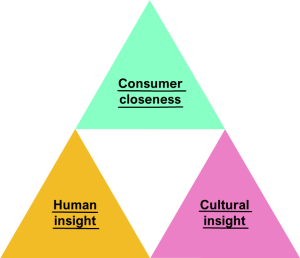
The next era of marketing combines AI’s capability with human judgment: embracing the communities that people find belonging, uncovering the cultural nuance and transforming insight into ideas that inspire, surprise and resonate through consumer empathy. AI can amplify, accelerate and scale these efforts, but it is humans who give them direction, purpose and soul.
- Creativity: from ideas to impact
A last dimension is creativity. It is what fuels differentiation and desire. In a world where attention is scarce, brands are no longer competing just on products or services alone, but on their ability to inspire, surprise and emotionally engage.
As Aude Gandon, Global Chief Marketing and Digital Officer at Nestlé puts it: “Creativity comes first. Absolutely! Today, we are in the entertainment business.”
In an AI-driven world, creativity risks being misunderstood. Generative AI has lowered the barrier to producing content, visuals and ideas at scale, but volume is not the same as originality. When creativity is reduced to recombining existing patterns, it accelerates sameness rather than distinction. The world doesn’t need more random ideas, it needs better ones.
Divergent thinking remains essential. It’s where imagination runs wild, where logic takes a backseat and ideas start to colour outside the lines. AI shines bright here, acting as a creative catalyst. Yet, true creativity emerges when we challenge conventions, reframe problems and imagine futures that do not yet exist. And humans still have important role to play here.
In our work with a global candy company, we compared AI-generated ideation with creative crowdsourcing and internal ideation. The internal workshops showed a tendency toward idea duplication, possibly due to groupthink. By contrast, AI-generated ideas and those from creative crowdsourcing introduced more unique concepts, demonstrating their value in breaking through conventional thinking. Yet AI-generated and crowdsourced ideas sometimes fell outside the brand’s specific product and brand constraints, highlighting the challenge of external perspectives lacking brand context. By combining human intuition with machine-assisted ideation, we increased winning ideas fivefold, a good demonstration of how AI can supercharge, not replace, human creativity.
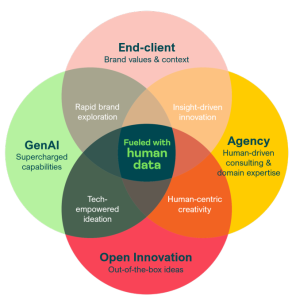
The next era of marketing is about embracing the communities that people find belonging, uncovering the cultural nuance, fostering real consumer closeness and lastly transforming insight into ideas that inspire, surprise and resonate through creativity. AI can amplify, accelerate and scale these efforts, but it is humans who give them direction, purpose and soul. The brands that will thrive are those that don’t compete on efficiency alone, but on distinctive human connection, making deliberate choices about what they stand for, how they show up, and how they co-create with people. In a world where algorithms predict patterns, it is human understanding that differentiates.
The Leading Qualitative Research Gathering is Just Around the Corner!
 Qual360 North America 2026 | March 11–12 | Washington, D.C., USA
Join qualitative leaders from top-tier companies to explore innovative research approaches, discover the latest methodologies, and learn how to leverage new types of insights.
If you’re looking to go deeper ahead of the event, explore our recent article, The Operating Playbook for Qualitative Leaders. It features how Visa, Adobe, DSM-Firmenich and Aylo are embedding AI responsibly, strengthening insight accountability, and elevating research influence across their organizations.
Those same themes will continue at Qual360 North America 2026, where senior qualitative leaders from Amtrak, Warner Bros. Discovery, Marriott International, Nestlé, Amazon and more will gather to exchange strategies and real-world experience. Explore the line-up here.
 Register today to lead the way in insights!