







 by
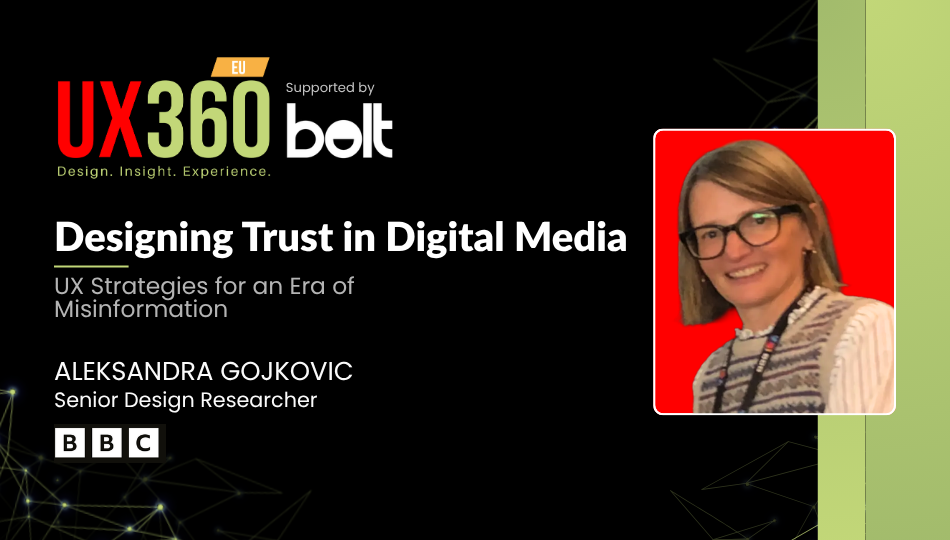
by BBC on Designing Trust in Digital Media: UX Strategies for an Era of Misinformation

As disinformation and AI-generated content increasingly blur the signals audiences rely on to assess credibility, trust in digital news is no longer passively granted—it is actively evaluated.
For UX leaders, this marks a shift from designing for usability alone to addressing credibility, transparency, and user confidence at a systemic level. UX360 Europe 2026 brings this conversation into focus—examining how research and design can respond to increasingly complex information environments.
Aleksandra Gojkovic, Senior Design Researcher at the BBC, approaches this challenge through the lens of behavioural insight and applied research. With nearly two decades of experience, she brings a practical perspective on how UX research and cross-functional collaboration can shape more credible and accountable digital news ecosystems.
UX360: What motivates you to join the UX360 EU 2026, and what is the core message of your talk?
Aleksandra: I’m motivated to join UX360 Europe 2026 because it brings together a community deeply engaged in tackling real-world challenges through UX.
Right now, one of the most pressing challenges is trust—particularly in digital media, where misinformation, disinformation, and AI-generated content are making it increasingly difficult for audiences to distinguish what is real. The core message of my case study is that trust is no longer a given—it must be intentionally designed for. I’ll share how UX research and design can play a critical role in building and sustaining trust in digital news experiences. Drawing on work at the BBC, I explored how behavioural insight, mixed-methods research, and design thinking can translate into tangible product decisions—from interface cues to tone of voice and content provenance.
UX360: How has this impacted your own work and your organisation?
Aleksandra: This work has fundamentally shifted how we approach product and experience design—moving trust from an abstract principle to something we can actively design for, measure, and validate through research.
At an organisational level, this work has:
- Strengthened our cross-functional collaboration across UX, engineering and R&D, ensuring trust is embedded end-to-end.
- Expanded into industry-wide collaboration, particularly around content provenance and authenticity, recognising that trust in media is a collective challenge that no single organisation can solve alone.
- Enabled us to quantify the impact of design decisions on trust.
Importantly, this work has also gained external recognition, being named one of TIME’s Best Innovations of 2024, which reinforced both the urgency and value of designing for trust in today’s information ecosystem.
For my own practice, it has deepened the focus on connecting behavioural insight directly to design outcomes, while also broadening the role of UX—from improving products to contributing to wider societal challenges like misinformation and media literacy.
UX360: How has UX Research and Design as a practice evolved in the last couple of years, and how would you like to see it evolve in the next few?
Aleksandra: Over the last few years, UX Research has evolved into a strategic partnership within organisations. Research is increasingly shaping problem definition, informing product strategy, and guiding decision-making at a higher level.
There’s also been a clear shift toward continuous discovery, with teams moving towards more ongoing, iterative engagements with users. This allows us to stay closer to changing behaviours, expectations, and contexts—particularly important in fast-moving areas like AI and digital media.
Cross-functional collaboration has become essential. The most impactful work happens when UX is deeply embedded within multidisciplinary teams—working closely with product, engineering, editorial, and data—to ensure insights are translated into real-world outcomes.
Going forward, I’d love to see UX continue to evolve into a discipline that addresses complex societal challenges—including misinformation, ethical AI, and digital well-being. I’d like to see UX continue to mature as a discipline that moves beyond optimising experiences, and instead helps shape more responsible, trustworthy, and human digital ecosystems.
UX360: Given this evolution, what are two expected and two less obvious skills UXers should possess, and why?
Aleksandra: As teams shift toward ongoing, iterative engagement with users, UXers need to be comfortable working in continuous discovery environments—constantly learning, adapting, and staying close to evolving user behaviours and expectations. This is especially important in fast-moving, high-uncertainty spaces.
As UX Research has evolved into a more strategic partner within organisations, practitioners must shape problem definition, inform product strategy, and guide decision-making. This requires confidence in combining methods to understand both behaviour and perception, particularly in complex areas like AI and digital media. UXers need to be able to influence and be proficient and impactful storytellers. The ability to communicate research clearly, tell compelling stories, and influence stakeholders is key to embedding UX into decision-making.
UX360: Apart from work, what can delegates at the event talk to you about? Do you have any particular personal interests, hobbies or extracurricular activities and engagements?
Aleksandra: Outside of work, delegates can talk to me about the intersection of technology, media, and society, psychology and human behaviour, the impact of AI on creativity and truth. I’m always up for conversations that connect UX to the wider world. Personal interests include travel, sport and architecture. I am currently trying to complete the London Capital Ring, which is a 130 km walking route around London.
UX360: Last but not least, we are publishing “reading/listening guides” on our blog, can you share your favourite recommendations for inspiration, learning and leadership:
Aleksandra:
Podcasts
- The Media Show (BBC) — great for understanding the evolving media landscape
- The Rest is Entertainment — Richard Osman and Marina Hyde share insider knowledge on TV, movies, and pop culture
Books & Blogs
- Radical Candor — Kim Scott
- Dear Data — Stefanie Posavec and Giorgia Lupi
Making UX Research Count at the Decision Level
For UX and research leaders, the focus is shifting from delivery to influence—ensuring insights shape decisions.
UX360 Europe 2026 brings together senior UX researchers working at that level. Explore how leading organisations apply UX research to guide product strategy, examine case studies grounded in execution, and gain frameworks that link UX work directly to measurable business outcomes.
In her roundtable, “Leveraging UX to Build Trust in the Age of ‘Fakeness’”, Aleksandra Gojkovic, Senior Design Researcher at the BBC, will share practical approaches to designing for trust—showing how research, interface decisions, and content signals can be used to strengthen credibility in digital products.
Join peers facing similar challenges and learn innovative methods and cutting-edge strategies from DHL, Google, Mastercard, Airbus, Volvo Cars, BBC and more, to embed research into decision-making structures.
If you work in or with UX, research, or product teams, this is directly relevant to your role.
 UX360 Europe 2026 | June 23–24 | Berlin, Germany