







 by
by QUAL360 Europe 2026 — A Social Media Review
Where AI, Human Judgment, and Cultural Insight Are Shaping the Future of Qualitative Research
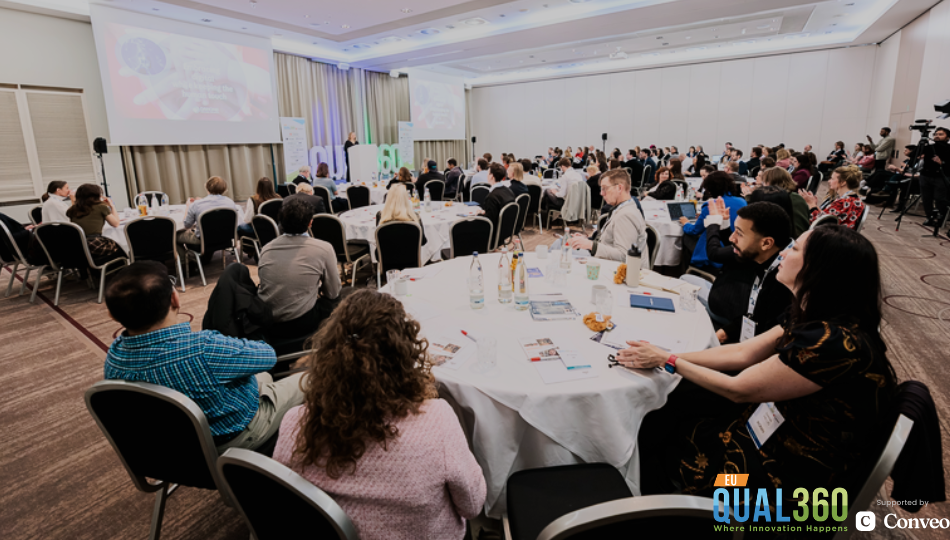
QUAL360 Europe 2026 in Berlin brought together leaders in qualitative research, UX/CX, brand strategy, and innovation. Over two days, participants from brands like Sony Pictures Entertainment, Google, Bayer, Coty, Danone Nutricia, Condé Nast, NatWest, and more explored one core question:
How can we scale insights, leverage AI, and increase speed, without losing the human judgment and cultural sensitivity that define meaningful qualitative research?

Social media posts captured both the energy of the event and the nuanced takeaways, highlighting the trends, debates, and reflections that mattered most to the community.
1. AI as a Tool, Not a Replacement
AI was everywhere in conversation, but what stood out was the focus on human judgment and meaning-making. AI may accelerate pattern detection, yet it cannot replace the human capacity to interpret cultural nuance, probe deeply, or translate insights into action.
Sharon Nyandoro, Global Strategy & Insights – Fragrances Lead at Coty, captured this succinctly:
“AI isn’t replacing qualitative research. But it is exposing where qualitative thinking is strong — and where it isn’t.”
Nathalie Boireau, User Experience Director Specialized Nutrition, Danone Nutricia Research emphasised ethical use: AI should accelerate insights “in partnership with human intelligence, and with a strong awareness of biases”.
The social media takeaway: the future of qualitative research is question-first, AI-enabled, but human-centered.
2. Making Data Usable, Not Just Abundant
A recurring insight across posts was that data alone is not enough. Research teams struggle not with access, but with creating a holistic, actionable picture from fragmented sources.
Tanya Sarakinis, Business Development Director, Redslim, summarised the challenge: connecting behavioral, survey, and commercial data into one coherent story is essential for driving confident decisions.
Discussions highlighted that data harmonisation is a strategic enabler, not a technical checkbox — it frees teams to spend more time interpreting insights rather than wrangling numbers.
3. Scaling Impact Through Focus and Intent
Scaling qualitative research isn’t about producing more output; it’s about prioritising what truly matters.
Lisa Payne, Director of Global Product and Design UX Research, Condé Nast, reflected:
“Scaling isn’t about doing more. It’s about doing the right work, at the right time, with real intention… Being small isn’t a limitation — it’s a condition that forces change.”
Audience reflections reinforced that focused, intentional approaches enable small teams to have disproportionate impact, a lesson echoed in both panels and networking discussions.
4. Community, Collaboration & Cross-Industry Dialogue
The mix of participants — from corporates to independent researchers — was a highlight, creating space for dialogue, debate, and shared learning.
Elana Otero, Research Analyst, D3: Designs, Data, Decisions, noted how rare it was to be in one room with researchers from diverse sectors and exchange perspectives respectfully.
Nils Gründler, UX Management, OTTO, observed that beyond methods, it was the people, conversations, and shared experiences that made the event memorable.

The conference sentiment was clear: collaboration, cross-industry learning, and authentic dialogue are central to driving meaningful insight.
5. The Human Side of AI Adoption
A key theme in a room was that technology adoption is never just about tools — it’s about people and culture.
Linh Slater, Head of Research – Retail Banking, NatWest, shared that teams often struggle not with the tech itself but with adoption, trust, and creating a safe environment for experimentation.
Discussions highlighted that cultivating curiosity, shared learning, and human engagement is the true driver of effective AI integration in qualitative research.

What QUAL360 EU 2026 Signals for the Future
The social media reflections from QUAL360 EU 2026 made things clear:
-
AI enhances insights but cannot replace human judgment or cultural understanding.
-
Data must be actionable, not just abundant.
-
Scaling research is about focus, intention, and priorities, not sheer volume.
-
Community and collaboration amplify insight impact.
-
Adoption of AI requires a human-centric culture, trust, and curiosity.
In a world increasingly shaped by technology and speed, human judgment, empathy, and cultural insight remain the most powerful differentiators — and the event captured that truth vividly.