








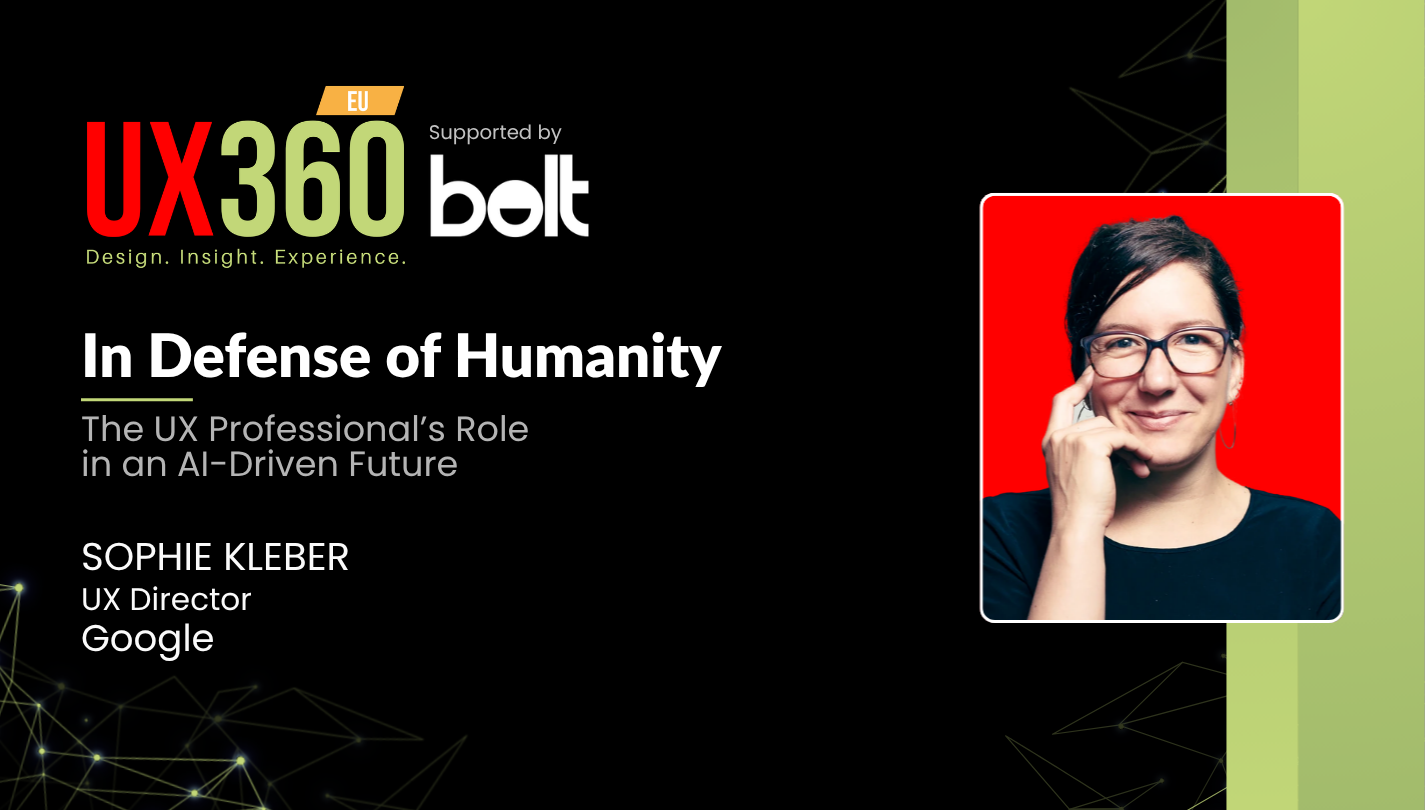
UX Practice in an AI-Driven Future: Extending into Physical Environments

There is a ballet happening in the spaces we move through every day — and most of us never notice it.
The architecture, the people who service the space, the temperature, the lighting, the airflow: when these elements work in sync, something happens to us. We feel better. We function better. We live, as Sophie Kleber puts it, our best lives. When they don’t work together — when a space is poorly designed, when the technology in it ignores the humans moving through it — the effect is equally powerful, and far more damaging.
This is the frontier Sophie has her sights on: user experience that moves off the screen and into the physical world. And it is, she argues, where UX professionals are most urgently needed right now.
Sophie Kleber is UX Director at Google, and she will be joining us as a speaker at UX360 Europe 2026, taking place 23–24 June in Berlin. Ahead of the event, we sat down with her to talk about where UX research is heading, what skills will define the next generation of practitioners, and why the most important work UXers can do right now has little to do with screens at all.
Watch the full conversation:

⚠️ Disclaimer: Everything Sophie states here represents her personal knowledge and opinion only, and does not reflect the views of Google or Alphabet.
From pixels to physical space
Sophie has spent 25 years in UX — long enough to remember debating whether a button should sit on the bottom left or the bottom right of a screen. That era, she says, is effectively over. Graphical user interfaces have been figured out. The standards exist. The conversation has moved on.
What has replaced it is something far more complex: intuitive interfaces that learn human language, conversational agents that don’t require users to adapt to technology at all, and now, anticipatory systems — interfaces that don’t even speak, but that understand what a person needs before they ask.
For UX professionals, this shift raises a fundamental question: what is the value of a UX practitioner when there is no UI to design?
Sophie’s answer is that the value has always been the same — it just needs to be applied somewhere new. “The empathy we have for people, the empathy in defense of humanity” — that phrase, the defense of humanity, is one she returns to more than once in the conversation, and it is not rhetorical. She means it precisely: UXers are the professionals in the room who ask whether a technology actually helps people live better or simply exists because it can.
That question is becoming more urgent, not less, as AI accelerates.
Designing relationships, not interfaces
One of the more striking ideas Sophie raises is the concept of permission in human-machine relationships. As conversational and anticipatory interfaces become the norm, UX designers are increasingly in the business of defining what kind of relationship a product has the right to form with its user.
The stakes are real. A virtual car sales assistant that tries to become your best friend is not just annoying — it is a violation of what the user actually needs from that interaction. A health coaching tool, by contrast, may have far greater permission to be intimate and personal. These are not branding decisions. They are ethical ones. And Sophie is clear about who should be making them.
It is also where she identifies the less obvious skill she believes every UX professional will need in the coming years: a strong ethical compass. Not as an abstract value, but as a practical working tool — the ability to look at what technology can do and ask, seriously and rigorously, whether it should.
The bigger questions ahead
What does it actually look like to conduct user research in a physical space where people move fast, anonymity matters, and the usual consent frameworks don’t apply? How do you design a system that adjusts temperature and lighting to support human wellbeing — and how do you know if it’s working? And what does it mean, in practice, to define the relationship between a human and a machine before that relationship has been built?
Watch the conversation, and join us in Berlin this June to hear her take these ideas further.
Making UX Research Count at the Decision Level
For UX and research leaders, the focus is shifting from delivery to influence—ensuring insights shape decisions, not just inform them.
UX360 Europe 2026 brings together senior leaders working at that level. Explore how leading organisations apply research to guide product strategy, examine case studies grounded in execution, and gain frameworks that link UX work directly to measurable business outcomes.
Connect with peers facing similar challenges and learn innovative methods and cutting-edge strategies from DHL, Google, Mastercard, Airbus, and Volvo Cars, and more, to embed research into decision-making structures.
If you work in or with UX, research, or product teams, this is directly relevant to your role.
 UX360 Europe 2026 | June 23–24 | Berlin, Germany