







Design Governance in UX: From DesignOps to Strategic Orchestration

In large, decentralised organisations, scaling UX consistently has become a structural challenge. As delivery cycles accelerate and “citizen UX designers” emerge across teams, the risks of fragmentation, inconsistency, and superficial design outcomes increase. In this environment, Design Governance in UX is becoming a critical mechanism for maintaining quality, coherence, and human-centred decision-making at scale.
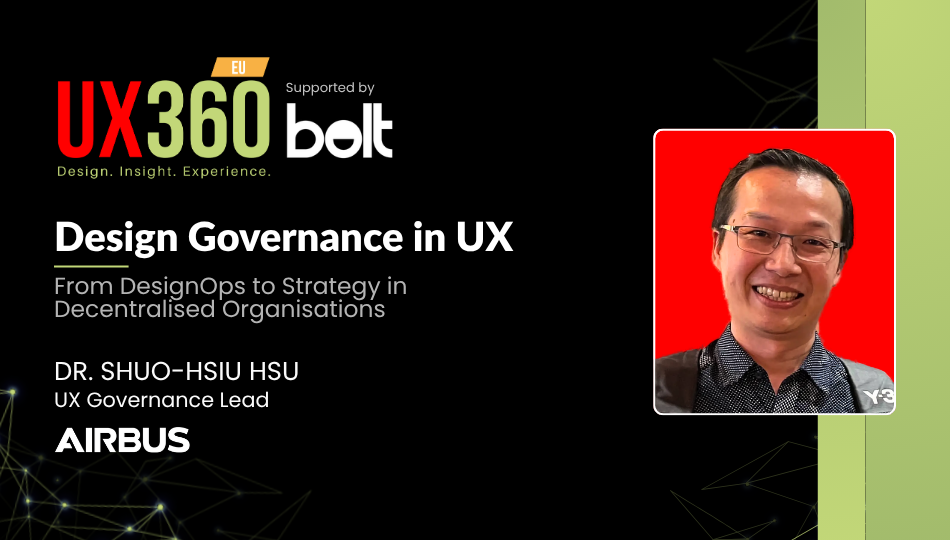
At UX360 Europe 2026, Dr. Shuo-Hsiu Hsu, UX Governance Lead at Airbus, shares a practical perspective on this shift, outlining how organisations can move from DesignOps to strategic orchestration and embed governance directly into their operational and engineering frameworks.
UX360: What motivates you to join the UX360 EU 2026 and what is the core message of your talk?
Shuo-Hsiu: We are currently navigating a “roller coaster” of industrial shifts. We must recognise that the radical impact ahead will not necessarily manifest as traditional growth. AI brings such deep disruption to our foundational workflows that maintaining UX resilience now requires profound adaptation, shifting our focus from the “mechanical” production of artifacts to high-level strategic sensemaking and governance.
My motivation for joining the event is to exchange battle-tested strategies on how to manage this exponential change without losing the “human signal”. I am eager to learn how other leaders and practitioners are moving beyond the “design theater” of templates to achieve true business impact.
The core of my talk, “The Enterprise UX Survival Kit,” is that keeping UX resilient requires a fundamental shift from Design Operations to Design Governance. Standard design playbooks might no longer suit this turbulent time because they rely on static mandates. In an environment where design lives across diverse digital and physical silos, orchestration is the only path to survival. My message focuses on three “survival” pillars:
- Governance as Strategy: How to move from advocacy to authority by embedding digital design standards directly into a company’s business processes.
- Community Connector: Strategies for using community management to align decentralised teams and diverse design disciplines under a shared vision.
- Adaptive Operations: A return of experience on DesignOps and UX Research practices, accepting that these practices must evolve and adapt to the shifting maturity and needs of a heavy-industry environment.
UX360: How has this impacted your own work and your organisation?
Shuo-Hsiu: For Me: From Operations to Orchestration
We are living through an era of radical disruption where AI provides an unprecedented empowerment to individuals, compressing development cycles that once took weeks into mere hours. This exponential change has profoundly shifted my work from established Design Operations toward a more robust Design Governance. While the core values of DesignOps remain essential, their implementation has evolved: we no longer act as the “police” to supervise quality through rigid control. Instead, governance now serves as a strategic support system—providing communication, templates, and processes in a more AI-adapted way to prevent the fragmented, siloed problems that can arise when everyone is empowered to perform UX tasks independently.
I have moved from being a practitioner to an “explainability layer” for the organisation. My role is to ensure that as UX tasks are democratised across the enterprise, the results remain strategically resilient. By offloading mechanical, joyless tasks to AI, I can focus on the high-level human sensemaking—curated taste, contextual judgment, and emotional nuance—that technology cannot replicate.
For the Organisation: Design as Risk Management and Strategic Orchestration
The rise of AI has fundamentally accelerated this shift by opening the door to the democratisation of UX. We are witnessing the emergence of “citizen UX designers,” as AI-augmented tools empower product managers, engineers, and business analysts to execute tactical UX activities—such as lightweight research analysis, UI prototyping, and UX writing—with minimal formal training. By offloading these often mechanical or joyless tasks to AI, decentralised teams can integrate tactical design directly into their established agile workflows, effectively reducing development bottlenecks and significantly accelerating the path from concept to delivery.
However, this democratisation inevitably leads to blurred professional boundaries and creates a significant challenge for design governance. In an era where standardised design systems allow almost anyone to produce a “decent-looking” interface, the organisation faces a real risk of “industrialised” mediocrity—where products are technically functional but lack the deeper human insight and judgment required for true differentiation. To prevent this superficial delivery, we must move beyond static playbooks and embed Digital Design standards directly into the software engineering governance. By acting as the “explainability layer,” design leaders ensure that technical speed is always anchored by curated taste, ethical guardrails, and rigorous quality standards.
UX360: How has UX Research and Design as a practice evolved in the last couple of years, and how would you like to see it evolve in the next few?
Shuo-Hsiu: The Last Few Years: Maturation and Industrialisation
In our company, for the past few years, the practice has focused on “catching up”—moving from a niche specialty to an industrialised, standard component of the digital lifecycle. We successfully built the “scaffolding” of the discipline through DesignOps and Research practices, standardising tools like Figma and centralising insights in repositories to drive efficiency. However, this “industrialisation” also brought a risk of “design theater,” where practitioners were often trapped in the mechanical production of artifacts rather than driving strategy.
The Present: The Automation Disruption
We have now entered a transformative AI Automation that is rewriting our foundational workflows. AI has compressed development cycles that once took weeks into mere hours, and we are witnessing a radical democratisation of UX. AI-augmented tools now allow “citizen UX designers” to handle some lightweight tactical activities. This is not just a growth in tools; it is a fundamental shift where the interface itself is becoming less of a differentiator than the underlying system logic.
The Future: From Production to Strategic Governance
In the next few years, I wish to see our practice evolve from tactical delivery to Strategic Orchestration. As AI handles the repetitive tasks, the peak impact of this disruption will force a restructuring of roles. I envision three core evolutions:
- Design as Risk Management: In decentralised, high-stakes environments like Airbus, UX must evolve into a strategic tool for managing the risks of probabilistic systems. We must move beyond “golden paths” to design resilient experiences for a world where “every interaction is an edge case”.
- The Explainability Layer: UX professionals must become the “explainability layer” of the enterprise—interpreting the complex human signals (trust, hesitation, emotional nuance) that AI pattern-matching still fails to capture.
- Top-Down Governance: True maturity will be reached when design strategy is embedded directly into software engineering governance, influencing “go/no-go” decisions at the executive level rather than just validating interfaces post-hoc.
UX360: Given this evolution, what are two expected and two less obvious skills UXers should possess, and why?
Expected Skills:
- AI Orchestration and Fluency: Mastering generative AI is no longer optional; it is a baseline requirement for efficiency. With more and more product teams already adopting AI tools, UXers must act as “stewards” who use technology to automate mechanical tasks to reclaim space for high-value thinking.
- Deep Qualitative Inquiry: As AI becomes proficient at processing the “what” at scale, the human ability to uncover the “why” becomes our primary differentiator. UXers need to sharpen their ability in witnessing whatever AI pattern-matching still fails to capture.
Less Obvious Skills:
- Quality Stewardship: With the “democratization of UX,” roles are blurring, and “citizen designers” (PMs, engineers) are increasingly performing UX tasks. UXers must shift from being the sole “makers” to becoming Quality Governors. This involves acting as the “explainability layer”—setting methodological standards and ethical guardrails to ensure that technical speed does not lead to “industrialized mediocrity”.
- Strategic Foresight for Probabilistic Systems: In an AI-embedded world, we are moving away from predictable “golden paths” toward probabilistic systems where every user experience is essentially an edge case. UXers need the strategic foresight to design resilient, adaptive systems that can handle chaos while maintaining user trust and ethical integrity.
UX360: Apart from work, what can delegates at the event talk to you about? Do you have any particular personal interests, hobbies or extracurricular activities and engagements?
Shuo-Hsiu: I am a cat lover, cardboard cat house prototyper and cycling warrior. I personally curate and share a list of global design conferences on LinkedIn every January 1st.
UX360: Last but not least, we are publishing “reading/listening guides” on our blog, can you share your favourite recommendations for inspiration, learning and leadership:
Shuo-Hsiu:
- Podcast: In Your Ears – Building One with Tomer Cohen
- Book/Blog: Wired to Create: Unraveling the Mysteries of the Creative Mind
Making UX Research Count at the Decision Level
For UX and research leaders, the focus is shifting from delivery to influence—ensuring insights shape decisions.
UX360 Europe 2026 brings together senior UX researchers working at that level. Explore how leading organisations apply UX research to guide product strategy, examine case studies grounded in execution, and gain frameworks that link UX work directly to measurable business outcomes.
Join peers facing similar challenges and learn innovative methods and cutting-edge strategies from DHL, Google, Mastercard, Airbus, Volvo Cars, BBC and more, to embed research into decision-making structures.
If you work in or with UX, research, or product teams, this is directly relevant to your role.
 UX360 Europe 2026 | June 23–24 | Berlin, Germany