








 by
by QUAL360 North America: Human Insight, Decision-Making, and the Evolving Role of Qualitative Research
Social Media Insights Review: Key Takeaways from Speakers, Attendees, and Industry Leaders
QUAL360 North America 2026 brought together senior insights leaders from organizations including Warner Bros. Discovery, Amtrak, Symrise, dsm-firmenich, Adobe, Visa, Bolt Insight, Human8, and more to address a pressing industry question:
how qualitative research must evolve to remain decision-relevant in a faster, more complex business environment.
Based on reflections shared by participants—including Michelle Kirszner (Senior Vice President, Lieberman, Inc.), Mansi Patney (Senior Manager, Global Data and Digital Analytics, Symrise), Anthony D. Paul (Director of Strategic Foresight, Amtrak), Dr. Niels Neudecker (Managing Director North America, Human8), Julie Tebeka (Senior Director, Global Strategy and Development, Bolt Insight), and more — this review captures the most important signals emerging from the event.
1. From AI Hype to Practical Application
While AI remained firmly on the agenda at QUAL360 North America 2026, the tone has shifted noticeably. The conversation has moved beyond exploration toward practical, grounded application in real research workflows.
Michelle Kirszner, Senior Vice President, Lieberman, Inc., described this shift clearly:
“The conversation felt more grounded and clear-eyed, with a shared understanding of where AI is already delivering tangible value, and where it still falls short.”
Across sessions and informal discussions, the industry showed alignment on where AI is delivering value today:
- accelerating pattern recognition
- scaling early-stage exploration
- reducing time from data collection to initial insight
At the same time, its limitations remain critical—particularly in areas requiring emotional nuance, ambiguity, and decision context.
This balance was reinforced by Mansi Patney, Senior Manager, Global Data and Digital Analytics, Symrise:
“AI can be a powerful enabler, but its value ultimately depends on our ability to think critically, frame the right questions, and lay strong methodological foundations.”
This shift is also beginning to create a clear divide across organizations. As Tanya Sarakinis (Business Development Director, Redslim) highlighted, while AI is becoming embedded in research workflows, the teams that will lead are those actively experimenting and integrating it into their processes today.
At the same time, QUAL360 provided space for practical discussion—not just headlines. Sessions such as Brian Laverty’s (Director, Global Corporate Research, Warner Bros. Discovery) on integrating AI into research workflows demonstrated how teams are applying these tools without compromising quality.
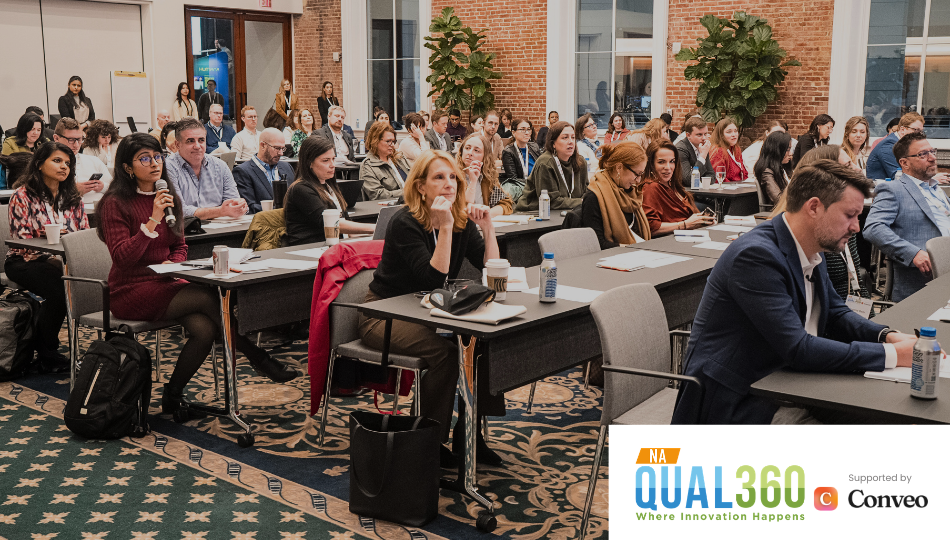
The structure of the event itself—highlighted by attendees as highly conducive to in-depth discussion—enabled this level of clarity. As Julia Polakova (Director of Growth, Q2Q) noted: “One of the things I enjoy about this conference is its setup – one session at a time, creative afternoon workshops, and long networking breaks. Overall, there are plenty of great opportunities to connect – sometimes so deep in conversation that you might even forget your laptop.”


Key takeaway:
AI is now embedded in qualitative research workflows. However, its impact is determined not by access to tools, but by the quality of thinking, design, and interpretation surrounding them.
2. From Insight Generation to Decision Enablement
A consistent theme across QUAL360 North America 2026 was the shift from producing insights to enabling decisions.
In an environment where data is abundant, the role of qualitative research is increasingly to provide:
- clarity
- direction
- confidence for stakeholders
This was reflected in discussions referencing “decision velocity” as a growing KPI for insights teams—highlighting the need to move faster without compromising quality.
Anthony D. Paul, Director of Strategic Foresight, Amtrak, demonstrated this evolution through his hands-on workshop: “Using future contexts to find and validate novel opportunities, risks, and potential solutions.”
The format—engaging around 150 research leaders in scenario-building and world-building—illustrates how qualitative research is expanding beyond understanding into active strategy development.
The collaborative nature of QUAL360 reinforced this shift. As Anthony noted:
“As anticipated, all the talks I saw were inspirational, and the hallway chats were rich. I made some new friends and caught up with ones from last year.”
Key takeaway:
The value of qualitative research is increasingly measured by its ability to drive decisions and shape strategy—not just generate insight.
3. Depth Over Volume: Reintroducing Focus as a Discipline
As the volume of available data increases, QUAL360 highlighted a counterintuitive reality:
more research does not necessarily lead to better outcomes.
This was reinforced in discussions around prioritization and internal alignment. Reflecting on the “Democratizing Research” panel, Dr. Niels Neudecker, Managing Director North America, Human8, pointed to a clear shift in how organizations should respond to budget pressure:
Focusing on fewer, more meaningful studies that answer the most relevant business questions—rather than running a high volume of fragmented research.
Michelle Kirszner summarized this shift succinctly:
“More inputs don’t necessarily lead to better outcomes. How we shape and interpret them matters more than ever.”
This is becoming a defining capability for insights teams: not just generating data, but prioritizing what truly matters.
Key takeaway:
Leading teams are shifting from volume of outputs to precision of thinking.
4. Human Understanding Remains the Core Asset
Despite rapid change, one theme remained constant throughout QUAL360:
qualitative research is fundamentally about understanding people.
Sofía Cristina Vázquez-Barrios, Director of Consumer Insights, North America, dsm-firmenich, expressed this clearly:
“Great research is not data about people, it’s proximity to people.”
Similarly, Leelan Farhan, Lead UX Researcher, Aylo, emphasized the importance of:
- building trust
- working with hard-to-reach audiences
- maintaining empathy in research design
Dr. Niels Neudecker offered one of the most memorable practical reminders of the event: ‘You can’t smell the internet‘ – a pointed reflection on the limits of digital and automated research methods in capturing sensory and lived experience.
Key takeaway:
As tools evolve, human proximity, empathy, and contextual understanding become more—not less—valuable.
5. Methodological Rigor as a Competitive Advantage
Another strong signal from QUAL360 North America 2026 is the renewed emphasis on methodological discipline.
As access to tools increases, differentiation shifts to:
- research design
- question framing
- interpretation quality
This was reflected across multiple sessions, including:
- Melanie Courtright’s research-on-research benchmarking
- Rob Adams and Victoria Hollis (Adobe), PhDs, “Retrofit” methodology for product expansion
- applied frameworks shared by Brian Laverty
Mansi Patney reinforced this priority:
“The real task, then, is to evaluate these tools thoughtfully, understanding where they genuinely strengthen our work while ensuring they support, rather than compromise, the rigor, depth and integrity of our research.”
Key takeaway:
In a tool-rich environment, rigor—not technology—defines research quality.
6. QUAL360 as a Working Forum for Senior Insights Leaders
Beyond the content, attendee feedback consistently highlights QUAL360 as a high-value working environment for senior professionals.
Leelan Farhan reflected: “My favorite part about attending Qual360 every year is undoubtedly learning from all the top researchers in the industry. This year was certainly no different.”

This cross-industry exchange was also highlighted by Julie Tebeka, Bolt Insight, who co-presented research on evolving definitions of beauty in the US:
“Grateful for all the incredible and inspiring researchers I met. It made for a particularly eclectic and all the more interesting mix.”

Cross-industry exposure was noted as a key strength by participants such as Elana Otero (Research Analyst, D3: Designs, Data, Decisions), who highlighted the diversity of perspectives—from media to public sector to FMCG:
“Kudos to Merlien Institute for attracting mixed-industry researchers and creating a space where different opinions could coexist respectfully.”
The event format itself continues to be a differentiator, enabling:
- deeper engagement per session
- meaningful peer exchange
- practical, experience-based discussions

Key takeaway:
QUAL360 continues to position itself as a focused, senior-level forum for advancing qualitative research practice globally.
Conclusion: A More Demanding Role for Qualitative Research
QUAL360 North America 2026 reflects a discipline becoming more defined—and more demanding.
For qualitative research to remain impactful, it must:
- support faster, higher-quality decisions
- maintain depth in an environment of scale
- apply rigorous methodology consistently
- stay anchored in real human understanding
Technology, including AI, will continue to shape workflows.
But the defining factor for success will be how effectively insights leaders translate complexity into clear, actionable direction for the business.
Stay Ahead of Qualitative Research Evolution
QUAL360 is more than an event—it’s an ongoing exchange shaping the future of qualitative research.
Stay connected with the latest thinking, practical frameworks, and peer-driven insights from global research leaders.
- Subscribe to our LinkedIn newsletter for curated articles, speaker perspectives, and key industry developments
- Get early access to event updates and upcoming QUAL360 initiatives
- Follow Merlien on LinkedIn to stay close to real-time conversations shaping the insights industry
All designed to support one goal: helping you set and maintain a higher standard for qualitative research within your organization.