







 by
by UX360 North America 2026: 5 UX Research Takeaways from the Community
UX research is not struggling to produce insights. It’s struggling to get them used. That reality sat underneath many of the conversations at UX360 North America 2026.
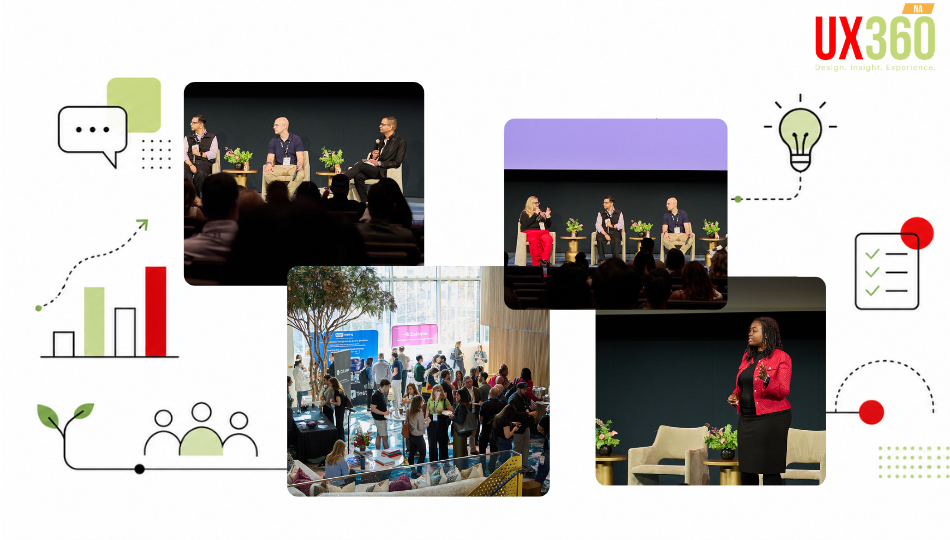
As the inaugural US edition, hosted in collaboration with SCAD, the event brought together senior UX and research leaders from Yahoo, Google, Coca-Cola, Pepsi, Amazon, and more. The conversations moved quickly past methods and tools, and focused on how research actually holds up in real decision-making environments. The discussion moved into specifics—where research breaks down in practice: how insights are translated for different stakeholders, how late they enter the process, and how often they lose momentum between teams.
Much of the discussion centered on the gap between research output and organizational action. Based on these conversations, we’ve pulled together the key takeaways from the community.
1. AI is not just changing research workflows. It is changing user expectations.
AI is beginning to reshape the standards users bring into digital experiences. Faster responses, personalization, and seamless interactions are quickly becoming expected rather than differentiated.
Natasha Brown put it clearly:
“We talk a lot about how AI is changing how we work. We’re talking less about how it changes how customers feel after interacting with it and how that reshapes their expectations for every experience (related or unrelated) that follows.”
User expectations are no longer formed within a single ecosystem. They are shaped across interactions spanning products, platforms, and services. That expands the role of UX research beyond evaluating individual touchpoints to understanding the broader context influencing user expectations.
2. The new advantage is not speed. It is judgment.
AI has made it easier to generate outputs. That part is already visible across teams. What’s less discussed—and more critical—is how this changes the role of judgment.
With more data, faster synthesis, and easier access to insight, the challenge shifts from producing information to interpreting it well. Distinguishing signal from noise, rigor from convenience, and meaningful insight from surface-level output becomes the real differentiator.
As Seda Palaz Pazarbasi put it:
“Yet craft still differentiates. As experiences commoditize, empathy, storytelling, and asking better questions matter even more.”
This is where senior teams will separate themselves. AI reduces the cost of producing research artifacts, but it increases the risk of misinterpretation. The teams that drive impact will not be those moving fastest, but those applying clearer judgment to what matters, what influences decisions, and what should not be automated away.
3. Research is becoming a shared business capability.
One of the clearer shifts across UX360 was how research is positioned inside organizations. Less as a standalone function— more as something that needs to move with the business—across product, design, and commercial teams.
The challenge isn’t access to insight. It’s whether that insight is understood, trusted, and used at the right moments.
This is where the role of research starts to change: not just delivering findings, but shaping how decisions are made—earlier in the process, and in a language that connects to business priorities.
As Josie Coffman reflected:
“I walked away reminded of how important it is to understand the business more deeply so research can inform meaningful decisions, to elevate how we tell the story when synthesizing insights, and to tailor how we present findings for different audiences.”
That shift is practical. It shows up in how research is communicated, how stakeholders are involved, and how insight is framed. The more research is embedded into these moments, the more it moves from being informative to being influential.
4. AI in research requires stewardship, not blind adoption.
The most useful conversations around AI at UX360 were not about what tools can do, but how they should be used in practice.
Kate Besel offered a perspective that reflects a more mature approach:
“AI agents in research aren’t tools you build once and trust. They’re more like collaborators you keep refining until the work meets the rigor you expect.”
This shifts AI from a one-time implementation to an ongoing process. Systems need calibration, review, and clear boundaries around where automation supports the work—and where human input remains essential.
It also opens new possibilities. As Kate noted, generative AI is already changing how participants engage in research:
“GenAI now lets participants in co-creative workshops visualize what they actually mean in high fidelity, which removes a friction that’s always made co-creation harder than it should be.”
But the value only holds if the underlying research quality remains intact. AI can extend what teams can do—but it still depends on how well it is guided.
5. In an AI-heavy moment, human connection became the premium experience.
While AI dominated much of the agenda, one of the more grounded observations from the community centered on what people felt was missing.
Alyssa Sheehan described it directly:
“The hype exhaustion is palpable… underneath the endless buzzwords, I sensed a desperate craving in the room for real, human connection and genuine conversation.”
That context explains why the structure of UX360 mattered as much as the content. Smaller format, networking moments, and partner-led discussions created space for conversations that tend to get lost in larger events.
This extended beyond the sessions. Gatherings like the Research Leaders Dinner hosted by Outset brought together senior practitioners in a setting designed for more candid exchange—less presentation, more perspective.
For a field navigating rapid change, this kind of interaction plays a different role. It’s not just about networking—it’s part of how teams validate what they’re seeing, compare approaches, and make sense of where the discipline is heading.
Final takeaway: UX research is entering a higher-stakes phase
What came through clearly at UX360 is that UX research is not becoming less relevant—it is becoming more exposed.
More visible in decision-making. More integrated into business outcomes. And more dependent on how well teams can balance speed, scale, and judgment.
Natasha Brown summarized this tension well:
“Facilitating empathy is still the edge. AI can run 1,000+ interviews, but it can’t replace being in the moment with a customer…”
That remains the anchor. As tools evolve, the core of the role does not disappear—it becomes more valuable but also more demanding. The expectation is no longer just to generate insight, but to ensure it leads to better decisions.
And that is where UX research is being tested today.
Continuing the Conversation: Making UX Matter at the Decision Level
UX360 Europe 2026 continues that conversation.
Bringing together UX and research leaders from across Europe and the world, the upcoming edition will continue to explore how teams are embedding research into decision-making, scaling insight without losing rigor, and redefining the role of UX in more complex, fast-moving organizations.
If you work in or with UX, research, or product teams, this is directly relevant to your role.
 UX360 Europe 2026 | June 23–24 | Berlin, Germany
Register today – regular rate expires on May 23!