







The cost and time required to generate analysis have reduced, driven by advances in AI and automation. Producing insights is no longer the constraint. The differentiator is how effectively those insights influence decisions.
As a result, the focus of the insights practice is evolving. Attention is shifting from output generation toward how demand is defined, prioritised, and translated into action. This reflects a broader change in how organisations operate — where speed of production is less limiting, and clarity of direction becomes more critical.
This article examines how that shift is taking shape in the evolving role of the researcher as a decision-maker. It draws on perspectives from senior insights professionals across our network, alongside discussions at MRMW Europe.
1. Demand Management is Becoming More Important Than Delivery Capacity
One of the clearest structural pressures in the insights function is the growing strain created by poor demand discipline. In many organisations, insights teams are still structured around incoming requests, which means capacity is consumed by the volume of demand rather than the value of the decision.
Daniel Kim from LinkedIn captured this precisely:
“When every partner request or opportunity turns into a sprint for data or a deck, we become order takers or human search engines instead of thought partners.”
This is not a complaint about workload. It is a diagnosis of how the function loses strategic ground. When every request is treated as urgent, insights teams become execution units. They produce output, but they do not control the quality of the questions entering the system. That weakens prioritisation, creates rework, and reduces the chances that research will influence business direction in a meaningful way.
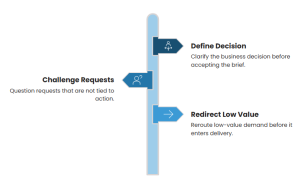
What matters now is whether teams have a mechanism for qualifying demand before committing resources. That requires a more deliberate front-end model:
- Define the business decision before accepting the brief
- Challenge requests that are not tied to action
- Redirect low-value demand before it enters delivery
2. Signal Selection Has Become a More Valuable Capability Than Data Collection
Another consistent theme was that most organisations are no longer constrained by access to information. They are constrained by their ability to identify what matters, circulate it effectively, and make it usable beyond the immediate project context.
Tomás Loureiro from EDP put it plainly:
“We are drowning in information, and the challenge is to analyse this vast amount.”
That observation matters because it changes where the insights team creates value. In a high-volume information environment, the differentiator is not more data collection. It is a stronger signal selection. Teams that cannot filter properly end up producing noise at scale: too many findings, too little hierarchy, and weak translation into decision relevance.
This also explains why insight distribution is becoming more important. Valuable learning still too often remains trapped within projects, teams, or stakeholder groups. Where that happens, organisations repeat work they already paid for and fail to build cumulative intelligence over time.
The implications are practical:
- Synthesis over reporting
- Distribution over presentation
- Reuse over one-off delivery
3. AI is Increasing the Standard of Research Leadership, Not Lowering It
The AI discussion feels more mature now. Less attention was given to speculative promise, and more to the conditions under which AI actually improves insight work. That is a healthier conversation.
Florian Bauer’s (Samsung) formulation was one of the clearest:
“AI amplifies our inputs… garbage in, garbage out.”
That line is useful because it cuts through the inflated framing that often surrounds AI adoption. The technology does not solve weak thinking, poor data quality, unclear objectives, or badly designed workflows. It accelerates whatever already exists. In well-run systems, that creates leverage. In weak ones, it increases risk.
For that reason, AI is not reducing the need for senior research judgment. It is making it more consequential. The role is moving away from managing individual projects and toward setting the conditions for reliable outputs at scale. That means stronger attention to:
- Input quality and source integrity
- Workflow design and method fit
- Governance, validation, and risk control
4. The Main Organisational Constraint is Integration, Not Tool Access
A recurring mistake in current industry discussion is to treat innovation as the main barrier. In practice, most large organisations already have access to more tools than they can absorb effectively. The limiting factor is not access. It is integration.
Sehnaz Arasan (Philips) expressed this more clearly than most:
“AI is easy. Change is hard.”
That distinction matters. Adding tools is relatively straightforward. Reworking processes, clarifying ownership, and embedding insights into how decisions are actually made is harder and slower. Yet that is where most of the commercial value sits. Without integration, AI simply speeds up one part of the workflow while leaving the rest of the organisation unchanged.
This is why so many discussions at MRMW pointed toward workflow design rather than isolated applications. The more serious ambition is not to automate individual tasks, but to connect research, strategy, collaboration, and decision-making more coherently.
That requires movement in a few specific areas:
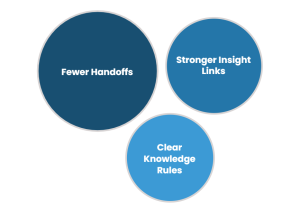
- Fewer fragmented handovers across the research process
- Stronger links between insight generation and business planning
- Clearer operating rules for how knowledge moves across teams
The Researcher Role Is Moving Upstream and Broadening in Scope
One of the more substantive themes at the event was the emerging definition of what senior research roles are becoming. The discussion is no longer centred on whether researchers will remain relevant. That question has largely been answered. The more useful question is where their relevance will sit.
Dan Jenkins from Product Hub summarised the direction well:
“The consensus seemed to be that this will be: to be the architect of the system that will feed insights into the organisation.”
That is a meaningful reframing. It suggests a move away from execution as the centre of professional value and toward a broader remit that includes system design, risk management, stakeholder influence, and commercial translation. This is consistent with the wider tone of the conference, where several contributors pointed to a more embedded, more strategic role for insights within the business.
That role expansion is visible in three areas:
- greater ownership of how insight enters business decisions
- stronger expectation to connect research to commercial outcomes
- less emphasis on producing deliverables as an end in itself
The implication is straightforward. The future senior researcher is not defined primarily by technical competence in project delivery. They are defined by their ability to build a function that improves decision quality across the organisation.
Continuing the Conversation
These conversations continue across Merlien Institute’s global conference portfolio, where senior practitioners share practical applications, case studies, and evolving approaches to insights-driven decision-making. Next up:
- UX360 Europe 2026 | June 23-24 | Berlin – flagship gathering for UX research professionals: the world’s leading UX minds from DHL, Nestle, Google, and more will share cutting-edge strategies that drive measurable ROI. Explore more.
- MRMW Europe 2026 | October 21-22 | Berlin – Move beyond reporting to real business impact at Europe’s leading market research event featuring global research experts from De’Longhi Group, eBay, and Warner Bros. Discovery. Explore more.