







 by
by The Future of Research Requires Human-AI Partnership
A Listen Labs White Paper
For decades, the default approach to customer research has been quantitative. Companies have been making major decisions based on quick, cheap surveys. But what are they actually getting? Panels full of professional survey-takers whose responses reflect a desire to get a payout rather than an honest account of their experience. Close-ended questions that tell you what people choose, but not why.
It’s surface-level by design.
Despite these well-known survey flaws, many organizations continue to rely on them out of necessity. Budget, bandwidth, and headcount limitations make the qualitative insights they need feel out of reach.
But then came the promise of “qual-at-scale”. AI-involved research has begun to dominate the conversation, promising to reduce cost and time by automating the research process from start to finish.
While AI integration may speed things up, it’s crucial that human research experts remain involved..
Humans are still critical in qual-at-scale
AI is a powerful tool — powerful enough to make it seem like your expert researchers are no longer required. But companies that replace their human teams with AI will be missing just as much as if they were back to running those close-ended surveys.
The organizations that will truly get ahead are those that leverage AI as trusted research partners to actively support them in designing, conducting and synthesizing studies. At Listen Labs, it’s called the human-in-the-loop model, and the Listen Labs team has seen firsthand how it focuses human expertise where it will make the most difference.
Here are the three stages where human involvement is non-negotiable:
1) Designing the study
At Listen, they treat study design as a collaborative first step rather than a handoff. When Simple Modern wanted to validate a new product before launch, Chief Marketing Officer Chris Hyle wrote the questions and worked with one of Listen’s Lead Insights Strategists to set up the study. Together, they ensured the questions were phrased well and ordered in a way that made it easy for people to open up. Within 2.5 hours, Simple Modern had feedback from 120 people across the country.
That huge influx of quality interviews in a short time period would have been totally wasted if Hoyle hadn’t leveraged his knowledge to ensure they were asking the right questions. It would’ve been a large pool of interviews, but in the context of the decisions Simple Modern needed to make, they would’ve been useless.
Listen can access a panel that meets company needs and ensure interviews are carried out quickly, in a way that’s convenient for the participants. But only once research experts have decided on the goal, the audience, and what they’re looking for.
2) Reviewing the outputs
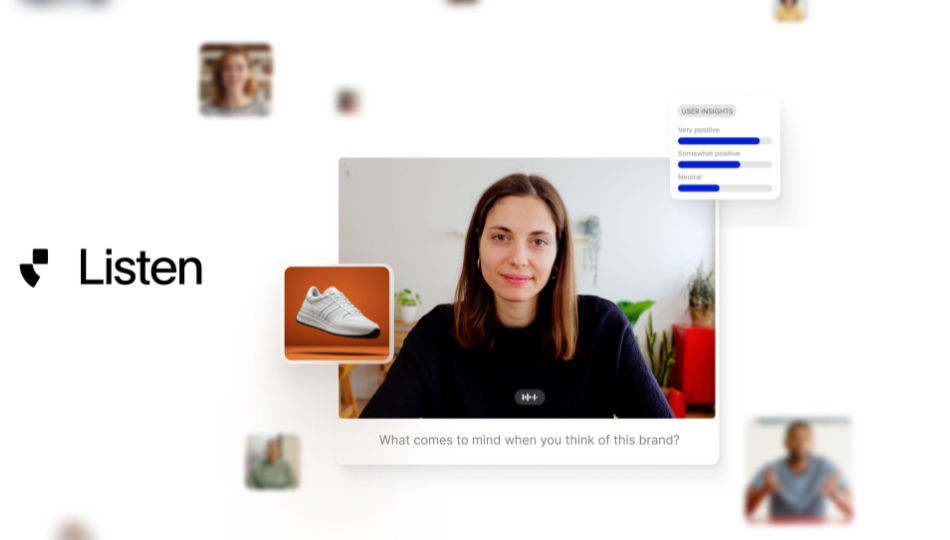
Even after AI moderates the conversations and produces summaries of what was said, it’s up to researchers to interpret those findings.
They have to decide whether the themes uncovered on Listen’s dashboard actually inform the decision their company needs to make. What follow-up questions does the study raise that need further investigation? Now more AI research partners can detect human emotion and nuance, but it’s the human researchers who are gifted at deciding when those emotions matter.
For example, when they partnered with Microsoft to collect user stories about Copilot for their 50th anniversary, Listen surfaced themes and assembled highlight reels, but it was up to Romani Patel, Senior Research Manager, and her team to decide which stories were the most emotionally compelling. They knew which clips leadership needed to see and could spot answers that resonated with Microsoft’s mission.
In other words, the human touch gave meaning to what AI made accessible.
“Research can be a lot of manual work.” Patel said, “ but I feel like Listen lets me focus more of my time on strategic work.”
AI excels at organizing information. Humans excel at understanding it. When companies use both AI and humans in this review stage, they turn high volume into useful insights.
3) Deciding what’s next
The patterns AI tools help detect across conversations don’t answer the final, and arguably most important, question in customer research: now what? Deciding what those patterns will mean in the context of your company’s decisions requires human discernment from someone who knows the business.
For example, AI might consider the discovery that color doesn’t seem to matter in fintech UX to be irrelevant. But when Listen found that pattern, Ali Romero, the Marketing Manager at Sling Money, knew that meant they had the opportunity to stand out. In a market saturated with blue, they could lean into their iconic bright orange without worry.
No longer distracted by color, their team was free to focus on other insights that made a difference to their customers, such as language that signals clarity.
The interaction of brand identity and long-term goals with user feedback is exactly the kind of decision you wouldn’t want to outsource to an AI research tool. It’s the leaders on a team who are best positioned to evaluate which insights justify action and investment. After all, they are the ones ultimately taking ownership over the failure or success of the decisions made.
Is Your Research Process Future-Ready?
AI-enhanced research makes it easier to hear more voices, more quickly. But without the wisdom of leaders and researchers willing to set the right intentions, engage with what’s uncovered, and make smart, business-informed decisions as a result, those voices can quickly become just noise.
Human-in-the-loop is about more than just empathy and creativity. It’s also judgment that knows which questions need asking, which findings need action, and which direction the business should take.
That judgment can be supercharged by AI, but shouldn’t be replaced by one.
That’s why the companies that will stay relevant in this next era are the ones using trusted research partners who understand how to leverage AI without letting it completely overtake the research team.
At Listen Labs, that’s the model they’re built on. They’ve shown what companies like Microsoft, Google, Nestle, Skims, and Anthropic uncovered.
What will your team discover?
As the future of research evolves — driven by human-ai collaboration and the demand for deeper insight — thoughtful, experience-led conversations are more critical than ever.
UX360 North America 2026, taking place April 21–23 in Atlanta, U.S.A., unites researchers, innovators, and decision-makers to explore how AI is transforming research without replacing the human judgment that gives insights meaning.
This is your chance to gain hands-on insights from UX research peers, learn cutting-edge techniques and master skills together with Pepsi, Yahoo, Google, American Express, Coca Cola, Amazon, Meta, and more!
Register today, limited tickets available!