







 by
by UX360: What motivates you to join the UX360 EU 2026, and what is the core message of your talk?

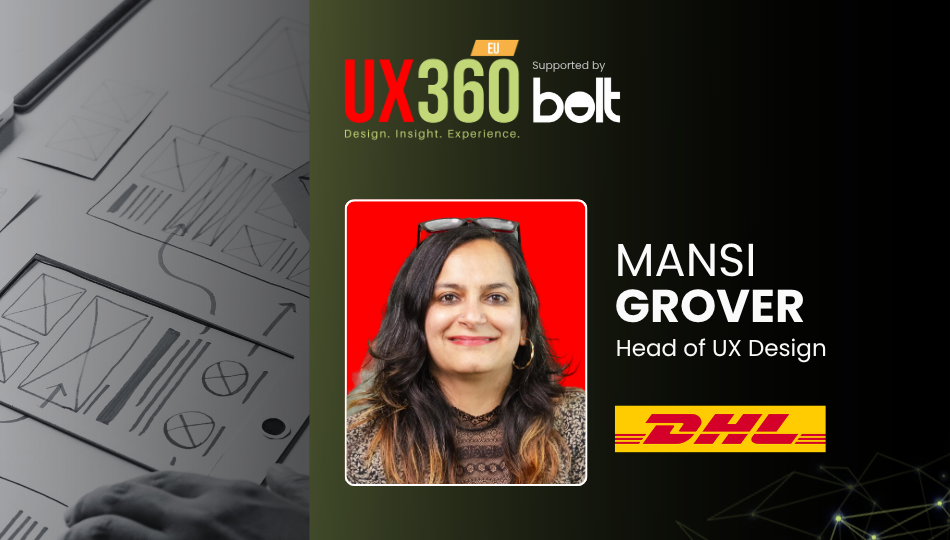
Mansi: Honestly, the timing feels right. The European Accessibility Act came into full force in 2025, and a lot of organisations are still figuring out what it actually means for their design practice and not just legally, but operationally. I lead a UX team at DHL where we work across multiple digital products and a shared design system, and accessibility has become one of the most consequential threads running through all of it. I wanted to share what that looks like in reality: the messy, human, cross-functional reality of embedding accessibility into a large organisation that wasn’t built with it as a default.
The core message I want people to leave with is this: accessibility at scale is not a compliance checklist. It’s a design culture problem. The techniques are learnable. The harder work is changing how teams think, how decisions get made, and who gets included in the conversation from day one.
I lead a UX team at DHL where we work across multiple digital products and a shared design system, and accessibility has become one of the most consequential threads running through all of it.
UX360: How has this impacted your own work and your organisation?
Mansi: It’s changed how we hire, how we onboard, and how we measure quality. A couple of years ago, accessibility was something that got flagged late, usually by a developer or a QA tester, rarely by a designer. Now it’s part of our design critique process, part of how we evaluate our design system components, and part of what I look for when I’m building out the team.
We also run internal accessibility audits for teams across DHL who are building tools or products not just external-facing ones. That’s been really eye-opening. Internal tools are often the most inaccessible, and the people using them have the least power to push back. Making that visible has been one of the most meaningful shifts in how our team is perceived and used.
On an organisational level, the EAA has been a useful forcing function. It’s given us a language that non-designer stakeholders respond to. That’s not the most idealistic reason to care about accessibility, but it opens doors, and once the conversations start, you can take them somewhere more genuine.
UX360: How has UX Research and Design as a practice evolved in the last couple of years, and how would you like to see it evolve in the next few?
Mansi: The biggest shift I’ve seen is the pressure on designers to justify their work in business terms. That’s not inherently bad, it’s made us sharper communicators and more strategic thinkers. But there’s a risk that we optimise for what’s measurable and lose sight of what’s right. Conversion rates are easy to measure. Dignity and inclusion are not.
AI has also changed the texture of the work. It’s accelerated a lot of execution, which means the premium is increasingly on judgment, knowing what to build, for whom, and why — rather than on craft alone. That’s good news for experienced practitioners and a real challenge for people early in their careers who are still developing that judgment.
For the next few years, I’d love to see the field take inclusion more seriously as a design methodology rather than an add-on. That means participatory research with people who are often excluded from the process, more diverse teams, and design systems built with accessibility and flexibility as first principles rather than retrofitted features. I’d also love to see more honesty in the field about failure — what didn’t work, what we got wrong, and what we’d do differently.
But there’s a risk that we optimise for what’s measurable and lose sight of what’s right. Conversion rates are easy to measure. Dignity and inclusion are not.
UX360: Given this evolution, what are two expected and two less obvious skills UXers should possess, and why?
Mansi: Expected — and I say expected because these really should be non-negotiable by now:
- Accessibility literacy: Understanding WCAG, knowing how to audit, being able to design and communicate about accessible components. It’s a baseline skill at this point, not a specialism.
- Systems thinking: The ability to design not just a screen but a pattern. Something that scales, that’s consistent, that other people can build on. As more organisations invest in design systems, this becomes essential.
Less obvious:
- Stakeholder translation: The ability to take a UX recommendation and make it land with someone who has never held a wireframe in their life. This is about narrative and trust, not just presentation skills. The best UX designers I’ve worked with are almost always the ones who can walk into a room with senior leadership and make the case without jargon.
- Taste and tenacity: In an age where AI can generate ideas endlessly, original thinking is no longer the scarce resource but good judgment is. Knowing what’s worth pursuing, what to throw away, and then having the persistence to actually execute on it well. This is harder to develop than any technical skill, and it’s increasingly what separates designers who create real impact from those who just produce output.
UX360: Apart from work, what can delegates at the event talk to you about? Do you have any particular personal interests, hobbies or extracurricular activities and engagements?
Mansi: Painting, I work across a few different styles, from acrylic palette knife work to traditional Indian art forms like Warli and Gond. I’m currently developing a body of work that’s been taking up a lot of my mental space in the best possible way, so if you want to talk about art and what it means to make something with your hands, I’m very much here for that conversation.
Also, I practice yoga regularly, strength train and love to binge-watch TV shows.
I live in Prague as an Indian expat, so I’m happy to talk about navigating life in a new city, building community, learning Czech (I’m working on it, slowly), or just the experience of carrying multiple cultural identities through your daily life and your work.
I’m also genuinely interested in geopolitics, particularly conflicts that don’t get enough mainstream attention. And I cook a lot, both Indian and everything else, so food is always a safe topic.
UX360: Last but not least, we are publishing reading/listening guides on our blog. Can you share your favourite recommendations for inspiration, learning and leadership?
Mansi:
Must read – Book/Blog:
The Courage to Be Disliked by Ichiro Kishimi and Fumitake Koga. It’s framed around Adlerian psychology but it’s really about letting go of the need for approval and taking responsibility for your choices. Quietly life-changing for anyone who manages people or navigates complex organisations.
Articulating Design Decisions by Tom Greever. Not a glamorous recommendation but an incredibly practical one. So much of our work lives or dies on how we communicate it to people who don’t share our frame of reference. This book takes that seriously, and I find myself returning to its thinking regularly when I’m preparing to present work to senior stakeholders.
Where UX Research Gets Real
UX is no longer evolving at the edges — it is being reshaped at its core. UX360 Europe is where that shift is addressed.
UX360 Europe 2026 brings together senior practitioners and leaders to address how UX operates inside complex organisations. From accessibility and design systems to research, governance, and AI-driven change, the focus is practical, cross-functional, and grounded in real organisational experience.
Engage with leaders from DHL, Google, Mastercard, Airbus, Volvo Cars, and more — and take forward approaches designed to scale.
📍 Join UX360 Europe 2026 | June 23–24 | Berlin, Germany