







 by
by The New Mandate for Qualitative Leaders: Embedding Intelligence, Accountability, and AI Discipline
Introduction
Qualitative research is no longer judged by the richness of its findings alone. It is evaluated by its ability to shape decisions, influence product roadmaps, integrate with data ecosystems, and withstand AI acceleration without compromising judgment.
Across conversations with senior research leaders from Visa, Adobe, DSM-Firmenich and Aylo, a clear pattern emerges: the future of qualitative research will be defined not by methodology, but by operating discipline.
This article distills their perspectives into three executive imperatives shaping the next phase of the profession.
AI as Augmentation — Not Replacement

The role of AI in qualitative research is no longer hypothetical. It is operational. What distinguishes mature organizations, however, is not whether they are using AI, but how intentionally they are integrating it.
At Adobe, Rob Adams, Principal UX Researcher, and Victoria Hollis, PhD, Sr. Staff UX Researcher, describe significant efficiency gains across secondary research reviews and transcript analysis.
“We have seen huge unlocks in researcher efficiency in AI-powered secondary research reviews as well as supporting the analysis of transcripts and raw notes from qual sessions. Our researchers find it much easier to find supporting and contradictory evidence for proposed insights within studies and we are exploring ways to consolidate raw data to enable analysis that crosses studies.
Our researchers find it much easier to find supporting and contradictory evidence for proposed insights within studies and we are exploring ways to consolidate raw data to enable analysis that crosses studies.

These technologies have also made it much easier to connect qual insights with relevant quantitative survey and analytics results to build a bigger picture for stakeholders. We have also seen greater use of our research in decision-making as we’ve expanded access to AI-driven search and summary agents to

the organization at large. We’ve leaned into communal spaces such as Slack channels where questions to the AI agent can also prompt discussion between researchers and stakeholders.”
Sofia Cristina Vazquez-Barrios, Director Consumer Insights North America at DSM-Firmenich, supported this message from a different industry context. In a business that relies heavily on emotional connection and sensory nuance, she sees big data as a support system, but not the core:
“Availability of big data is a great support source, but the “meat” comes from the work itself- especially in my niche business. AI has been extremely useful in organizing thought processes and simplifying certain methods, but the human piece always needs to touch this. AI isn’t the solve, it’s an assist in the process of uncovering the insights.”
“Availability of big data is a great support source, but the “meat” comes from the work itself- especially in my niche business.
At Visa, Michael Nevski, Director of Global Insights, extends the conversation into the realm of Agentic AI and its implications for commerce. He describes a shift from traditional personalization models toward systems that act on behalf of consumers, reshaping how decisions are made across digital ecosystems:
“Researchers should remember that retailers and brands must move beyond personalization, toward autonomy, enabling AI to act on behalf of consumers responsibly and transparently.”

Michael is embracing AI as an augmentation tool, not a replacement. Big data provides breadth, but qualitative research provides depth. He is using AI for pattern detection and hypothesis generation. Michael then humanizes these patterns through ethnography, interviews and contextual inquiry.
“My approach: Use AI for pattern detection and hypothesis generation. Validate and humanize those patterns through ethnography, interviews, and contextual inquiry. Ensure ethical and transparent use of AI, maintaining consumer trust.”

Leelan Farhan, Lead UX Researcher at Ayl and her team have benefited from AI-powered repositories and planning support. However, she is cautious about adopting every new platform: “AI is speeding up our research capabilities. You can run a study in no time. The skillset that I believe we need to hone, is not so much conducting research, but tracking its impact and taking ownership of the way research is used.
Leelan says: “There’s a time and place for AI tools, however, you don’t need all of them. The way I am approaching this ‘proliferation’ is by being mindful of where inefficiencies are for myself and my team. I ask myself, ‘will this tool improve my research efficiency without sacrificing the quality and reliability of my insights?’. If the answer is yes, then it is a tool worth exploring.
I ask myself, ‘will this tool improve my research efficiency without sacrificing the quality and reliability of my insights?’. If the answer is yes, then it is a tool worth exploring.
Some of my favourites have been: AI-powered research repositories, AI-summarizing of research results or insights, AI-suggested research plans based on previous research. As you can probably tell from my answer, I have yet to be impressed by completely AI-moderated research. It has its applications, but I have not seen quality that is equal to or better than a human moderator. In short: there is a lot of AI and big data noise – take what is useful, leave what is fleeting and trendy.”
From Insight Generation to Insight Accountability
If AI is reshaping research workflows, expectations around impact are reshaping the role of the researcher.
Victoria and Rob explain that at Adobe Firefly, research is embedded directly into the forums where product and design decisions are made. Rather than functioning as external consultants, researchers operate as core members of leadership groups, bringing user evidence into prioritization conversations in real time:
“In Adobe Firefly, we’re able to land insights effectively by building trust and embedding research directly into the forums where product or design decisions are made. Rather than operating as an external consultant to teams, we work as core members of the leadership group. This enables us to be in the room where priorities are shaped and bring user evidence into those conversations in real time.”
For Adobe Express, the team has consolidated qualitative insights into synthesized dashboards that articulate issues, suggest solution directions, and — critically — connect those issues to measurable business outcomes tied to OKRs. “We have consolidated insights across hundreds of individual studies and reports into synthesized and simplified qual data dashboards that articulate issues, suggest directions for solutions, and most importantly connect the issues we’ve uncovered to their impact on business metrics such as retention, activation, and conversion, prioritizing issues with the largest impact on our OKRs.“
We have consolidated insights across hundreds of individual studies and reports into synthesized and simplified qual data dashboards.
Michael Nevski describes a similar dynamic at Visa, where storytelling with data is essential:
“By translating insights into business language and measurable impact. I focus on: Storytelling with data—turning qualitative findings into compelling narratives tied to KPIs. Embedding insights into agile workflows – so decisions are informed in real time. Partnering with cross-functional teams – ensuring insights influence product design, marketing, and customer experience strategies.”
At Aylo, Leelan Farhan emphasized ownership beyond delivery. Researchers, she argues, should track how their findings are cited, applied, or potentially misinterpreted:
“ It is no longer sufficient, especially for an established, in-house researcher, to just ‘do’ the research and hope for the best. Who is quoting our research? How is it being used – or not used? If you are embedded in an organisation, like I am, it is our responsibility to track the impact of our work and correct any misinterpretation of insights. This also includes naming the risks of a research practice – product inaction, hallucinations (AI), harmful applications.”
The Leadership Shift Behind Modern Qualitative Influence
If qualitative research is becoming more embedded, more accountable, and more AI-enabled, then the profile of the qualitative leader must evolve with it.
At Adobe, that evolution begins with analytical confidence — not to replace qualitative depth, but to strengthen it.
Rob and Victoria explain: “Data analytics fluency doesn’t necessarily mean becoming a statistician, but it does mean being able to confidently interpret and integrate quantitative signals alongside qualitative findings. This can enrich research planning — for example, to shape hypotheses or sampling — and strengthens mixed-methods storytelling to connect with different decision-makers.”
In other words, credibility increasingly depends on the ability to move across systems — to translate depth into metrics without diluting meaning.
But fluency alone is insufficient if research stops at presentation. Adobe emphasizes a second shift: ownership. Great qualitative research can have little impact if recommendations live in a deck without follow-through. Expanding skills to ensure accountability include converting insights into clear, role-specific steps, and following through to ensure those actions have been resolved.
Rob and Victoria share:
“Great qualitative research can unfortunately have little impact if recommendations live in a deck without follow-through. Expanding skills to ensure accountability include converting insights into clear, actionable, role-specific steps, and follow through to ensure those actions have been resolved. Depending on the team dynamic, this can be done through working sessions, integration with project management systems, or in how recommendations are framed in research reporting.”
“Great qualitative research can unfortunately have little impact if recommendations live in a deck without follow-through.
At DSM-Firmenich, the capability expansion takes a different — but complementary — form. Sofia Cristina Vazquez-Barrios describes this as: “A researcher has to be a jack of all trades — psychiatrist, anthropologist, businessperson — but above all, they have to consistently remind themselves of the human element and provide empathy to design, engage, and dig deeper. That empathetic element gets lost sometimes — and returning to it is a ‘skill’ to continue flexing. The researcher also needs to seek opportunities to apply RISK for something unique.”
That empathetic element gets lost sometimes — and returning to it is a ‘skill’ to continue flexing. The researcher also needs to seek opportunities to apply RISK for something unique.”
Meanwhile, Aylo’s Leelan Farhan pushes the discussion further into temporal responsibility: “Practicing a forecast mindset — interpreting insights and findings in terms of how they will evolve, scale, or degrade over time — is essential and related to owning our impact. Which insights will need follow-up in the future? What is a durable, stable insight and what is a momentary signal that needs immediate action?”
This introduces a dimension often overlooked in research discussions: lifecycle awareness. Not every finding is meant to last. Some require monitoring, others demand immediate intervention.
What This Signals
Taken together, these perspectives suggest that the qualitative leader of the next phase is:
-
Fluent across data systems
-
Accountable beyond delivery
-
AI-literate but disciplined
-
Strategically embedded
-
Empathically grounded
-
Responsible for the lifecycle of insight
The profession is not merely adding tools. It is expanding its mandate.
A Strategic Inflection Point
What becomes clear through these conversations, is that qualitative research is not being diminished by AI or data proliferation. It is being reframed. Organizations are distinguishing between research that informs and research that influences; between insights that are interesting and those that are embedded; between AI adoption that is performative and adoption that is disciplined.
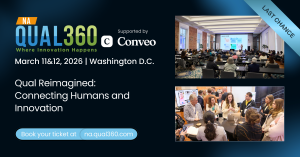
At Qual360 North America 2026, these themes will continue to shape discussion among senior practitioners navigating this transition.
Join us at Qual360 NA on March 11–12, 2026, in Washington, D.C., U.S.A.
We gather qualitative leaders from top-tier companies to explore innovative research approaches, discover the latest methodologies, and learn how to leverage new types of insights.
Connect with industry peers and experts—this year’s attendees include qualitative leaders from Mondelez International, Amtrak, Warner Bros. Discovery, Marriott International, Nestlé, Adobe, Amazon, and more. Explore the line-up here.
👉 Register today to lead the way in insights!